Carr Delgado Hamish, Moradifar Parivash, Chinn Garry, Levin Craig S, Dionne Jennifer A
Department of Materials Science and Engineering, Stanford University, Stanford, CA 94305, USA.
Department of Radiology, Stanford University, Stanford, CA, 94305, USA.
Nanophotonics. 2024 Apr 15;13(11):1953-1962. doi: 10.1515/nanoph-2023-0946. eCollection 2024 May.
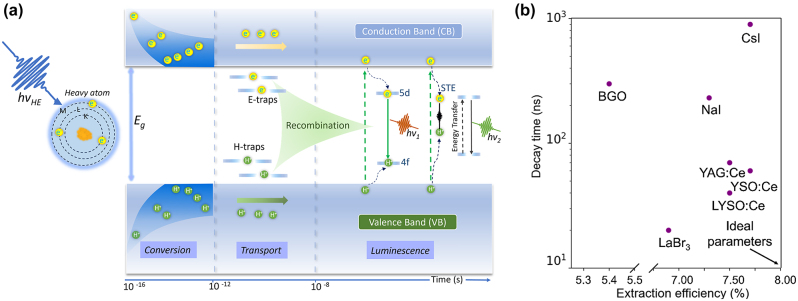
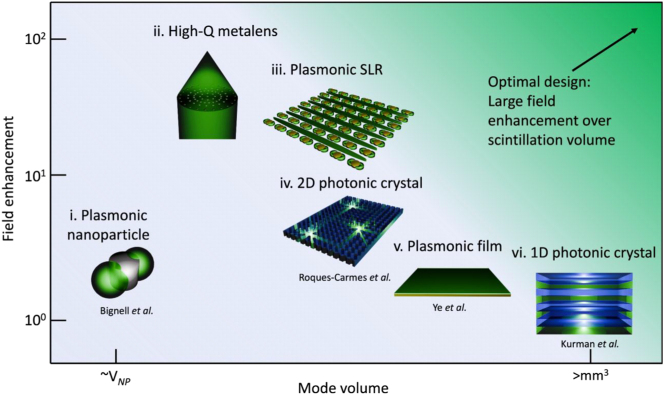
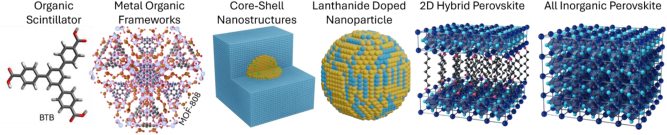
Following the discovery of X-rays, scintillators are commonly used as high-energy radiation sensors in diagnostic medical imaging, high-energy physics, astrophysics, environmental radiation monitoring, and security inspections. Conventional scintillators face intrinsic limitations including a low extraction efficiency of scintillated light and a low emission rate, leading to efficiencies that are less than 10 % for commercial scintillators. Overcoming these limitations will require new materials including scintillating nanomaterials ("nanoscintillators"), as well as new photonic approaches that increase the efficiency of the scintillation process, increase the emission rate of materials, and control the directivity of the scintillated light. In this perspective, we describe emerging nanoscintillating materials and three nanophotonic platforms: (i) plasmonic nanoresonators, (ii) photonic crystals, and (iii) high-Q metasurfaces that could enable high performance scintillators. We further discuss how a combination of nanoscintillators and photonic structures can yield a "super scintillator" enabling ultimate spatio-temporal resolution while enabling a significant boost in the extracted scintillation emission.
在X射线被发现之后,闪烁体在诊断医学成像、高能物理、天体物理、环境辐射监测和安全检查中通常被用作高能辐射传感器。传统闪烁体面临着一些固有局限性,包括闪烁光的提取效率低和发射率低,这导致商业闪烁体的效率低于10%。克服这些局限性将需要新型材料,包括闪烁纳米材料(“纳米闪烁体”),以及能够提高闪烁过程效率、增加材料发射率并控制闪烁光方向性的新型光子学方法。从这个角度出发,我们描述了新兴的纳米闪烁材料和三种纳米光子平台:(i)等离子体纳米谐振器,(ii)光子晶体,以及(iii)能够实现高性能闪烁体的高Q值超表面。我们还进一步讨论了纳米闪烁体和光子结构的组合如何能够产生一种“超级闪烁体”,实现最终的时空分辨率,同时显著提高提取的闪烁发射。