Zebrack Jane E, Gao Jaynelle, Verhey Britta, Tian Lu, Stave Christopher, Farhadian Bahare, Ma Meiqian, Silverman Melissa, Xie Yuhuan, Tran Paula, Thienemann Margo, Wilson Jenny L, Frankovich Jennifer
Division of Allergy, Immunology and Rheumatology, Department of Pediatrics, Stanford University School of Medicine, Stanford, CA, USA.
Stanford PANS/Immune Behavioral Health Clinic and PANS Research Program at Lucile Packard Children's Hospital, Stanford, CA, USA.
medRxiv. 2024 Apr 30:2024.04.26.24306193. doi: 10.1101/2024.04.26.24306193.
Studies of brain imaging and movements during REM sleep indicate basal ganglia involvement in pediatric acute-onset neuropsychiatric syndrome (PANS). Characterizing neurological findings commonly present in patients with PANS could improve diagnostic accuracy.
To determine the prevalence of neurological soft signs which may reflect basal ganglia dysfunction (NSS-BG) in youth presenting with PANS and whether clinical characteristics of PANS correlate with NSS-BG. Design, Setting, and Participants: 135 new patients who were evaluated at the Stanford Children's Immune Behavioral Health Clinic between November 1, 2014 and March 1, 2020 and met strict PANS criteria were retrospectively reviewed for study inclusion. 16 patients were excluded because they had no neurological exam within the first three visits and within three months of clinical presentation.
The following NSS-BG were recorded from medical record review: 1) glabellar tap reflex, 2) tongue movements, 3) milkmaid's grip, 4) choreiform movements, 5) spooning, and 6) overflow movements. We included data from prospectively collected symptoms and impairment scales.
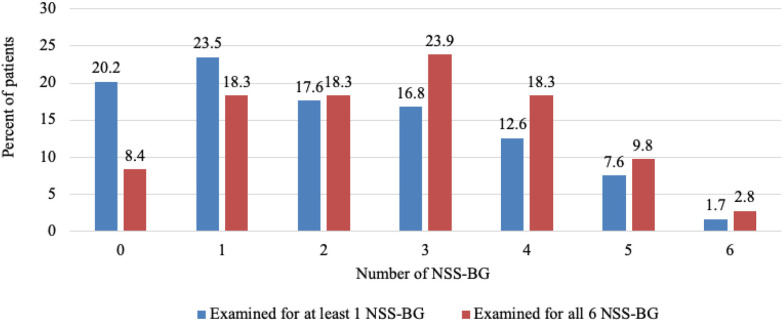
The study included 119 patients: mean age at PANS onset was 8.2 years, mean age at initial presentation was 10.4 years, 55.5% were male, and 73.9% were non-Hispanic White. At least one NSS-BG was observed in 95/119 patients (79.8%). Patients had 2.1 NSS-BG on average. Patients with 4 or more NSS-BG had higher scores of global impairment (p=0.052) and more symptoms (p=0.008) than patients with 0 NSS-BG. There was no significant difference in age at visit or reported caregiver burden. On Poisson and linear regression, the number of NSS-BG was associated with global impairment (2.857, 95% CI: 0.092-5.622, p=0.045) and the number of symptoms (1.049, 95% CI: 1.018-1.082, p=0.002), but not age or duration of PANS at presentation.
We found a high prevalence of NSS-BG in patients with PANS and an association between NSS-BG and disease severity that is not attributable to younger age. PANS may have a unique NSS-BG profile, suggesting that targeted neurological exams may support PANS diagnosis.
快速眼动睡眠期间的脑成像和运动研究表明,基底神经节参与小儿急性起病神经精神综合征(PANS)。明确PANS患者中常见的神经系统表现有助于提高诊断准确性。
确定PANS青少年患者中可能反映基底神经节功能障碍的神经系统软体征(NSS - BG)的患病率,以及PANS的临床特征与NSS - BG是否相关。设计、设置和参与者:回顾性纳入2014年11月1日至2020年3月1日期间在斯坦福儿童免疫行为健康诊所接受评估且符合严格PANS标准的135例新患者。16例患者因在前三次就诊以及临床表现后三个月内未进行神经学检查而被排除。
通过病历回顾记录以下NSS - BG:1)眉间轻叩反射,2)舌运动,3)挤乳妇握力,4)舞蹈样动作,5)匙状姿势,6)溢出动作。我们纳入了前瞻性收集的症状和损伤量表数据。
该研究纳入119例患者:PANS发病的平均年龄为8.2岁,初次就诊的平均年龄为10.4岁,55.5%为男性,73.9%为非西班牙裔白人。95/119例患者(79.8%)观察到至少一项NSS - BG。患者平均有2.1项NSS - BG。有4项或更多NSS - BG的患者与无NSS - BG的患者相比,总体损伤评分更高(p = 0.052)且症状更多(p = 0.008)。就诊时年龄或报告的照顾者负担无显著差异。在泊松回归和线性回归中,NSS - BG的数量与总体损伤(2.857,95%置信区间:0.092 - 5.622,p = 0.045)和症状数量(1.049,95%置信区间:1.018 - 1.082,p = 0.002)相关,但与就诊时的年龄或PANS病程无关。
我们发现PANS患者中NSS - BG的患病率较高,且NSS - BG与疾病严重程度相关,这并非由年龄较小所致。PANS可能具有独特的NSS - BG特征,提示针对性的神经学检查可能有助于PANS的诊断。