Xu Jialian, Bao Guo, Jia Bo, Wang Minqi, Wen Peng, Kan Tianyou, Zhang Shutao, Liu Aobo, Tang Haozheng, Yang Hongtao, Yue Bing, Dai Kerong, Zheng Yufeng, Qu Xinhua
Department of Bone and Joint Surgery, Department of Orthopedics, Renji Hospital, Shanghai Jiaotong University School of Medicine, Shanghai, 200001, China.
Laboratory Animal centre, National Research Institute for Family Planning, Beijing, 100081, China.
Bioact Mater. 2024 May 6;38:207-224. doi: 10.1016/j.bioactmat.2024.04.027. eCollection 2024 Aug.
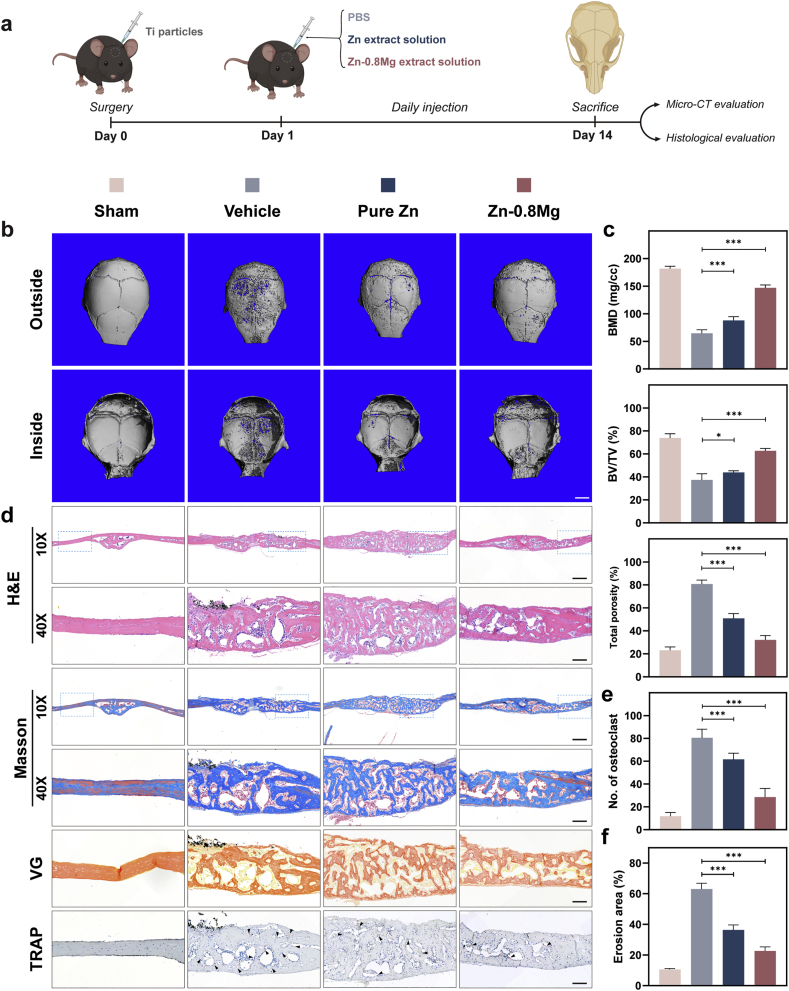
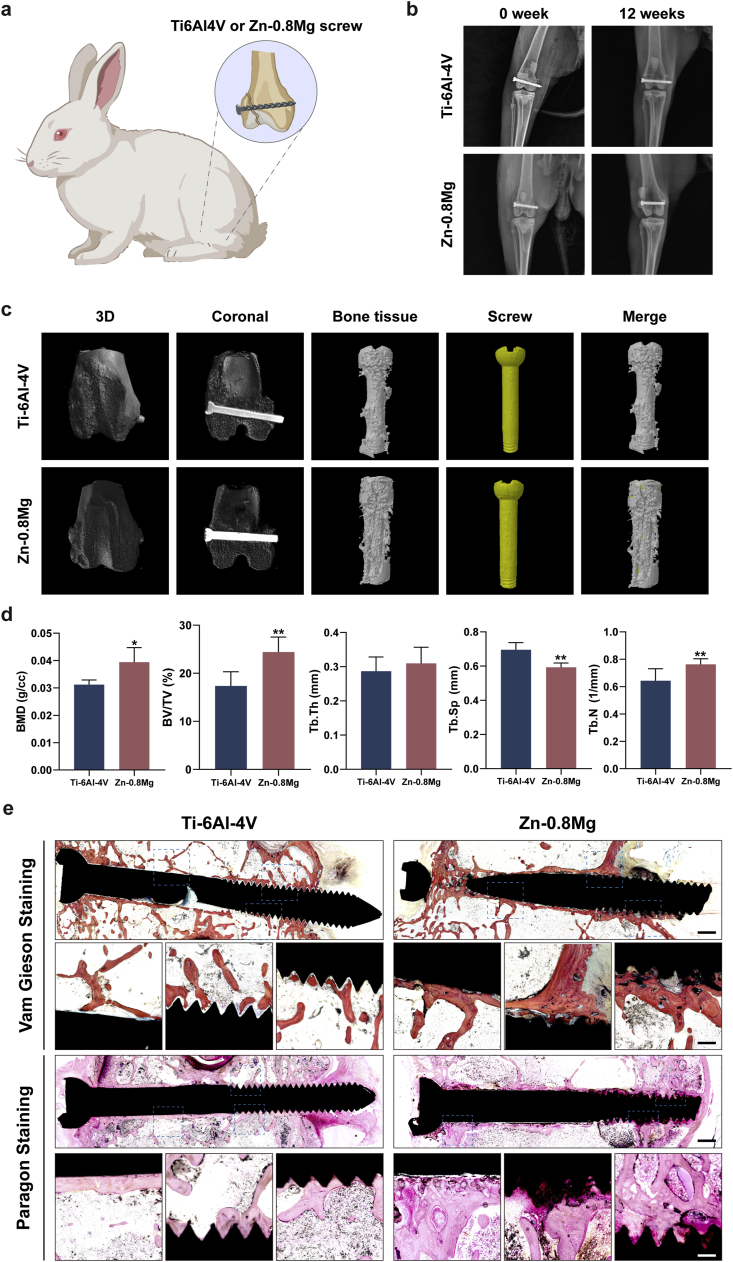
Healing of fractures or bone defects is significantly hindered by overactivated osteoclasts and inhibited osteogenesis in patients with abnormal bone metabolism. Current clinical approaches using titanium alloys or stainless steel provide mechanical support but have no biological effects on bone regeneration. Therefore, designing and fabricating degradable metal materials with sufficient mechanical strength and bidirectional regulation of both osteoblasts and osteoclasts is a substantial challenge. Here, this study first reported an adaptive biodegradable Zn-0.8 Mg alloy with bidirectional regulation of bone homeostasis, which promotes osteogenic differentiation by activating the Pi3k/Akt pathway and inhibits osteoclast differentiation by inhibiting the GRB2/ERK pathway. The -osteolytic ability of the Zn-0.8 Mg alloy was verified in a mouse calvarial osteolysis model and its suitability for internal fracture fixation with high-strength screws was confirmed in the rabbit femoral condyle fracture model. Furthermore, in an aged postmenopausal rat femoral condyle defect model, 3D printed Zn-0.8 Mg scaffolds promoted excellent bone regeneration through adaptive structures with good mechanical properties and bidirectionally regulated bone metabolism, enabling personalized bone defect repair. These findings demonstrate the substantial potential of the Zn-0.8 Mg alloy for treating fractures or bone defects in patients with aberrant bone metabolism.
在骨代谢异常的患者中,破骨细胞过度活化和成骨作用受抑制会显著阻碍骨折愈合或骨缺损修复。目前使用钛合金或不锈钢的临床方法提供了机械支撑,但对骨再生没有生物学作用。因此,设计和制造具有足够机械强度且能对成骨细胞和破骨细胞进行双向调节的可降解金属材料是一项重大挑战。在此,本研究首次报道了一种具有骨稳态双向调节作用的适应性可降解Zn-0.8Mg合金,它通过激活Pi3k/Akt途径促进成骨细胞分化,并通过抑制GRB2/ERK途径抑制破骨细胞分化。Zn-0.8Mg合金的抗骨溶解能力在小鼠颅骨骨溶解模型中得到验证,其适用于高强度螺钉内固定治疗兔股骨髁骨折也在该模型中得到证实。此外,在老年绝经后大鼠股骨髁缺损模型中,3D打印的Zn-0.8Mg支架通过具有良好机械性能的适应性结构和双向调节骨代谢促进了优异的骨再生,实现了个性化骨缺损修复。这些发现证明了Zn-0.8Mg合金在治疗骨代谢异常患者的骨折或骨缺损方面具有巨大潜力。