Waisman Center, University of Wisconsin-Madison, Madison, WI 53705, USA; Department of Neuroscience, School of Medicine and Public Health, University of Wisconsin-Madison, Madison, WI 53705, USA; Neuroscience Training Program, University of Wisconsin-Madison, Madison, WI 53705, USA.
Department of Pediatrics-Neurology, Baylor College of Medicine, Houston, TX, USA; Jan and Dan Duncan Neurological Research Institute, Texas Children's Hospital, Houston, TX, USA.
Stem Cell Reports. 2024 Jun 11;19(6):796-816. doi: 10.1016/j.stemcr.2024.04.008. Epub 2024 May 16.
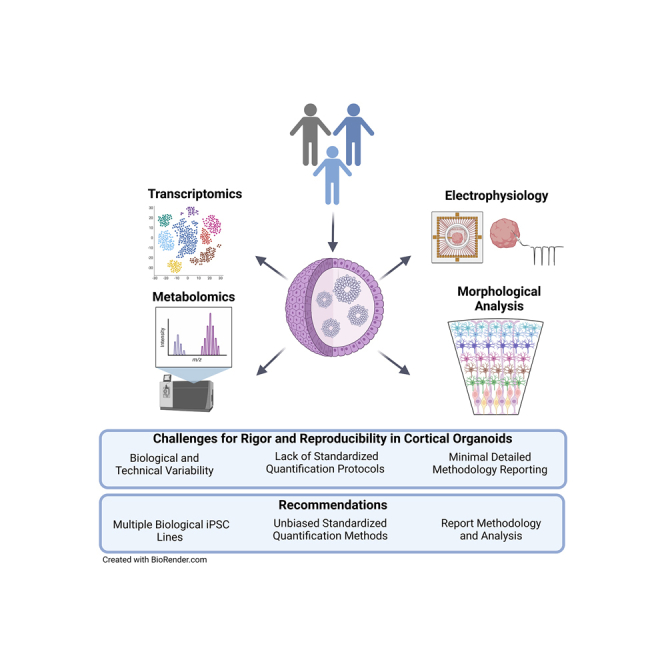
Human brain organoid models have emerged as a promising tool for studying human brain development and function. These models preserve human genetics and recapitulate some aspects of human brain development, while facilitating manipulation in an in vitro setting. Despite their potential to transform biology and medicine, concerns persist about their fidelity. To fully harness their potential, it is imperative to establish reliable analytic methods, ensuring rigor and reproducibility. Here, we review current analytical platforms used to characterize human forebrain cortical organoids, highlight challenges, and propose recommendations for future studies to achieve greater precision and uniformity across laboratories.
人脑类器官模型已成为研究人类大脑发育和功能的一种很有前途的工具。这些模型保留了人类的遗传特性,并再现了人类大脑发育的某些方面,同时便于在体外环境中进行操作。尽管它们有可能改变生物学和医学,但人们仍然对其真实性存在担忧。为了充分发挥它们的潜力,必须建立可靠的分析方法,确保严谨性和可重复性。在这里,我们回顾了目前用于描述人类前脑皮质类器官的分析平台,强调了挑战,并为未来的研究提出了建议,以实现实验室之间更高的精度和一致性。