Vaghefi Ehsan, Squirrell David, Yang Song, An Songyang, Xie Li, Durbin Mary K, Hou Huiyuan, Marshall John, Shreibati Jacqueline, McConnell Michael V, Budoff Matthew
Toku Eyes, Auckland, New Zealand.
Topcon Healthcare, Oakland, New Jersey.
Cardiovasc Digit Health J. 2024 Jan 9;5(2):59-69. doi: 10.1016/j.cvdhj.2023.12.004. eCollection 2024 Apr.
Atherosclerotic cardiovascular disease (ASCVD) is a leading cause of death globally, and early detection of high-risk individuals is essential for initiating timely interventions. The authors aimed to develop and validate a deep learning (DL) model to predict an individual's elevated 10-year ASCVD risk score based on retinal images and limited demographic data.
The study used 89,894 retinal fundus images from 44,176 UK Biobank participants (96% non-Hispanic White, 5% diabetic) to train and test the DL model. The DL model was developed using retinal images plus age, race/ethnicity, and sex at birth to predict an individual's 10-year ASCVD risk score using the pooled cohort equation (PCE) as the ground truth. This model was then tested on the US EyePACS 10K dataset (5.8% non-Hispanic White, 99.9% diabetic), composed of 18,900 images from 8969 diabetic individuals. Elevated ASCVD risk was defined as a PCE score of ≥7.5%.
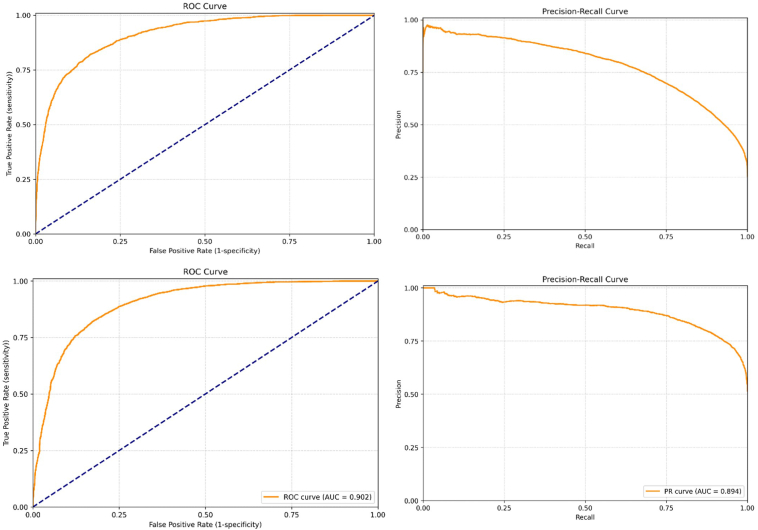
In the UK Biobank internal validation dataset, the DL model achieved an area under the receiver operating characteristic curve of 0.89, sensitivity 84%, and specificity 90%, for detecting individuals with elevated ASCVD risk scores. In the EyePACS 10K and with the addition of a regression-derived diabetes modifier, it achieved sensitivity 94%, specificity 72%, mean error -0.2%, and mean absolute error 3.1%.
This study demonstrates that DL models using retinal images can provide an additional approach to estimating ASCVD risk, as well as the value of applying DL models to different external datasets and opportunities about ASCVD risk assessment in patients living with diabetes.
动脉粥样硬化性心血管疾病(ASCVD)是全球主要的死亡原因,早期发现高危个体对于及时开展干预至关重要。作者旨在开发并验证一种深度学习(DL)模型,以根据视网膜图像和有限的人口统计学数据预测个体10年ASCVD风险评分升高情况。
该研究使用了来自44176名英国生物银行参与者的89894张视网膜眼底图像(96%为非西班牙裔白人,5%患有糖尿病)来训练和测试DL模型。DL模型利用视网膜图像以及年龄、种族/族裔和出生时的性别来预测个体的10年ASCVD风险评分,以汇总队列方程(PCE)作为基准真值。然后在由8969名糖尿病个体的18900张图像组成的美国EyePACS 10K数据集(5.8%为非西班牙裔白人,99.9%患有糖尿病)上对该模型进行测试。ASCVD风险升高定义为PCE评分≥7.5%。
在英国生物银行内部验证数据集中,DL模型检测ASCVD风险评分升高个体的受试者工作特征曲线下面积为0.89,灵敏度为84%,特异性为90%。在EyePACS 10K数据集中,加上回归衍生的糖尿病修正因子后,其灵敏度为94%,特异性为72%,平均误差为-0.2%,平均绝对误差为3.1%。
本研究表明,使用视网膜图像的DL模型可为估计ASCVD风险提供一种额外方法,同时也证明了将DL模型应用于不同外部数据集以及评估糖尿病患者ASCVD风险的价值。