Department of Internal Medicine, Maastricht University Medical Center+, P. Debyelaan 25, Maastricht, 6229 HX, the Netherlands.
Center of Expertise for Palliative Care, Maastricht University Medical Center+, (MUMC+), Maastricht, the Netherlands.
BMC Nephrol. 2024 May 22;25(1):179. doi: 10.1186/s12882-024-03617-8.
Patients undergoing dialysis have an impaired health-related quality of life (HRQOL). There are conflicting data from small series on whether patient-related factors such as educational level have an impact on experienced HRQOL. The aim of this study was to investigate the association between educational level and HRQOL in dialysis patients.
In a single-center retrospective cross-sectional study HRQOL was measured using the Kidney Disease Quality of Life Short Form-36 (KDQOL-SF36) in prevalent chronic dialysis patients. Educational level was categorized into low, intermediate and high subgroups. Univariate and multivariate regression analyses were performed to assess the effects of age, gender, ethnicity, and dialysis vintage on the association between HRQOL and educational level.
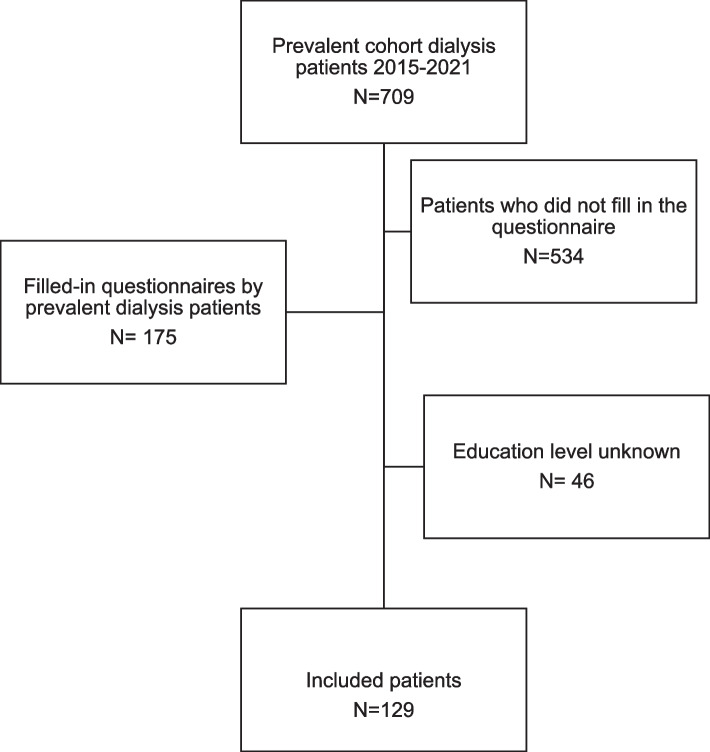
One hundred twenty-nine chronic dialysis patients were included. Patients with an intermediate educational level had significantly higher odds of a higher emotional well-being than patients with a low educational level 4.37 (1.-89-10.13). A similar trend was found for a high educational level (OR 4.13 (1.04-16.42), p = 0.044) The odds for women compared to men were 2.83 (1.32-6.06) for better general health and 2.59 (1.15-5,84) for emotional well-being. There was no interaction between gender and educational level for both subdomains. Each year of increasing age significantly decreased physical functioning (OR 0.94 (0.91-0.97)).
Educational level and sex were associated with emotional well-being, since patients with intermediate and high educational level and females had better emotional well-being in comparison to patients with low educational level and males. Physical functioning decreased with increasing age.
接受透析的患者健康相关生活质量(HRQOL)受损。一些小型系列研究的数据显示,患者相关因素(如教育水平)是否对体验到的 HRQOL 有影响存在冲突。本研究旨在探讨透析患者的教育水平与 HRQOL 之间的关系。
在一项单中心回顾性横断面研究中,使用肾脏病生活质量简表-36 (KDQOL-SF36)评估了慢性透析患者的 HRQOL。教育水平分为低、中、高三个亚组。进行单变量和多变量回归分析,以评估年龄、性别、种族和透析年限对 HRQOL 与教育水平之间关联的影响。
共纳入 129 例慢性透析患者。与低教育水平的患者相比,具有中等教育水平的患者的情绪健康评分更高,优势比为 4.37(1.-89-10.13)。高教育水平也存在类似趋势(OR 4.13(1.04-16.42),p=0.044)。与男性相比,女性的总体健康状况更好的优势比为 2.83(1.32-6.06),情绪健康状况更好的优势比为 2.59(1.15-5.84)。在这两个亚领域中,性别与教育水平之间没有交互作用。年龄每增加 1 岁,身体功能显著下降(OR 0.94(0.91-0.97))。
教育水平和性别与情绪健康有关,因为与低教育水平和男性相比,具有中、高教育水平和女性的患者情绪健康更好。随着年龄的增长,身体功能逐渐下降。