Department of Clinical Research in Tumor Immunology, Graduate School of Medicine, Osaka University, Suita, Osaka, 565-0871, Japan.
Department of Gastroenterological Surgery, Graduate School of Medicine, Osaka University, Suita, Osaka, 565-0871, Japan.
BMC Cancer. 2024 May 23;24(1):627. doi: 10.1186/s12885-024-12363-x.
CCR8-expressing regulatory T cells (Tregs) are selectively localized within tumors and have gained attention as potent suppressors of anti-tumor immunity. This study focused on CCR8 Tregs and their interaction with CD8 T cells in the tumor microenvironment of human lung cancer. We evaluated their spatial distribution impact on CD8 T cell effector function, specifically granzyme B (GzmB) expression, and clinical outcomes.
A total of 81 patients with lung squamous cell carcinoma (LSCC) who underwent radical surgical resection without preoperative treatment were enrolled. Histological analyses were performed, utilizing an automated image analysis system for double-stained immunohistochemistry assays of CCR8/Foxp3 and GzmB/CD8. We investigated the association of CCR8 Tregs and GzmB CD8 T cells in tumor tissues and further evaluated the prognostic impact of their distribution profiles.
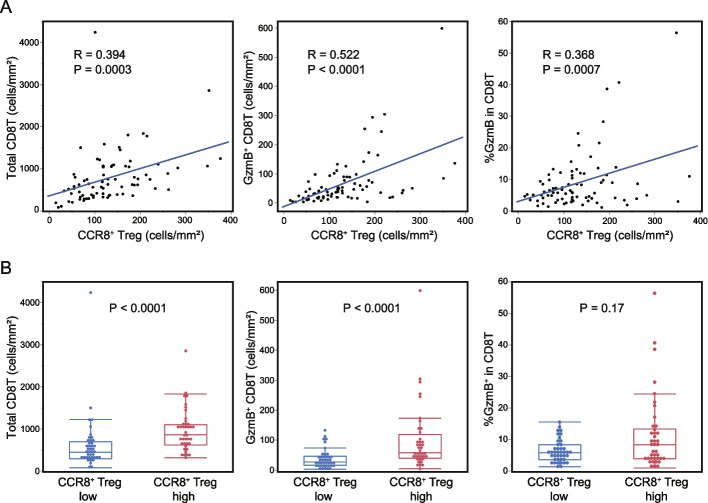
Histological evaluation using the region of interest (ROI) protocol showed that GzmB expression levels in CD8 T cells were decreased in areas with high infiltration of CCR8 Tregs, suggesting a suppressive effect of CCR8 Tregs on T cell cytotoxicity in the local tumor microenvironment. Analysis of the association with clinical outcomes showed that patients with more CCR8 Tregs and lower GzmB expression, represented by a low GzmB/CCR8 ratio, had worse progression-free survival.
Our data suggest that local CCR8 Treg accumulation is associated with reduced CD8 T cell cytotoxic activity and poor prognosis in LSCC patients, highlighting the biological role and clinical significance of CCR8 Tregs in the tumor microenvironment. The GzmB/CCR8 ratio may be a useful prognostic factor for future clinical applications in LSCC.
CCR8 表达的调节性 T 细胞(Tregs)在肿瘤内选择性定位,并作为抗肿瘤免疫的有效抑制剂而受到关注。本研究聚焦于 CCR8 Tregs 及其与人类肺癌肿瘤微环境中 CD8 T 细胞的相互作用。我们评估了它们在 CD8 T 细胞效应功能(特别是颗粒酶 B [GzmB]表达)和临床结局方面的空间分布影响。
共纳入 81 例接受根治性手术切除且无术前治疗的肺鳞癌(LSCC)患者。对肿瘤组织进行了组织学分析,利用自动图像分析系统对 CCR8/Foxp3 和 GzmB/CD8 的双重染色免疫组化进行分析。我们研究了肿瘤组织中 CCR8 Tregs 和 GzmB CD8 T 细胞的相关性,并进一步评估了其分布特征的预后影响。
使用感兴趣区域(ROI)方案的组织学评估显示,在 CCR8 Tregs 高浸润区域,CD8 T 细胞中 GzmB 的表达水平降低,提示 CCR8 Tregs 对局部肿瘤微环境中 T 细胞细胞毒性具有抑制作用。与临床结局的关联分析表明,CCR8 Tregs 较多且 GzmB 表达较低(表现为 GzmB/CCR8 比值较低)的患者无进展生存期更差。
我们的数据表明,LSCC 患者中局部 CCR8 Treg 聚集与 CD8 T 细胞细胞毒性活性降低和预后不良相关,突出了 CCR8 Tregs 在肿瘤微环境中的生物学作用和临床意义。GzmB/CCR8 比值可能是 LSCC 未来临床应用的一个有用的预后因素。