Elzhraa Fatma, Al-Ashmawy Maha, El-Sherbini Mohammed, El-Sebaey Ahmed M, Mohácsi-Farkas Csilla, Kiskó Gabriella, Belák Ágnes
Department of Food Hygiene and Control, Faculty of Veterinary Medicine, Mansoura University, Mansoura 35516, Egypt.
Department of Food Microbiology, Hygiene and Safety, Institute of Food Science and Technology, Hungarian University of Agriculture and Life Sciences, Somlói út 14-16, H-1118 Budapest, Hungary.
Antibiotics (Basel). 2024 May 16;13(5):454. doi: 10.3390/antibiotics13050454.
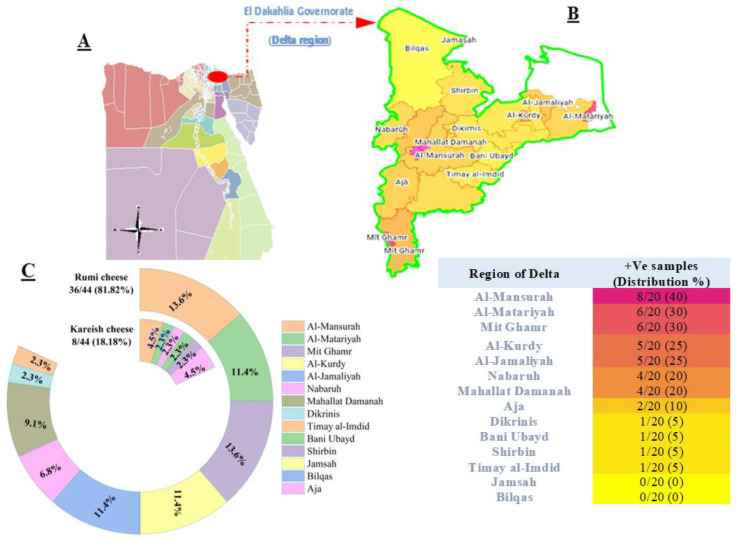
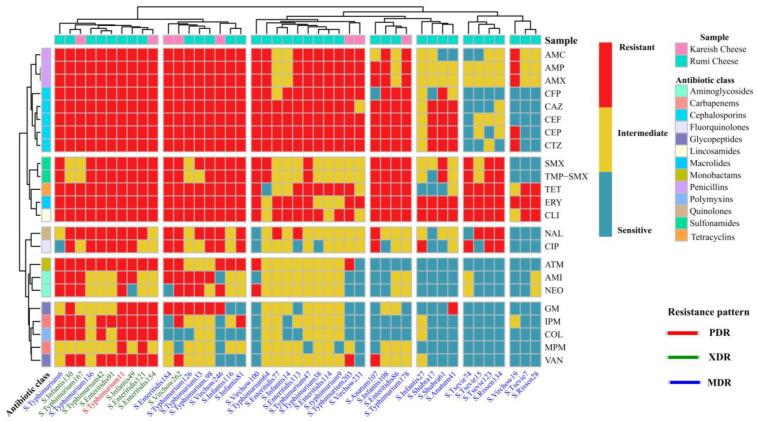
The spread of superbugs in dairy products can jeopardize global public health. To date, information on the incidence rates of virulent and β-lactams-resistant (BLR) in cheeses from rural areas of Egypt has been lacking. Biochemical, serological, antibiotic susceptibility, and multiplex PCR (M-PCR) tests were performed to identify and characterize isolates. In this study, 44 (15.71%) isolates of eight different serotypes were recovered from 280 samples of Rumi and pasteurized Kariesh cheeses across the Nile Delta region of Egypt. The most predominant serotypes were . Typhimurium, . Enteritidis, and . Infantis. The virulence genes (, , and ) were identified in all isolates. However, was only detected in . Typhimurium. The highest resistance was developed against Erythromycin and Clindamycin (90.91%), followed by Ceftazidime and Cephalothin (84.09%). Meropenem and colistin were the most effective antibiotics. A high proportion (79.55%) of multi-drug resistance (MDR) isolates carried narrow spectrum (NS), extended-spectrum (ES), and AmpC-BLR genes. The , , , , and BLR genes were positive in 37.04%, 29.63%, 25.93%, 14.81%, 37.04%, and 3.70% of isolates, respectively. In conclusion, a high prevalence of virulence and BLR genes harboring strains in Egyptian cheeses is considered a great threat to public health.
超级细菌在乳制品中的传播会危及全球公共卫生。迄今为止,埃及农村地区奶酪中强毒和耐β-内酰胺(BLR)的发病率信息一直缺乏。进行了生化、血清学、抗生素敏感性和多重PCR(M-PCR)检测以鉴定和表征分离株。在本研究中,从埃及尼罗河三角洲地区的280份鲁米奶酪和巴氏杀菌卡里什奶酪样本中分离出44株(15.71%)8种不同血清型的菌株。最主要的血清型是鼠伤寒沙门氏菌、肠炎沙门氏菌和婴儿沙门氏菌。在所有分离株中均鉴定出毒力基因(、和)。然而,仅在鼠伤寒沙门氏菌中检测到。对红霉素和克林霉素的耐药性最高(90.91%),其次是头孢他啶和头孢噻吩(84.09%)。美罗培南和黏菌素是最有效的抗生素。高比例(79.55%)的多重耐药(MDR)分离株携带窄谱(NS)、广谱(ES)和AmpC-BLR基因。、、、、和BLR基因在分离株中的阳性率分别为37.04%、29.63%、25.93%、14.81%、37.04%和3.70%。总之,埃及奶酪中携带强毒和BLR基因的菌株的高流行率被认为是对公共卫生的巨大威胁。