Real Jardín Botánico (CSIC), Plaza de Murillo 2, 28014 Madrid, Spain.
Departamento de Biología Funcional, Universidad de Santiago de Compostela, 14971 Santiago de Compostela, Spain.
Int J Mol Sci. 2024 May 14;25(10):5369. doi: 10.3390/ijms25105369.
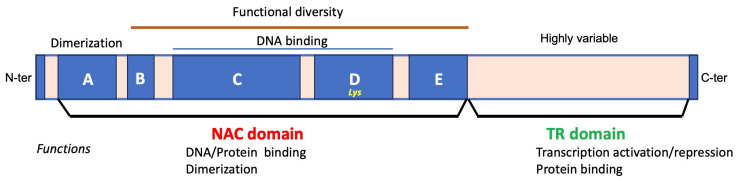
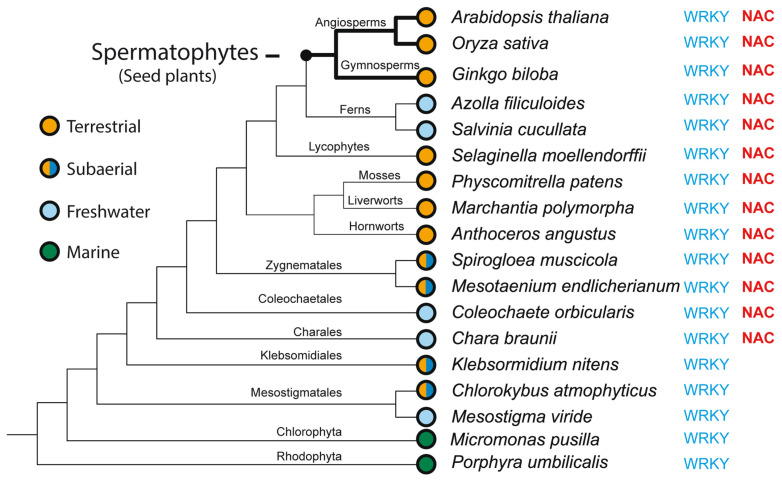
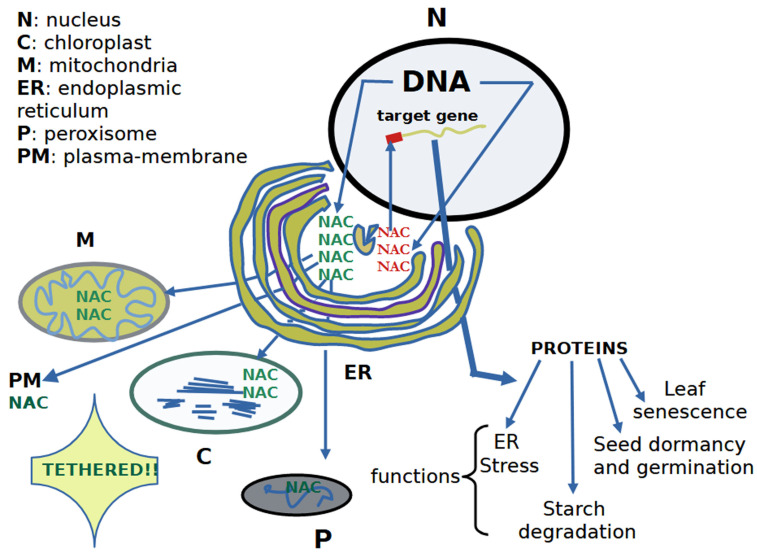
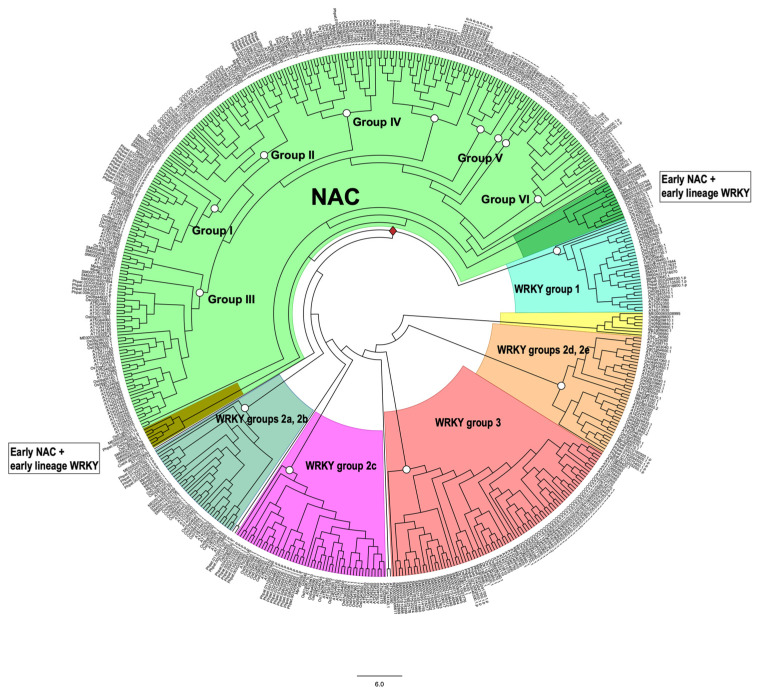
Transcription factors (TFs) regulate gene expression by binding to specific sequences on DNA through their DNA-binding domain (DBD), a universal process. This update conveys information about the diverse roles of TFs, focusing on the NACs (NAM-ATAF-CUC), in regulating target-gene expression and influencing various aspects of plant biology. NAC TFs appeared before the emergence of land plants. The NAC family constitutes a diverse group of plant-specific TFs found in mosses, conifers, monocots, and eudicots. This update discusses the evolutionary origins of plant NAC genes/proteins from green algae to their crucial roles in plant development and stress response across various plant species. From mosses and lycophytes to various angiosperms, the number of NAC proteins increases significantly, suggesting a gradual evolution from basal streptophytic green algae. NAC TFs play a critical role in enhancing abiotic stress tolerance, with their function conserved in angiosperms. Furthermore, the modular organization of NACs, their dimeric function, and their localization within cellular compartments contribute to their functional versatility and complexity. While most NAC TFs are nuclear-localized and active, a subset is found in other cellular compartments, indicating inactive forms until specific cues trigger their translocation to the nucleus. Additionally, it highlights their involvement in endoplasmic reticulum (ER) stress-induced programmed cell death (PCD) by activating the vacuolar processing enzyme (VPE) gene. Moreover, this update provides a comprehensive overview of the diverse roles of NAC TFs in plants, including their participation in ER stress responses, leaf senescence (LS), and growth and development. Notably, NACs exhibit correlations with various phytohormones (i.e., ABA, GAs, CK, IAA, JA, and SA), and several genes are inducible by them, influencing a broad spectrum of biological processes. The study of the spatiotemporal expression patterns provides insights into when and where specific genes are active, shedding light on their metabolic contributions. Likewise, this review emphasizes the significance of NAC TFs in transcriptional modules, seed reserve accumulation, and regulation of seed dormancy and germination. Overall, it effectively communicates the intricate and essential functions of NAC TFs in plant biology. Finally, from an evolutionary standpoint, a phylogenetic analysis suggests that it is highly probable that the WRKY family is evolutionarily older than the NAC family.
转录因子(TFs)通过其 DNA 结合域(DBD)与 DNA 上的特定序列结合,从而调节基因表达,这是一个普遍的过程。本次更新传达了关于 TFs 的多种角色的信息,重点介绍了 NACs(NAM-ATAF-CUC)在调节靶基因表达和影响植物生物学各个方面的作用。NAC TFs 出现在陆地植物出现之前。NAC 家族是一个多样化的植物特异性 TF 家族,存在于苔藓植物、裸子植物、单子叶植物和双子叶植物中。本更新讨论了从绿藻到各种植物物种中 NAC 基因/蛋白在植物发育和应激反应中的关键作用的植物 NAC 基因/蛋白的进化起源。从苔藓植物和石松植物到各种被子植物,NAC 蛋白的数量显著增加,这表明它们是从基生的石松类绿藻逐渐进化而来的。NAC TFs 在增强非生物胁迫耐受性方面起着关键作用,其功能在被子植物中得到了保守。此外,NAC 的模块化组织、二聚体功能以及它们在细胞区室中的定位,有助于其功能的多样性和复杂性。虽然大多数 NAC TFs 是核定位的且活跃的,但有一部分存在于其他细胞区室中,这表明它们在特定信号触发其向核内易位之前处于非活性状态。此外,它还强调了它们通过激活液泡加工酶(VPE)基因参与内质网(ER)应激诱导的程序性细胞死亡(PCD)的作用。此外,本更新提供了 NAC TFs 在植物中的多种作用的全面概述,包括它们在内质网应激反应、叶片衰老(LS)以及生长和发育中的参与。值得注意的是,NACs 与各种植物激素(即 ABA、GA、CK、IAA、JA 和 SA)相关,并且一些基因可被它们诱导,影响广泛的生物学过程。对时空表达模式的研究提供了特定基因何时何地活跃的见解,揭示了它们在新陈代谢中的贡献。同样,本综述强调了 NAC TFs 在转录模块、种子储备积累以及调节种子休眠和萌发中的重要性。总的来说,它有效地传达了 NAC TFs 在植物生物学中的复杂而重要的功能。最后,从进化的角度来看,系统发育分析表明,WRKY 家族很可能比 NAC 家族进化得更早。