Department of Orthopaedics and Trauma Surgery, Musculoskeletal University Center Munich (MUM), LMU University Hospital, LMU Munich, Marchioninistr. 15, 81377, Munich, Germany.
Arch Orthop Trauma Surg. 2024 Jun;144(6):2665-2671. doi: 10.1007/s00402-024-05390-7. Epub 2024 May 27.
Open book injuries are challenging injuries that oftentimes require surgical treatment. Currently, treatment is performed with symphyseal plating requiring extensive surgery and entirely limiting physiological movement of the symphyseal joint, frequently resulting in implant failure. Therefore, we investigated the biomechanical properties of a minimally invasive tape suture construct (modified SpeedBridge™) as an alternative stabilization technique for the treatment of open book injuries in human cadaver pelvic rings.
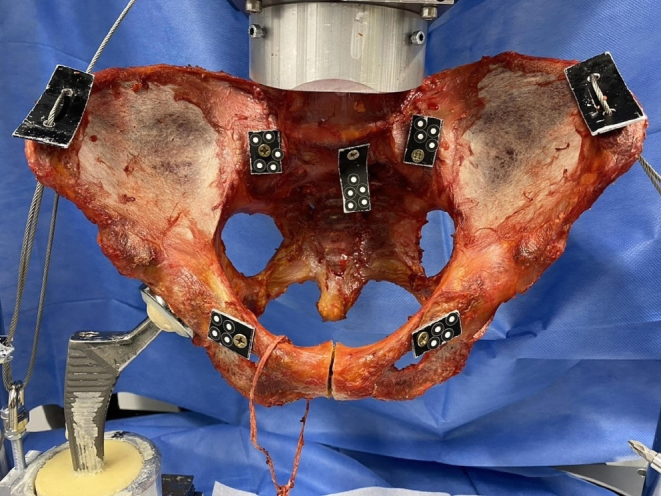
The symphysis of 9 human cadaver pelvises was dissected and dilated to 3 cm creating an open book injury. Next, the two osteosynthesis methods (plating, modified SpeedBridge™) were applied. All specimens then underwent cyclic horizontal and vertical loading, simulating biomechanical forces while sitting, standing and walking. For statistical analysis, 3D dislocation (mm) was calculated.
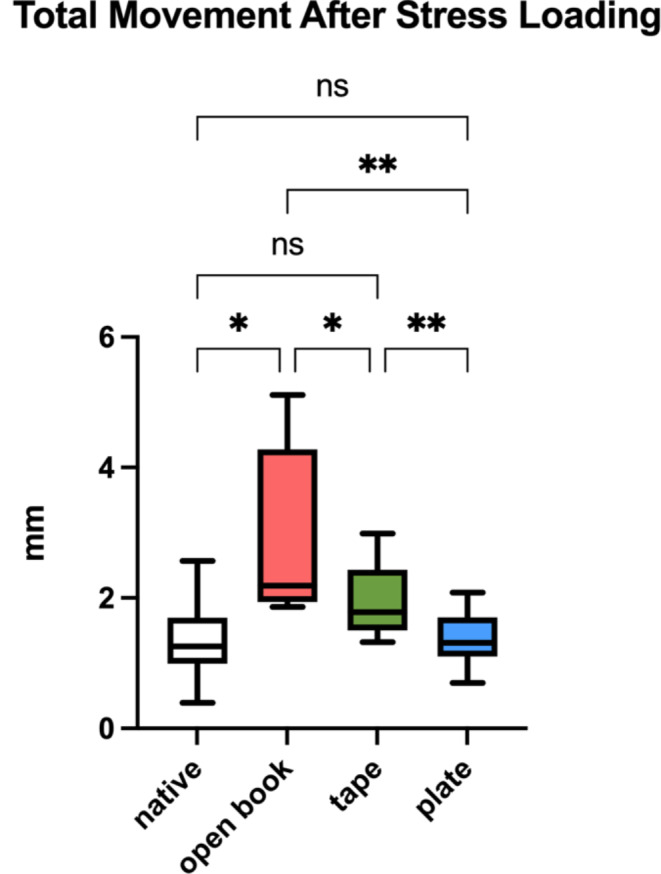
Total displacement (mm) of the pubic symphysis displayed the following means and standard deviations: native group 1.34 ± 0.62 mm, open book group 3.01 ± 1.26 mm, tape group 1.94 ± 0.59 mm and plate group 1.37 ± 0.41 mm. Comparison between native and open book (p = 0.029), open book and plate (p = 0.004), open book and tape (p = 0.031), as well as tape and plate group (p = 0.002) showed significant differences. No significant differences were found when comparing the native and tape (p = 0.059), as well as the native and plate (p = 0.999) group.
While both osteosynthesis techniques sufficiently stabilized the injury, symphyseal plating displayed the highest rigidity. The modified SpeedBridge™ as a tape suture construct provided statistically sufficient biomechanical stability while maintaining symphyseal micro mobility, consequently allowing ligamental healing of the injured joint without iatrogenic arthrodesis.
开放性骨盆骨折是一种具有挑战性的骨折,通常需要手术治疗。目前,治疗方法是采用耻骨联合钢板固定,需要进行广泛的手术,完全限制耻骨联合的生理运动,经常导致植入物失败。因此,我们研究了微创带线缝合结构(改良 SpeedBridge™)作为治疗人类骨盆环开放性骨盆骨折的替代稳定技术的生物力学特性。
解剖 9 个人体尸体骨盆的耻骨联合并将其扩张至 3 厘米,造成开放性骨盆骨折。然后应用两种接骨术方法(钢板、改良 SpeedBridge™)。所有标本均进行了循环水平和垂直加载,模拟坐、站和行走时的生物力学力。为了进行统计分析,计算了 3D 脱位(mm)。
耻骨联合的总位移(mm)显示以下平均值和标准差:自然组 1.34 ± 0.62mm,开放性骨盆组 3.01 ± 1.26mm,带线组 1.94 ± 0.59mm 和钢板组 1.37 ± 0.41mm。自然组与开放性骨盆组(p = 0.029)、开放性骨盆组与钢板组(p = 0.004)、开放性骨盆组与带线组(p = 0.031)以及带线组与钢板组(p = 0.002)之间的比较均显示出显著差异。然而,自然组与带线组(p = 0.059)以及自然组与钢板组(p = 0.999)之间的比较没有显示出显著差异。
虽然两种接骨术技术都充分稳定了损伤,但耻骨联合钢板固定显示出最高的刚度。改良 SpeedBridge™ 作为带线缝合结构,在保持耻骨联合微运动的同时,提供了统计学上足够的生物力学稳定性,从而允许受伤关节的韧带愈合,而不会发生医源性融合。