
通过调节小胶质细胞M1极化改善神经性疼痛:一项基于网络药理学的研究
. Ameliorates Neuropathic Pain by Regulating Microglial M1 Polarization: A Study Based on Network Pharmacology.
作者信息
Cui Shanshan, Feng Xiaobo, Xia Zhongyuan
机构信息
Department of Anesthesiology, Renmin Hospital of Wuhan University, Wuhan, Hubei Province, People's Republic of China.
Department of Anesthesiology, Zhongnan Hospital, Wuhan University, Wuhan, Hubei Province, People's Republic of China.
出版信息
J Pain Res. 2024 May 23;17:1881-1901. doi: 10.2147/JPR.S446137. eCollection 2024.
BACKGROUND
In traditional Chinese medicine, . (LCH) is used to treat neuropathic pain (NP). This study was performed to investigate the underlying pharmacological mechanisms.
METHODS
The main components of the LCH were obtained from the TCMSP database. The targets of the active components were obtained using the Swiss Target Prediction database and HERB database. The NP-related genes were obtained from the CTD database and GeneCard database. Protein-protein interaction (PPI) network was constructed using the STRING platform and Cytoscape 3.9.0 software. GO and KEGG enrichment analyses were performed using the DAVID database. Interactions between the key components and hub target proteins were verified using molecular docking and molecular dynamics simulation. In addition, microglial cell line HMC3 was induced to polarize to the M1 phenotype using 100 ng/mL lipopolysaccharide (LPS). Quantitative real-time polymerase chain reaction (qRT-PCR), Western blot and enzyme-linked immunosorbent assays were used to detect the expression levels of M1 markers and inflammatory factors, respectively.
RESULTS
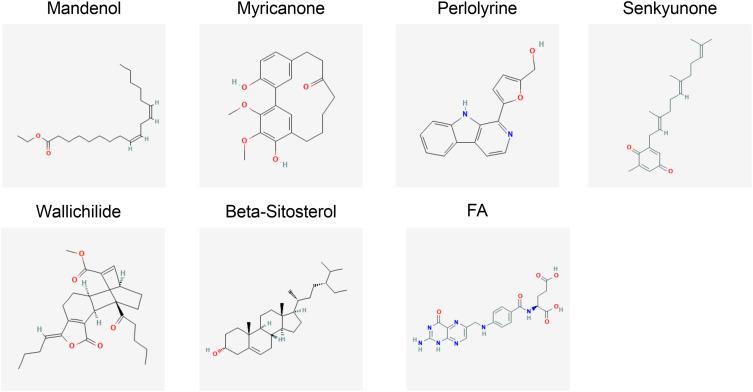
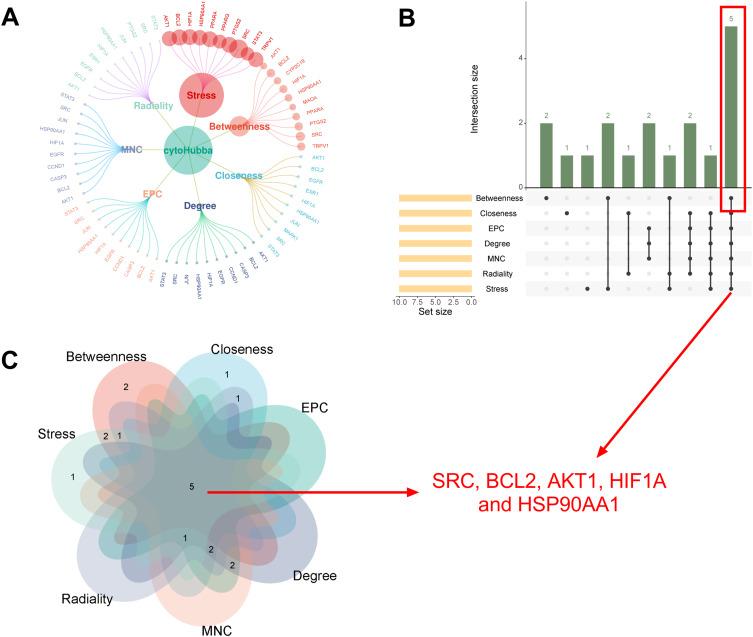
Seven LCH active components of LCH were identified, corresponding to 387 target genes. 2019 NP-related genes were obtained, and a total of 174 NP-related genes were identified as target genes that could be modulated by LCH. Beta-sitosterol, senkyunone, wallichilide, myricanone, and mandenol were considered as the key components of LCH in the treatment of NP. SRC, BCL2, AKT1, HIF1A and HSP90AA1 were identified as the hub target proteins. GO analysis showed that 328 biological processes, 61 cell components, and 85 molecular functions were likely modulated by the components of LCH, and KEGG enrichment analysis showed that 132 signaling pathways were likely modulated by the components of LCH. Beta-sitosterol, senkyunone, wallichilide, myricanone, and mandenol showed good binding activity with hub target proteins including SRC, BCL2, AKT1, and HSP90AA1. In addition, beta-sitosterol inhibited LPS-induced M1 polarization in HMC3 in vitro.
CONCLUSION
This study provides a theoretical basis for the application of LCH in the treatment of NP through multicomponent, multitarget, and multiple pathways.
背景
在传统中医中,[此处原文缺失具体药物名称](LCH)用于治疗神经性疼痛(NP)。本研究旨在探究其潜在的药理机制。
方法
LCH的主要成分从中药系统药理学数据库(TCMSP)中获取。活性成分的靶点通过瑞士靶点预测数据库和中药系统药理学数据库(HERB)获取。NP相关基因从 Comparative Toxicogenomics Database(CTD)数据库和 GeneCard 数据库中获取。使用 STRING 平台和 Cytoscape 3.9.0 软件构建蛋白质-蛋白质相互作用(PPI)网络。使用 DAVID 数据库进行基因本体论(GO)和京都基因与基因组百科全书(KEGG)富集分析。通过分子对接和分子动力学模拟验证关键成分与枢纽靶蛋白之间的相互作用。此外,使用 100 ng/mL 脂多糖(LPS)诱导小胶质细胞系 HMC3 向 M1 表型极化。分别使用定量实时聚合酶链反应(qRT-PCR)、蛋白质免疫印迹法和酶联免疫吸附测定法检测 M1 标志物和炎症因子的表达水平。
结果
鉴定出 LCH 的七种活性成分,对应 387 个靶基因。获得 2019 个 NP 相关基因,共鉴定出 174 个 NP 相关基因作为可被 LCH 调节的靶基因。β-谷甾醇、升麻酮、垂头菊内酯、杨梅素和满多醇被认为是 LCH 治疗 NP 的关键成分。原癌基因酪氨酸蛋白激酶(SRC)、B 细胞淋巴瘤 2(BCL2)、蛋白激酶 B(AKT1)、缺氧诱导因子 1α(HIF1A)和热休克蛋白 90α家族成员 1(HSP90AA1)被鉴定为枢纽靶蛋白。GO 分析表明,LCH 的成分可能调节 328 个生物学过程、61 个细胞成分和 85 个分子功能,KEGG 富集分析表明,LCH 的成分可能调节 132 条信号通路。β-谷甾醇、升麻酮、垂头菊内酯、杨梅素和满多醇与包括 SRC、BCL2、AKT1 和 HSP90AA1 在内的枢纽靶蛋白表现出良好的结合活性。此外,β-谷甾醇在体外抑制 LPS 诱导的 HMC3 细胞向 M1 极化。
结论
本研究为 LCH 通过多成分、多靶点和多途径治疗 NP 的应用提供了理论依据。





 Zotero 插件