Chen Jing-Jing, Yu Bing, Yan Ling, Sun Xiao-Xiao, Dai Qin
School of Nursing, Fujian Medical University, Research Center for Nursing Humanity, Fuzhou, Fujian, China.
Department of Psychology, Army Medical University, Chongqing, China.
Front Psychol. 2024 May 16;15:1343264. doi: 10.3389/fpsyg.2024.1343264. eCollection 2024.
The purpose of this study is to assess the physical and psychological conditions of hospitalized patients who were infected with COVID-19 in Wuhan, China, including post-traumatic stress disorder (PTSD) and post-traumatic growth (PTG) scores and predictors.
The test group consisted of 102 hospitalized patients diagnosed with COVID-19 in Wuhan between March 4, 2020 and April 5, 2020, whereas the control group comprised 168 healthy study participants. Relevant information of the study participants was obtained using online questionnaires, covering five aspects-general information, physical state, emotional state, PTSD, and PTG.
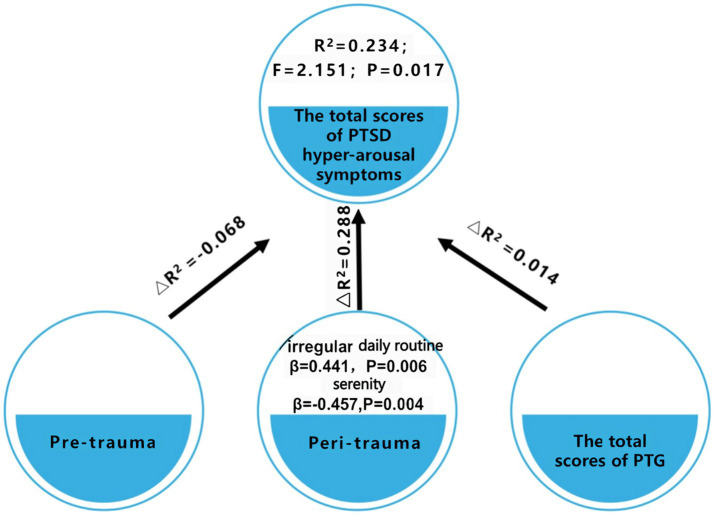
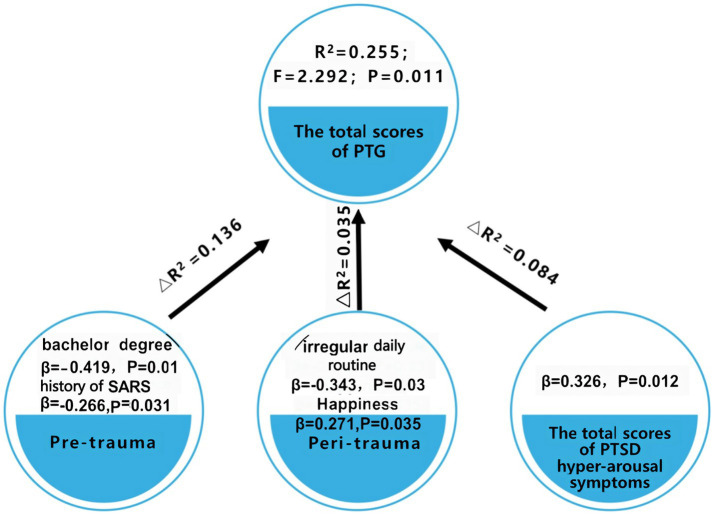
In Wuhan, 37.3% of COVID-19-diagnosed hospitalized patients exhibited hyper-arousal symptoms of PTSD. This percentage is significantly higher than the 13.1% observed in the healthy population. Furthermore, the prevalence of PTG among the same group of hospitalized patients stood at 77.5%, surpassing the 66.1% rate found within the healthy population. It was determined that inconsistent sleep patterns during the hospitalization phase could be indicative of heightened vulnerability to hyperarousal symptoms of PTSD in COVID-19-diagnosed hospitalized patients. The study determined that inconsistent sleep patterns during hospitalization may be a predisposition factor that makes hospitalized patients diagnosed with covid-19 more susceptible to high arousal symptoms of post-traumatic stress disorder. Conversely, COVID-19-diagnosed hospitalized patients who maintained a tranquil demeanor and exhibited positive emotional perceptions during their hospitalization displayed reduced susceptibility to these PTSD symptoms. Factors such as possession of a bachelor's degree, history of severe acute respiratory syndrome (SARS) infection, and poor sleep patterns were identified as predictors elevating the risk of PTG. Whereas, a sentiment of happiness and consistent positive emotional perception during hospitalization were predictors of PTG. Intriguingly, a direct correlation was established between hyper-arousal symptoms of PTSD and PTG.
Although the outbreak of COVID-19 has badly affected the physical and psychological well-being of patients, it has greatly enhanced their PTG.
本研究旨在评估中国武汉新冠肺炎住院患者的身心状况,包括创伤后应激障碍(PTSD)和创伤后成长(PTG)得分及预测因素。
测试组由2020年3月4日至2020年4月5日期间在武汉被诊断为新冠肺炎的102名住院患者组成,而对照组包括168名健康研究参与者。通过在线问卷获取研究参与者的相关信息,涵盖五个方面——一般信息、身体状况、情绪状态、PTSD和PTG。
在武汉,37.3%的新冠肺炎确诊住院患者表现出PTSD的过度唤醒症状。这一比例显著高于健康人群中观察到的13.1%。此外,同一组住院患者中PTG的患病率为77.5%,超过了健康人群中的66.1%。研究确定,住院期间睡眠模式不一致可能表明新冠肺炎确诊住院患者更容易出现PTSD的过度唤醒症状。研究确定,住院期间睡眠模式不一致可能是一个 predisposition 因素,使被诊断为新冠肺炎的住院患者更容易出现创伤后应激障碍的高唤醒症状。相反,新冠肺炎确诊住院患者在住院期间保持平静的 demeanor 并表现出积极的情绪感知,对这些PTSD症状的易感性较低。拥有学士学位、严重急性呼吸综合征(SARS)感染史和睡眠模式差等因素被确定为增加PTG风险的预测因素。而住院期间的幸福感和持续的积极情绪感知是PTG的预测因素。有趣的是,PTSD的过度唤醒症状与PTG之间建立了直接关联。
尽管新冠肺炎疫情严重影响了患者的身心健康,但它极大地增强了他们的PTG。