Sun Luna, Yi Bin, Pan Xiao, Wu Lili, Shang Zhilei, Jia Yanpu, Tao Xiandong, Zhao Feng, Xie Weifen, Sun Zhuoer, Bai Yonghai, Liu Weizhi
Lab for Post-Traumatic Stress Disorder, Faculty of Psychology and Mental Health, Naval Medical University, Shanghai, 200433, People's Republic of China.
The Emotion & Cognition Lab, Faculty of Psychology and Mental Health, Naval Medical University, Shanghai, 200433, People's Republic of China.
Nat Sci Sleep. 2021 Sep 14;13:1519-1531. doi: 10.2147/NSS.S317618. eCollection 2021.
The outbreak of COVID-19 has developed into a pandemic. Data are required that specifically address the psychological consequences in COVID-19 confirmed patients. This study mainly aimed to examine posttraumatic stress disorder (PTSD) symptoms and sleep quality among COVID-19 confirmed patients during hospitalization.
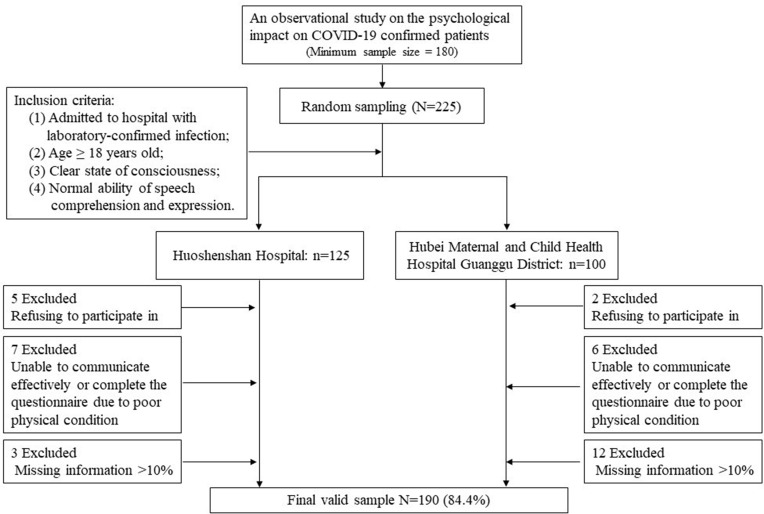
An observational study was conducted in two designated hospitals in Wuhan, China. Data were collected from 190 patients hospitalized with laboratory-confirmed COVID-19 infection between February 10, 2020 and March 13, 2020.
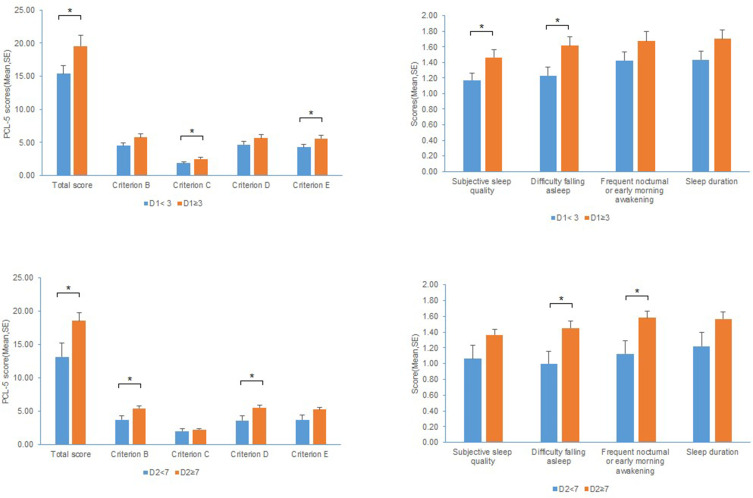
The mean age of the 190 confirmed patients was 55.7 years (SD = 13.7), of which 96 (50.5%) were female and 88 (46.3%) had family members or acquaintances infected with COVID-19. Lymphocytopenia was presented in 62 (32.6%) patients and 25 (13.2%) patients showed oxygen desaturation. The prevalence of high PTSD symptoms was 22.6% among the 190 patients. The median time from symptom onset to first medical visit and hospitalization was 2 days (IQR, 1-5) and 16 days (IQR, 10-27), respectively. Patients' PTSD symptoms were positively related to the time from symptom onset to first medical visit ( = 0.156, < 0.05) and hospitalization ( = 0.181, < 0.01). There were significant correlations between sleep quality and PTSD symptoms ( = 0.312-0.547, < 0.01).
The prevalence of high PTSD symptoms was 22.6% among hospitalized COVID-19 patients. Early diagnosis and treatment of COVID-19 symptoms are beneficial to infected patients both physically and psychologically. With the recovery of physical symptoms, psychological intervention is desired to promote the trauma recovery in COVID-19 patients.
新型冠状病毒肺炎(COVID-19)疫情已发展成为全球大流行。需要有专门针对COVID-19确诊患者心理后果的数据。本研究主要旨在调查COVID-19确诊患者住院期间的创伤后应激障碍(PTSD)症状和睡眠质量。
在中国武汉的两家定点医院进行了一项观察性研究。收集了2020年2月10日至2020年3月13日期间190例实验室确诊为COVID-19感染的住院患者的数据。
190例确诊患者的平均年龄为55.7岁(标准差=13.7),其中96例(50.5%)为女性,88例(46.3%)有家庭成员或熟人感染了COVID-19。62例(32.6%)患者出现淋巴细胞减少,25例(13.2%)患者出现氧饱和度下降。190例患者中PTSD症状严重的患病率为22.6%。从症状出现到首次就诊和住院的中位时间分别为2天(四分位间距,1-5)和16天(四分位间距,10-27)。患者的PTSD症状与从症状出现到首次就诊的时间(r=0.156,P<0.05)和住院时间(r=0.181,P<0.01)呈正相关。睡眠质量与PTSD症状之间存在显著相关性(r=0.312-0.547,P<0.01)。
住院COVID-19患者中PTSD症状严重的患病率为22.6%。早期诊断和治疗COVID-19症状对感染患者的身体和心理都有益。随着身体症状的恢复,需要进行心理干预以促进COVID-19患者的创伤恢复。