Faculty of Information Technology and Electrical Engineering, University of Oulu, Oulu, Finland.
Department of Computer Science, Norwegian University of Science and Technology, Trondheim, Norway.
J Med Internet Res. 2024 May 31;26:e49320. doi: 10.2196/49320.
Mobile health (mHealth) uses mobile technologies to promote wellness and help disease management. Although mHealth solutions used in the clinical setting have typically been medical-grade devices, passive and active sensing capabilities of consumer-grade devices like smartphones and activity trackers have the potential to bridge information gaps regarding patients' behaviors, environment, lifestyle, and other ubiquitous data. Individuals are increasingly adopting mHealth solutions, which facilitate the collection of patient-generated health data (PGHD). Health care professionals (HCPs) could potentially use these data to support care of chronic conditions. However, there is limited research on real-life experiences of HPCs using PGHD from consumer-grade mHealth solutions in the clinical context.
This systematic review aims to analyze existing literature to identify how HCPs have used PGHD from consumer-grade mobile devices in the clinical setting. The objectives are to determine the types of PGHD used by HCPs, in which health conditions they use them, and to understand the motivations behind their willingness to use them.
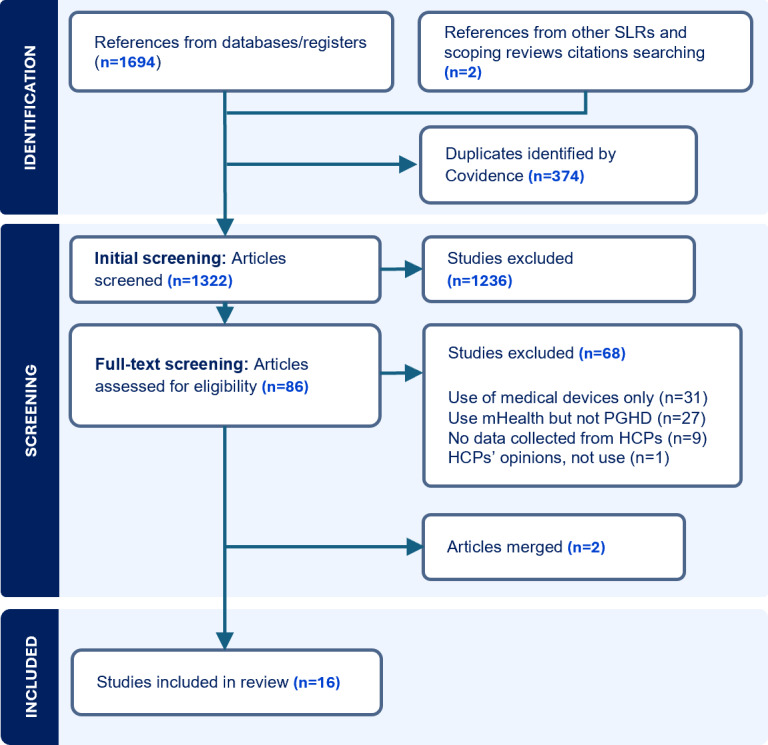
A systematic literature review was the main research method to synthesize prior research. Eligible studies were identified through comprehensive searches in health, biomedicine, and computer science databases, and a complementary hand search was performed. The search strategy was constructed iteratively based on key topics related to PGHD, HCPs, and mobile technologies. The screening process involved 2 stages. Data extraction was performed using a predefined form. The extracted data were summarized using a combination of descriptive and narrative syntheses.
The review included 16 studies. The studies spanned from 2015 to 2021, with a majority published in 2019 or later. Studies showed that HCPs have been reviewing PGHD through various channels, including solutions portals and patients' devices. PGHD about patients' behavior seem particularly useful for HCPs. Our findings suggest that PGHD are more commonly used by HCPs to treat conditions related to lifestyle, such as diabetes and obesity. Physicians were the most frequently reported users of PGHD, participating in more than 80% of the studies.
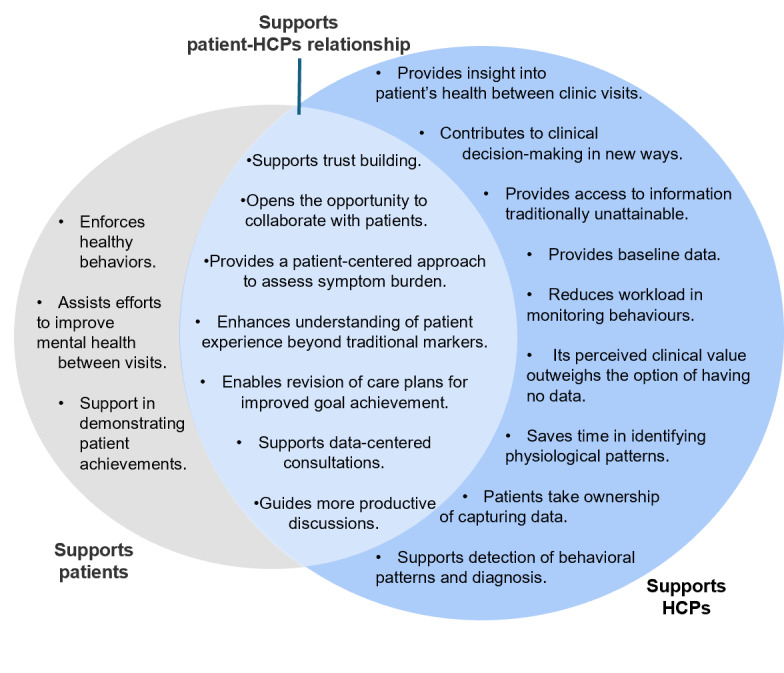
PGHD collection through mHealth solutions has proven beneficial for patients and can also support HCPs. PGHD have been particularly useful to treat conditions related to lifestyle, such as diabetes, cardiovascular diseases, and obesity, or in domains with high levels of uncertainty, such as infertility. Integrating PGHD into clinical care poses challenges related to privacy and accessibility. Some HCPs have identified that though PGHD from consumer devices might not be perfect or completely accurate, their perceived clinical value outweighs the alternative of having no data. Despite their perceived value, our findings reveal their use in clinical practice is still scarce.
INTERNATIONAL REGISTERED REPORT IDENTIFIER (IRRID): RR2-10.2196/39389.
移动医疗(mHealth)利用移动技术促进健康,并帮助疾病管理。虽然临床应用的 mHealth 解决方案通常是医疗级设备,但智能手机和活动追踪器等消费级设备的被动和主动感应功能有可能弥合患者行为、环境、生活方式和其他普遍数据方面的信息差距。越来越多的个人正在采用 mHealth 解决方案,这有助于收集患者生成的健康数据(PGHD)。医疗保健专业人员(HCPs)可能会利用这些数据来支持慢性病的护理。然而,关于 HCP 在临床环境中使用来自消费级 mHealth 解决方案的 PGHD 的实际经验的研究有限。
本系统评价旨在分析现有文献,以确定 HCP 如何在临床环境中使用来自消费级移动设备的 PGHD。目的是确定 HCP 使用的 PGHD 类型、他们在哪些健康状况下使用以及他们愿意使用的动机。
系统文献综述是综合先前研究的主要研究方法。通过全面搜索健康、生物医学和计算机科学数据库,确定了合格的研究,并进行了补充的手工搜索。搜索策略根据与 PGHD、HCP 和移动技术相关的关键主题进行了迭代构建。筛选过程分为 2 个阶段。使用预定义的表格进行数据提取。使用描述性和叙述性综合的组合总结提取的数据。
综述包括 16 项研究。这些研究的时间跨度从 2015 年到 2021 年,其中大多数发表于 2019 年或之后。研究表明,HCP 通过各种渠道审查 PGHD,包括解决方案门户和患者设备。PGHD 关于患者行为的信息似乎对 HCP 特别有用。我们的研究结果表明,PGHD 更常用于治疗与生活方式相关的疾病,如糖尿病和肥胖症。医生是报告使用 PGHD 最多的人,超过 80%的研究都有他们的参与。
通过 mHealth 解决方案收集 PGHD 已被证明对患者有益,也可以支持 HCP。PGHD 对于治疗与生活方式相关的疾病(如糖尿病、心血管疾病和肥胖症)或在不确定性水平较高的领域(如不孕症)特别有用。将 PGHD 纳入临床护理存在与隐私和可及性相关的挑战。一些 HCP 已经认识到,尽管来自消费级设备的 PGHD 可能不完美或不完全准确,但他们认为的临床价值超过了没有数据的替代方案。尽管他们认为有价值,但我们的研究结果表明,PGHD 在临床实践中的使用仍然很少。
国际注册报告标识符(IRRID):RR2-10.2196/39389.