Medical Oncology Department, Hospital Univ. Ramón y Cajal, Madrid, Spain.
Medical Oncology Department, Hospital General Univ. Gregorio Marañón, Madrid, Spain.
Clin Transl Oncol. 2024 Nov;26(11):2866-2876. doi: 10.1007/s12094-024-03502-8. Epub 2024 Jun 1.
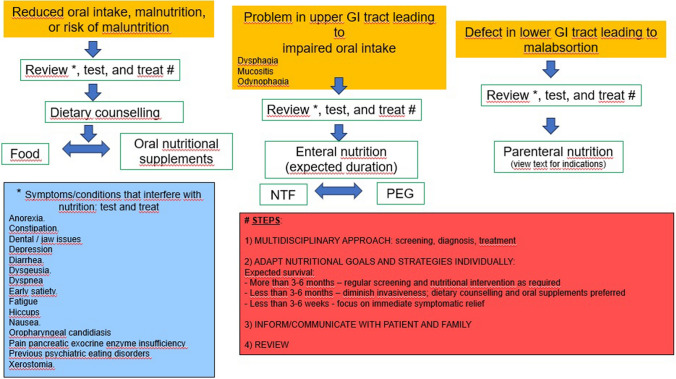
Cancer-related anorexia-cachexia syndrome (CACS) is a debilitating condition afflicting up to 80% of advanced-stage cancer patients. Characterized by progressive weight loss, muscle wasting, and metabolic abnormalities, CACS significantly compromises patients' quality of life and treatment outcomes. This comprehensive review navigates through its intricate physiopathology, elucidating its stages and diagnostic methodologies. CACS manifests in three distinct stages: pre-cachexia, established cachexia, and refractory cachexia. Early detection is pivotal for effective intervention and is facilitated by screening tools, complemented by nutritional assessments and professional evaluations. The diagnostic process unravels the complex interplay of metabolic dysregulation and tumor-induced factors contributing to CACS. Management strategies, tailored to individual patient profiles, encompass a spectrum of nutritional interventions. These include dietary counseling, oral nutritional supplements, and, when necessary, enteral nutrition and a judicious use of parenteral nutrition. Specific recommendations for caloric intake, protein requirements, and essential nutrients address the unique challenges posed by CACS. While pharmacological agents like megestrol acetate may be considered, their use requires careful evaluation of potential risks. At its core, this review underscores the imperative for a holistic and personalized approach to managing CACS, integrating nutritional interventions and pharmacological strategies based on a nuanced understanding of patient's condition.
癌症相关性厌食-恶病质综合征(CACS)是一种使人衰弱的疾病,影响多达 80%的晚期癌症患者。其特征是进行性体重减轻、肌肉消耗和代谢异常,显著影响患者的生活质量和治疗效果。本文全面探讨了其复杂的病理生理学,阐明了其阶段和诊断方法。CACS 表现为三个不同阶段:恶病质前期、恶病质期和难治性恶病质期。早期发现对于有效干预至关重要,可通过筛查工具、营养评估和专业评估来辅助进行。诊断过程揭示了代谢失调和肿瘤诱导因素的复杂相互作用,导致 CACS。根据个体患者的特点,管理策略包括一系列营养干预措施。这些措施包括饮食咨询、口服营养补充剂,在必要时还包括肠内营养和合理使用肠外营养。针对 CACS 提出了热量摄入、蛋白质需求和必需营养素的具体建议,以应对其独特的挑战。虽然可能考虑使用美司钠醇等药物治疗,但需要仔细评估潜在风险。总之,本文强调了采用整体和个性化方法来管理 CACS 的必要性,将营养干预和基于患者病情的细微差别理解的药物策略相结合。