
施用废弃菌棒后土壤有机碳组分和微生物群落的变化
Changes in soil organic carbon components and microbial community following spent mushroom substrate application.
作者信息
Yang Guiting, Ma Yan, Ma Xiaochi, Wang Xuanqing, Lu Chao, Xu Wenyi, Luo Jia, Guo Dejie
机构信息
Institute of Agricultural Resources and Environment, Jiangsu Academy of Agricultural Sciences, Nanjing, China.
Key Laboratory of Saline-Alkali Soil Improvement and Utilization (Coastal Saline-Alkali Lands), Ministry of Agriculture and Rural Affairs, Nanjing, China.
出版信息
Front Microbiol. 2024 May 17;15:1351921. doi: 10.3389/fmicb.2024.1351921. eCollection 2024.
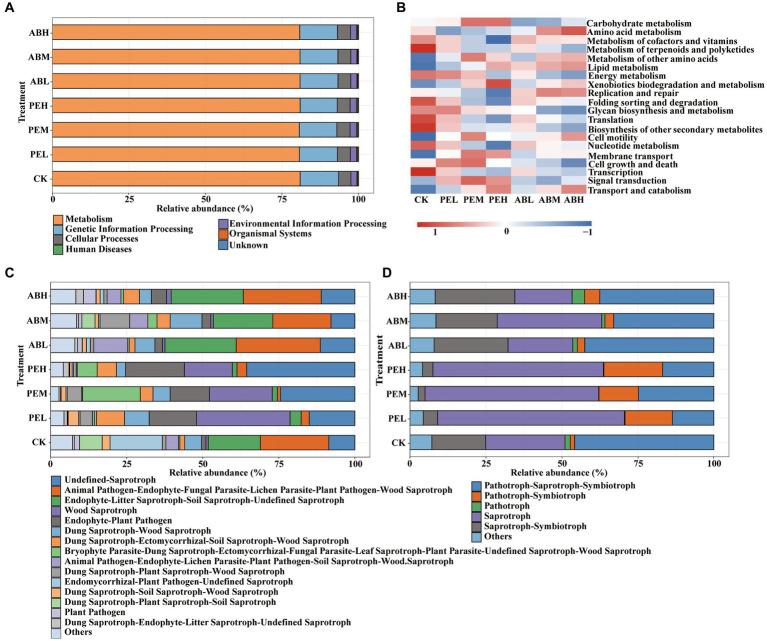
While spent mushroom substrate (SMS) has shown promise in increasing soil organic carbon (SOC) and improving soil quality, research on the interplay between SOC components and microbial community following the application of diverse SMS types remains scant. A laboratory soil incubation experiment was conducted with application of two types of SMSs from cultivation of (PE) and (AB), each at three application rates (3, 5.5, and 8%). Advanced techniques, including solid-state C nuclear magnetic resonance (NMR) and high-throughput sequencing, were employed to investigate on SOC fractions and chemical structure, microbial community composition and functionality. Compared to SMS-AB, SMS-PE application increased the relative abundances of carbohydrate carbon and O-alkyl C in SOC. In addition, SMS-PE application increased the relative abundance of the bacterial phylum Proteobacteria and those of the fungal phyla Basidiomycota and Ascomycota. The relative abundances of cellulose-degrading bacterial (e.g., and ) and fungal genera (e.g., , , and ) were increased as well. The application of SMS-AB increased the aromaticity index of SOC, the relative abundance of aromatic C, and the contents of humic acid and heavy fraction organic carbon. In addition, SMS-AB application significantly increased the relative abundances of the bacterial phyla Firmicutes and Actinobacteria. Notably, the genera , , and , which were positively correlated with humic acid, experienced an increase in relative abundance. Functional prediction revealed that SMS-PE application elevated carbohydrate metabolism and reduced the prevalence of fungal pathogens, particularly . The application of high-rate SMS-AB (8%) enhanced bacterial amino acid metabolism and the relative abundances of plant pathogenic fungi. Our research provides strategies for utilizing SMS to enrich soil organic carbon and fortify soil health, facilitating the achievement of sustainable soil management.
虽然废弃蘑菇基质(SMS)在增加土壤有机碳(SOC)和改善土壤质量方面已显示出前景,但关于不同类型SMS施用后SOC组分与微生物群落之间相互作用的研究仍然很少。进行了一项实验室土壤培养实验,施用了来自平菇(PE)和姬菇(AB)栽培的两种类型的SMS,每种以三种施用量(3%、5.5%和8%)施用。采用了先进技术,包括固态碳核磁共振(NMR)和高通量测序,来研究SOC组分和化学结构、微生物群落组成及功能。与SMS-AB相比,施用SMS-PE增加了SOC中碳水化合物碳和O-烷基碳的相对丰度。此外,施用SMS-PE增加了细菌门变形菌门以及真菌门担子菌门和子囊菌门的相对丰度。纤维素降解细菌(如纤维杆菌属和梭菌属)和真菌属(如曲霉属、青霉属和木霉属)的相对丰度也增加了。施用SMS-AB增加了SOC的芳香性指数、芳香碳的相对丰度以及腐殖酸和重质有机碳的含量。此外,施用SMS-AB显著增加了厚壁菌门和放线菌门细菌的相对丰度。值得注意的是,与腐殖酸呈正相关的芽孢杆菌属、链霉菌属和假单胞菌属的相对丰度有所增加。功能预测表明,施用SMS-PE提高了碳水化合物代谢并降低了真菌病原体的流行率,特别是尖孢镰刀菌。高施用量SMS-AB(8%)的施用增强了细菌氨基酸代谢和植物致病真菌的相对丰度。我们的研究为利用SMS来富集土壤有机碳和增强土壤健康提供了策略,有助于实现可持续的土壤管理。


 Zotero 插件