Manokasemsan Weerawan, Jariyasopit Narumol, Poungsombat Patcha, Kaewnarin Khwanta, Wanichthanarak Kwanjeera, Kurilung Alongkorn, Duangkumpha Kassaporn, Limjiasahapong Suphitcha, Pomyen Yotsawat, Chaiteerakij Roongruedee, Tansawat Rossarin, Srisawat Chatchawan, Sirivatanauksorn Yongyut, Sirivatanauksorn Vorapan, Khoomrung Sakda
Department of Biochemistry, Faculty of Medicine Siriraj Hospital, Mahidol University, Bangkok, Thailand.
Siriraj Center of Research Excellent in Metabolomics and Systems Biology (SiCORE-MSB), Faculty of Medicine Siriraj Hospital, Mahidol University, Bangkok, Thailand.
Comput Struct Biotechnol J. 2024 May 8;23:2163-2172. doi: 10.1016/j.csbj.2024.05.007. eCollection 2024 Dec.
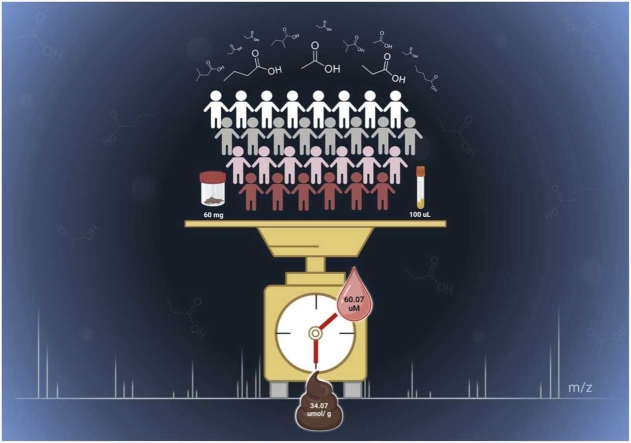
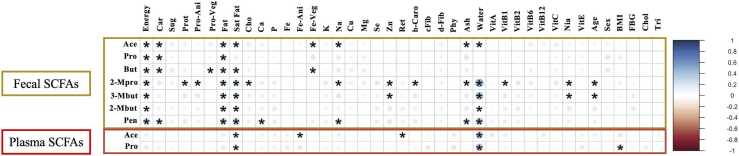
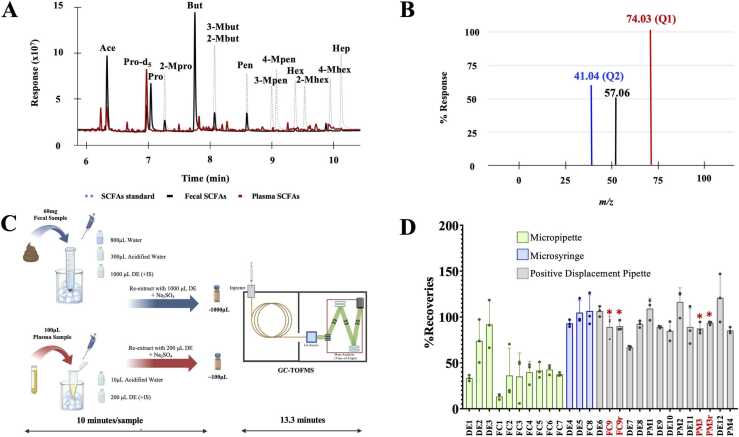
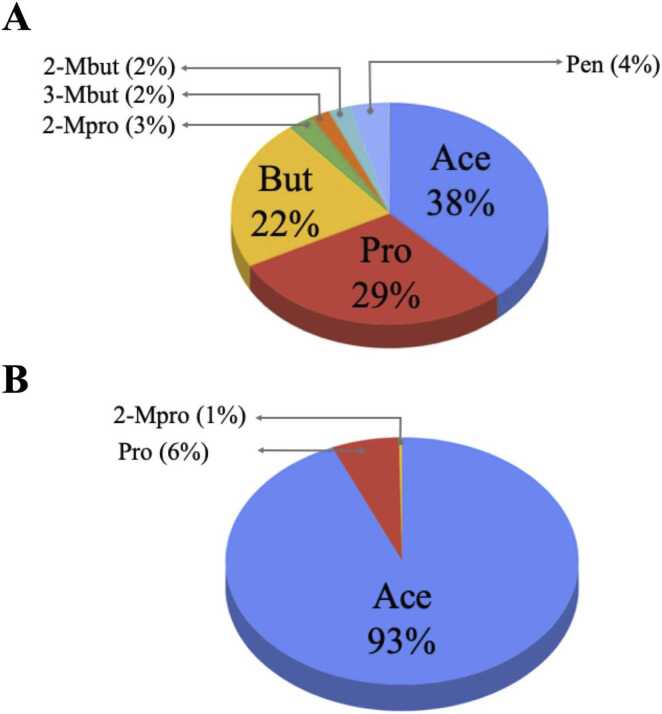
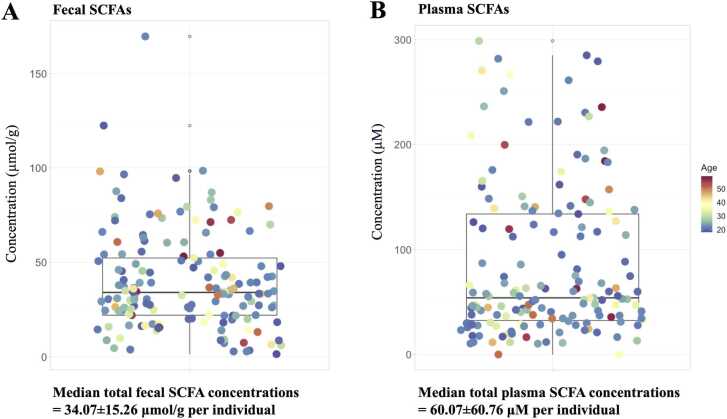
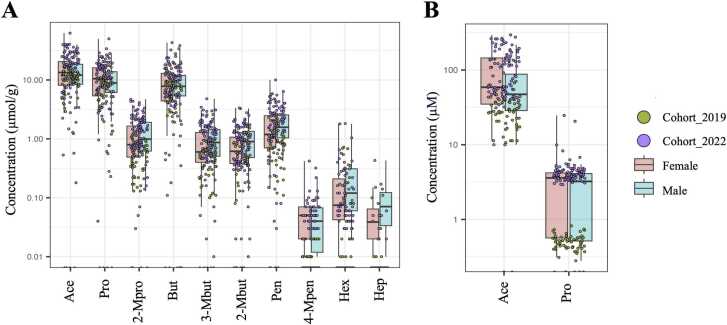
Short-chain fatty acids (SCFAs) are involved in important physiological processes such as gut health and immune response, and changes in SCFA levels can be indicative of disease. Despite the importance of SCFAs in human health and disease, reference values for fecal and plasma SCFA concentrations in healthy individuals are scarce. To address this gap in current knowledge, we developed a simple and reliable derivatization-free GC-TOFMS method for quantifying fecal and plasma SCFAs in healthy individuals. We targeted six linear- and seven branched-SCFAs, obtaining method recoveries of 73-88% and 83-134% in fecal and plasma matrices, respectively. The developed methods are simpler, faster, and more sensitive than previously published methods and are well suited for large-scale studies. Analysis of samples from 157 medically confirmed healthy individuals showed that the total SCFAs in the feces and plasma were 34.1 ± 15.3 µmol/g and 60.0 ± 45.9 µM, respectively. In fecal samples, acetic acid (Ace), propionic acid (Pro), and butanoic acid (But) were all significant, collectively accounting for 89% of the total SCFAs, whereas the only major SCFA in plasma samples was Ace, constituting of 93% of the total plasma SCFAs. There were no statistically significant differences in the total fecal and plasma SCFA concentrations between sexes or among age groups. The data revealed, however, a positive correlation for several nutrients, such as carbohydrate, fat, iron from vegetables, and water, to most of the targeted SCFAs. This is the first large-scale study to report SCFA reference intervals in the plasma and feces of healthy individuals, and thereby delivers valuable data for microbiome, metabolomics, and biomarker research.
短链脂肪酸(SCFAs)参与肠道健康和免疫反应等重要生理过程,SCFA水平的变化可能预示疾病。尽管SCFAs对人类健康和疾病很重要,但健康个体粪便和血浆中SCFA浓度的参考值却很稀少。为填补当前知识空白,我们开发了一种简单可靠的无需衍生化的气相色谱-飞行时间质谱法,用于定量健康个体粪便和血浆中的SCFAs。我们测定了6种直链和7种支链SCFAs,在粪便和血浆基质中的方法回收率分别为73%-88%和83%-134%。所开发的方法比先前发表的方法更简单、更快且更灵敏,非常适合大规模研究。对157名医学确诊的健康个体的样本分析表明,粪便和血浆中的总SCFAs分别为34.1±15.3µmol/g和60.0±45.9µM。在粪便样本中,乙酸(Ace)、丙酸(Pro)和丁酸(But)均占显著比例,合计占总SCFAs的89%,而血浆样本中唯一的主要SCFA是Ace,占血浆总SCFAs的93%。性别或年龄组之间粪便和血浆中总SCFA浓度无统计学显著差异。然而,数据显示几种营养素,如碳水化合物、脂肪、蔬菜中的铁和水,与大多数目标SCFAs呈正相关。这是第一项报告健康个体血浆和粪便中SCFA参考区间的大规模研究,从而为微生物组、代谢组学和生物标志物研究提供了有价值的数据。