Department of Botany and Microbiology, College of Science, King Saud University, P.O. Box 2455, 11451, Riyadh, Saudi Arabia.
Sci Rep. 2024 Jun 3;14(1):12701. doi: 10.1038/s41598-024-63641-4.
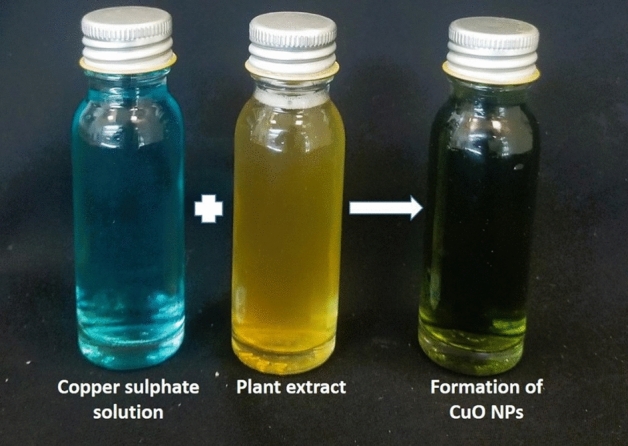
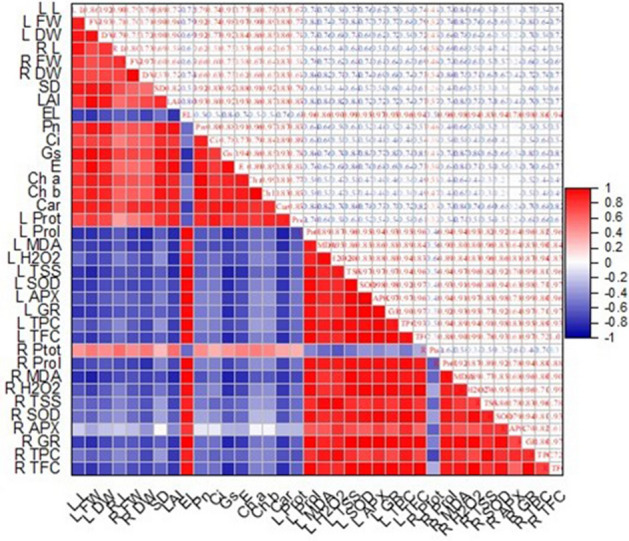
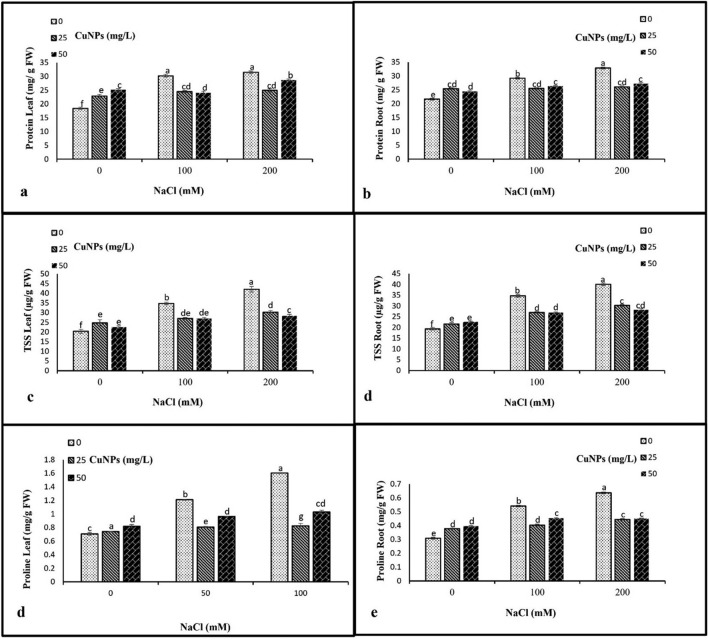
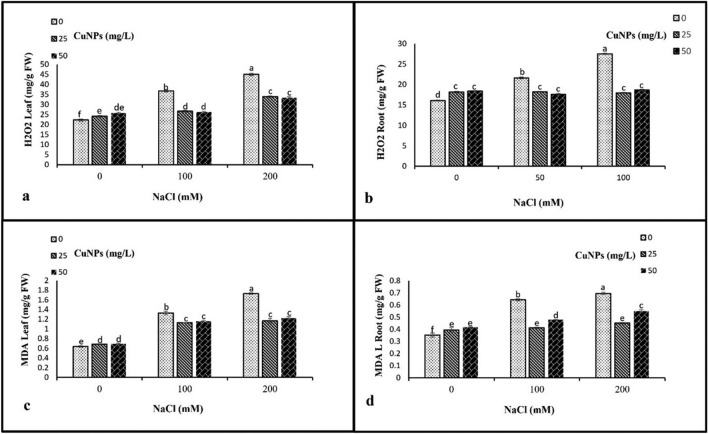
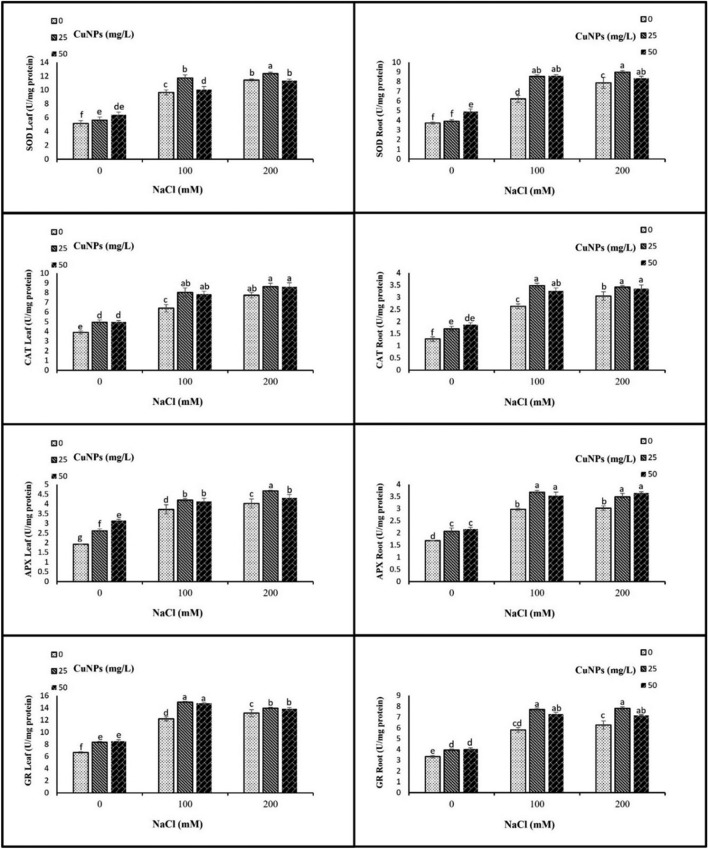
The distinctive characteristics of nanoparticles and their potential applications have been given considerable attention by scientists across different fields, particularly agriculture. However, there has been limited effort to assess the impact of copper nanoparticles (CuNPs) in modulating physiological and biochemical processes in response to salt-induced stress. This study aimed to synthesize CuNPs biologically using Solenostemma argel extract and determine their effects on morphophysiological parameters and antioxidant defense system of barley (Hordeum vulgare) under salt stress. The biosynthesized CuNPs were characterized by (UV-vis spectroscopy with Surface Plasmon Resonance at 320 nm, the crystalline nature of the formed NPs was verified via XRD, the FTIR recorded the presence of the functional groups, while TEM was confirmed the shape (spherical) and the sizes (9 to 18 nm) of biosynthesized CuNPs. Seeds of barley plants were grown in plastic pots and exposed to different levels of salt (0, 100 and 200 mM NaCl). Our findings revealed that the supplementation of CuNPs (0, 25 and 50 mg/L) to salinized barley significantly mitigate the negative impacts of salt stress and enhanced the plant growth-related parameters. High salinity level enhanced the oxidative damage by raising the concentrations of osmolytes (soluble protein, soluble sugar, and proline), malondialdehyde (MDA) and hydrogen peroxide (HO). In addition, increasing the activities of enzymatic antioxidants, total phenol, and flavonoids. Interestingly, exposing CuNPs on salt-stressed plants enhanced the plant-growth characteristics, photosynthetic pigments, and gas exchange parameters. Furthermore, CuNPs counteracted oxidative damage by lowering the accumulation of osmolytes, HO, MDA, total phenol, and flavonoids, while simultaneously enhancing the activities of antioxidant enzymes. In conclusion, the application of biosynthesized CuNPs presents a promising approach and sustainable strategy to enhance plant resistance to salinity stress, surpassing conventional methods in terms of environmental balance.
纳米粒子的独特特征及其潜在应用已引起不同领域科学家的广泛关注,特别是在农业领域。然而,对于铜纳米粒子(CuNPs)在调节生理和生化过程以响应盐诱导胁迫方面的影响,研究还很有限。本研究旨在使用马齿苋提取物生物合成 CuNPs,并确定其对盐胁迫下大麦(Hordeum vulgare)形态生理参数和抗氧化防御系统的影响。通过(UV-vis 光谱法,表面等离子体共振在 320nm 处)、形成 NPs 的晶体性质通过 XRD 验证、FTIR 记录存在的功能基团,而 TEM 则确认了生物合成 CuNPs 的形状(球形)和大小(9 至 18nm)来表征合成的 CuNPs。大麦种子在塑料盆中生长,并暴露于不同水平的盐(0、100 和 200mM NaCl)下。我们的研究结果表明,向盐渍大麦中添加 CuNPs(0、25 和 50mg/L)可显著减轻盐胁迫的负面影响并提高与植物生长相关的参数。高盐度水平通过提高渗透物(可溶性蛋白质、可溶性糖和脯氨酸)、丙二醛(MDA)和过氧化氢(HO)的浓度来增强氧化损伤。此外,提高了酶抗氧化剂、总酚和类黄酮的活性。有趣的是,在盐胁迫下的植物上暴露 CuNPs 可增强植物生长特性、光合色素和气体交换参数。此外,CuNPs 通过降低渗透物、HO、MDA、总酚和类黄酮的积累,同时提高抗氧化酶的活性,来抵消氧化损伤。总之,生物合成 CuNPs 的应用为提高植物对盐胁迫的抗性提供了一种有前途的方法和可持续策略,在环境平衡方面超过了传统方法。