Department of Medicine and Surgery, Università degli Studi di Milano Bicocca, Milan, Italy.
Department of Medicine and Rehabilitation, Policlinico di Monza, Via Modigliani 10, 20900, Monza, Italy.
Acta Diabetol. 2024 Aug;61(8):941-950. doi: 10.1007/s00592-024-02300-6. Epub 2024 Jun 3.
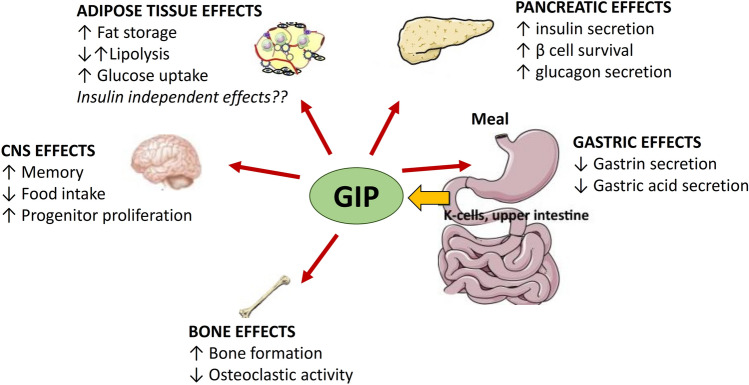
Type 2 diabetes represents a growing challenge for global public health. Its prevalence is increasing worldwide, and, like obesity, it affects progressively younger populations compared to the past, with potentially greater impact on chronic complications. Dual glucagon like peptide 1 (GLP1) and glucose-dependent insulinotropic peptide (GIP) receptor agonists are among the new pharmacological strategies recently developed to address this challenge. Tirzepatide, characterized by its ability to selectively bind and activate receptors for the intestinal hormones GIP and GLP-1, has been tested in numerous clinical studies and is already currently authorized in several countries for the treatment of type 2 diabetes and obesity. In this context, the aim of the present document is to summarize, in the form of a narrative literature review, the currently available data on the main mechanisms of action of GIP/GLP-1 co-agonists and the clinical effects of tirzepatide evaluated in various clinical trials.
2 型糖尿病是全球公共卫生面临的一项日益严峻的挑战。其发病率在全球范围内呈上升趋势,与过去相比,它还影响着越来越年轻的人群,可能对慢性并发症产生更大的影响。双重胰高血糖素样肽 1 (GLP1) 和葡萄糖依赖性胰岛素促分泌肽 (GIP) 受体激动剂是最近开发的用于应对这一挑战的新的药物治疗策略之一。替西帕肽的特点是能够选择性地结合和激活肠道激素 GIP 和 GLP-1 的受体,已在多项临床研究中进行了测试,并已在多个国家获得批准用于治疗 2 型糖尿病和肥胖症。在此背景下,本文件旨在以叙述性文献综述的形式,总结目前关于 GIP/GLP-1 双重激动剂的主要作用机制以及替西帕肽在各种临床试验中评估的临床效果的现有数据。