Department of Nephrology, The Second Xiangya Hospital, Central South University, Changsha, Hunan, China.
Department of Nephrology, The Second Xiangya Hospital, Central South University, Changsha, Hunan, China; Department of Cellular Biology and Anatomy, Medical College of Georgia at Augusta University, Augusta, GA, USA; Charlie Norwood VA Medical Center, Augusta, GA, USA.
Mol Ther. 2023 May 3;31(5):1451-1467. doi: 10.1016/j.ymthe.2023.03.027. Epub 2023 Apr 3.
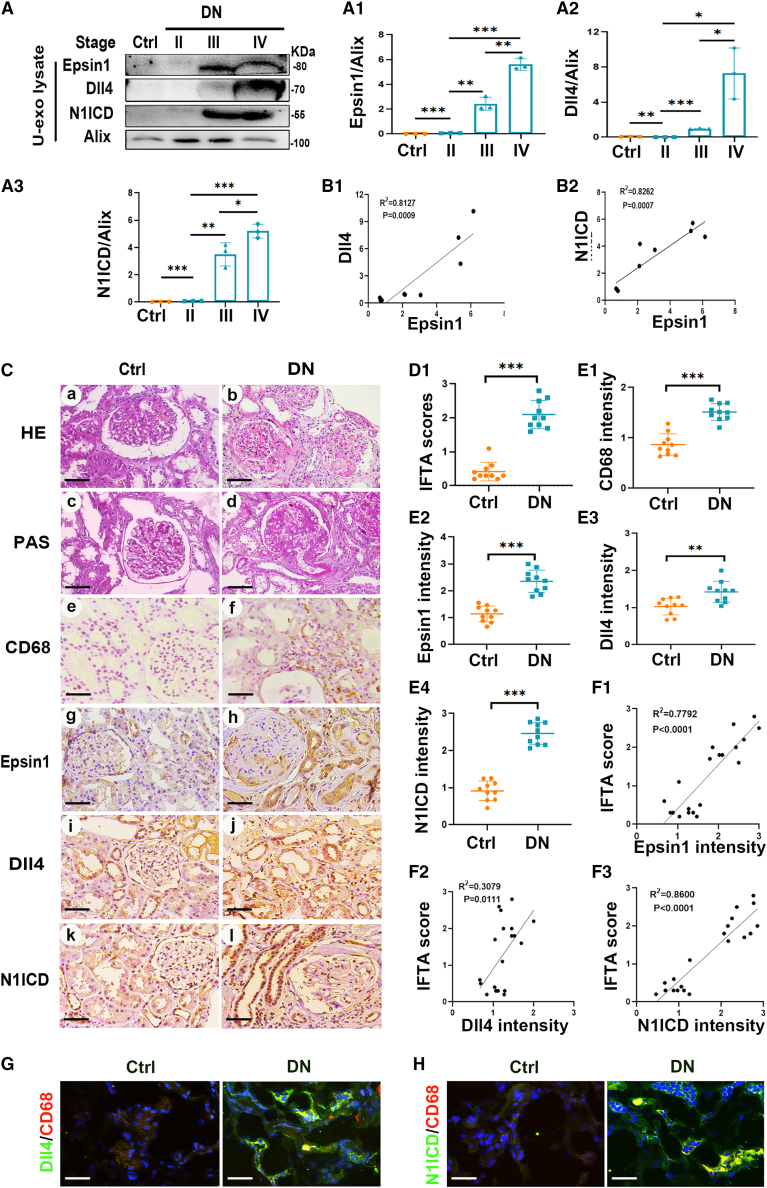
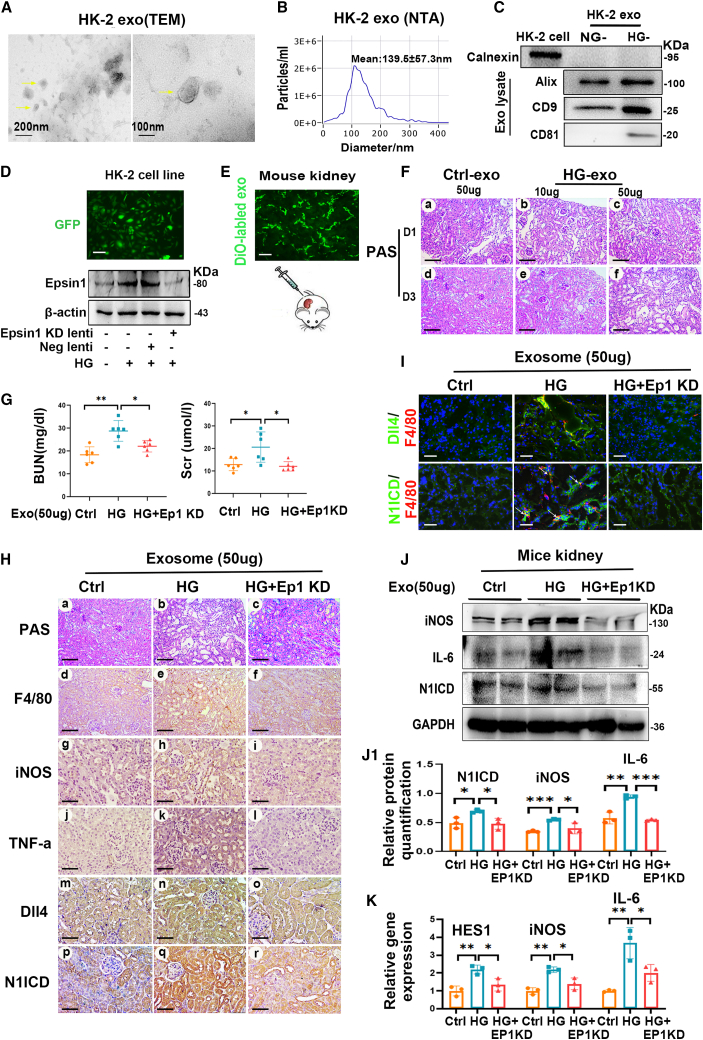
Tubular epithelial cells (TECs) play critical roles in the development of diabetic nephropathy (DN), and can activate macrophages through the secretion of exosomes. However, the mechanism(s) of TEC-exosomes in macrophage activation under DN remains unknown. By mass spectrometry, 1,644 differentially expressed proteins, especially Dll4, were detected in the urine exosomes of DN patients compared with controls, which was confirmed by western blot assay. Elevated Epsin1 and Dll4/N1ICD expression was observed in kidney tissues in both DN patients and db/db mice and was positively associated with tubulointerstitial damage. Exosomes from high glucose (HG)-treated tubular cells (HK-2) with Epsin1 knockdown (KD) ameliorated macrophage activation, TNF-α, and IL-6 expression, and tubulointerstitial damage in C57BL/6 mice in vivo. In an in vitro study, enriched Dll4 was confirmed in HK-2 cells stimulated with HG, which was captured by THP-1 cells and promoted M1 macrophage activation. In addition, Epsin1 modulated the content of Dll4 in TEC-exosomes stimulated with HG. TEC-exosomes with Epsin1-KD significantly inhibited N1ICD activation and iNOS expression in THP-1 cells compared with incubation with HG alone. These findings suggested that Epsin1 could modulate tubular-macrophage crosstalk in DN by mediating exosomal sorting of Dll4 and Notch1 activation.
管状上皮细胞 (TECs) 在糖尿病肾病 (DN) 的发展中起着关键作用,并且可以通过外泌体的分泌激活巨噬细胞。然而,DN 条件下 TEC 外泌体在巨噬细胞激活中的机制尚不清楚。通过质谱分析,与对照组相比,DN 患者的尿液外泌体中检测到 1644 种差异表达蛋白,尤其是 Dll4,Western blot 检测也证实了这一点。在 DN 患者和 db/db 小鼠的肾脏组织中均观察到 Epsin1 和 Dll4/N1ICD 表达升高,并且与肾小管间质损伤呈正相关。用 Epsin1 敲低 (KD) 的高糖 (HG) 处理的管状细胞 (HK-2) 的外泌体处理 C57BL/6 小鼠,可改善巨噬细胞激活、TNF-α 和 IL-6 表达以及肾小管间质损伤。在体外研究中,用 HG 刺激的 HK-2 细胞中证实了富含 Dll4 的外泌体,该外泌体被 THP-1 细胞捕获并促进 M1 巨噬细胞激活。此外,Epsin1 调节了 HG 刺激的 TEC 外泌体中 Dll4 的含量。与单独用 HG 孵育相比,用 Epsin1-KD 的 TEC 外泌体明显抑制了 THP-1 细胞中 N1ICD 的激活和 iNOS 的表达。这些发现表明,Epsin1 可以通过调节 Dll4 和 Notch1 激活的外泌体分拣来调节 DN 中的管状细胞-巨噬细胞串扰。