Gurmassa Bethlhem Kinfu, Gari Sirak Robele, Solomon Ephrem Tefera, Goodson Michaela L, Walsh Claire L, Dessie Bitew K, Alemu Bezatu Mengistie
Water and Health, Ethiopian Institute of Water Resources, Addis Ababa University, Addis Ababa, Ethiopia.
College of Agriculture and Environmental Sciences, School of Natural Resources Management and Environmental Sciences, Haramaya University, Haramaya, Ethiopia.
Trop Med Health. 2024 Jun 6;52(1):41. doi: 10.1186/s41182-024-00604-5.
Untreated or inadequately treated wastewater carrying human feces can host helminth eggs and larvae, contaminating the soil and plants that are irrigated with it. In Addis Ababa, farmers use untreated wastewater to grow vegetables; however, there are little data currently available published on vegetables' contribution to the prevalence of helminth among female farmers along the Akaki River, in Addis Ababa, Ethiopia.
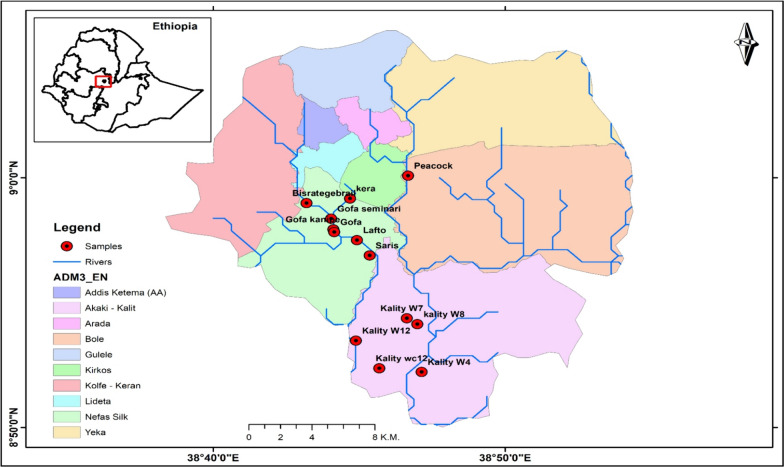
A cross-sectional study was conducted in Addis Ababa City in February 2022. A stratified random sampling method was used to sample farming households. The sample size for each district was determined by a proportional allocation to the total number of households in the area. Two hundred and fifty-two composite vegetable samples and 101 farmers' stool samples were collected and analyzed for helminth prevalence. Data on socio-demographics were collected by trained data collators using a structured questionnaire. Kato-Katz concentration was used to detect STH from a stool sample. Stata version 14.0 was used to process the data. Poisson regression was used to identify the association between STH prevalence in the vegetable and the farm's stool.
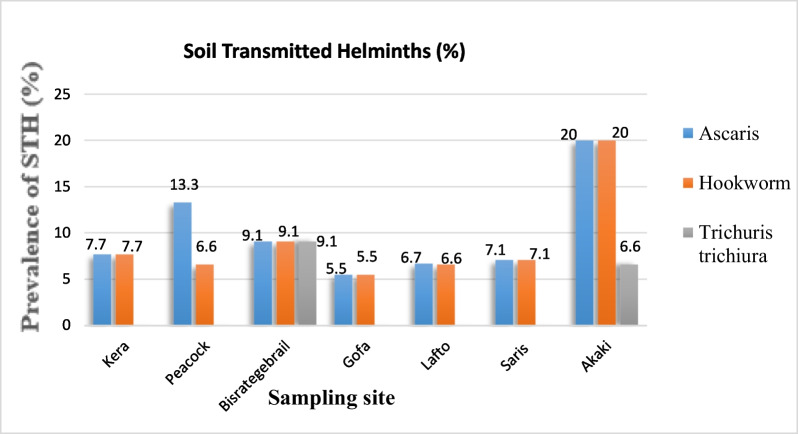
Helminths were found in 67.5% of vegetables sampled and 20.8% of female farmers' stools. Ascaris lumbricoides eggs (vegetable 48.4% and stool 9.9%) were identified in all analyzed samples. Hookworm eggs (vegetable 13.1% and stool 8.9%) and Trichuris trichiura eggs (vegetable 5.9% and stool 2%) were also isolated. The total number of helminth eggs present in wastewater-irrigated vegetables and female farmers' stool had a positive association (p < 0.05) with a regression coefficient of 1.92 (95% CI = 1.56-2.28).
The study found a significant prevalence of helminth infections, particularly Ascaris lumbricoides, in stool and vegetable samples irrigated with wastewater. A clear association was found between vegetable production and a higher prevalence of helminth infections among female farmers. Therefore, it is important to ensure that farmers are educated in the importance of food washing and sanitation/hygiene practices when using wastewater irrigation for vegetable crops.
携带人类粪便的未经处理或处理不当的废水可能含有蠕虫卵和幼虫,污染用于灌溉的土壤和植物。在亚的斯亚贝巴,农民使用未经处理的废水种植蔬菜;然而,目前关于埃塞俄比亚亚的斯亚贝巴阿卡卡河沿岸女性农民中蔬菜对蠕虫流行率影响的数据很少。
2022年2月在亚的斯亚贝巴市进行了一项横断面研究。采用分层随机抽样方法对农户进行抽样。每个区的样本量通过按比例分配到该地区的家庭总数来确定。收集了252份复合蔬菜样本和101份农民粪便样本,并分析蠕虫感染率。社会人口统计学数据由经过培训的数据整理人员使用结构化问卷收集。采用加藤-卡茨浓缩法从粪便样本中检测土源性蠕虫。使用Stata 14.0版本处理数据。采用泊松回归分析蔬菜中蠕虫感染率与农场粪便中蠕虫感染率之间的关联。
在67.5%的抽样蔬菜和20.8%的女性农民粪便中发现了蠕虫。在所有分析样本中均鉴定出蛔虫卵(蔬菜中占48.4%,粪便中占9.9%)。还分离出钩虫卵(蔬菜中占13.1%,粪便中占8.9%)和鞭虫卵(蔬菜中占5.9%,粪便中占2%)。废水灌溉蔬菜和女性农民粪便中存在的蠕虫卵总数呈正相关(p<0.05),回归系数为1.92(95%CI = 1.56 - 2.28)。
该研究发现,在废水灌溉的粪便和蔬菜样本中,蠕虫感染率很高(尤其是蛔虫)。蔬菜生产与女性农民中较高的蠕虫感染率之间存在明显关联。因此,重要的是要确保在农民使用废水灌溉蔬菜作物时,对他们进行食品清洗以及卫生/卫生习惯重要性方面的教育。