Kawamura Takuji, Higuchi Mitsuru, Ito Tomoko, Kawakami Ryoko, Usui Chiyoko, McGreevy Kristen M, Horvath Steve, Zsolt Radak, Torii Suguru, Suzuki Katsuhiko, Ishii Kaori, Sakamoto Shizuo, Oka Koichiro, Muraoka Isao, Tanisawa Kumpei
Waseda Institute for Sport Sciences, Waseda University, Saitama, Japan.
Research Center for Molecular Exercise Science, Hungarian University of Sports Science, Budapest, Hungary.
Front Nutr. 2024 May 24;11:1373806. doi: 10.3389/fnut.2024.1373806. eCollection 2024.
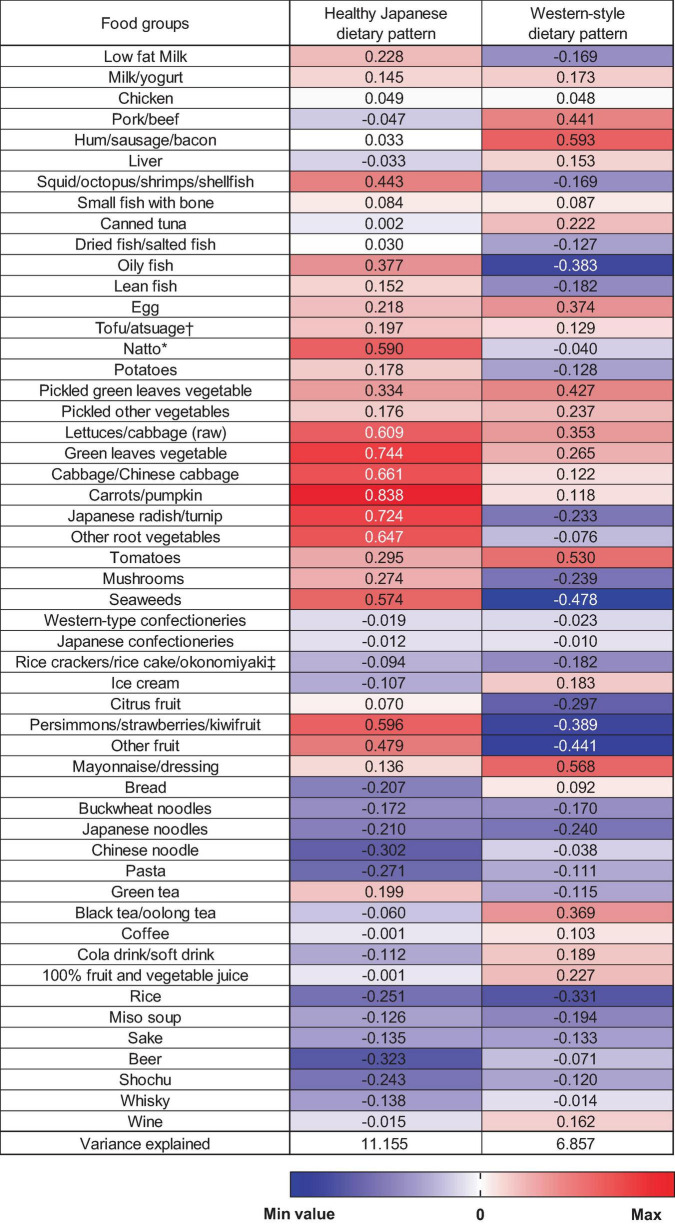
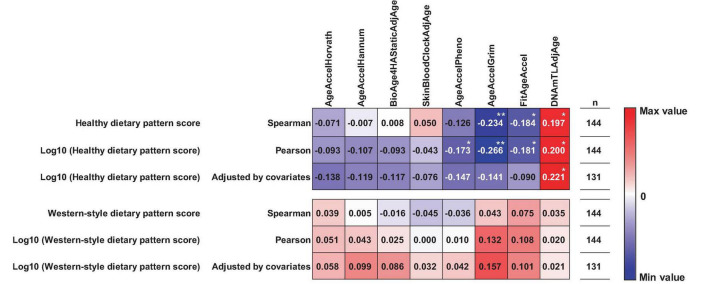
Aging is the greatest risk factor for numerous diseases and mortality, and establishing geroprotective interventions targeting aging is required. Previous studies have suggested that healthy dietary patterns, such as the Mediterranean diet, are associated with delayed biological aging; however, these associations depend on nationality and sex. Therefore, this study aimed to investigate the relationship between dietary patterns identified through principal component analysis and biological aging in older men of Japan, one of the countries with the longest life expectancies. Principal component analysis identified two dietary patterns: a healthy Japanese dietary pattern and a Western-style dietary pattern. Eight epigenetic clocks, some of the most accurate aging biomarkers, were identified using DNA methylation data from whole-blood samples. Correlation analyses revealed that healthy Japanese dietary patterns were significantly negatively or positively correlated with multiple epigenetic age accelerations (AgeAccel), including AgeAccelGrim, FitAgeAccel, and age-adjusted DNAm-based telomere length (DNAmTLAdjAge). Conversely, the Western-style dietary pattern was observed not to correlate significantly with any of the examined AgeAccels or age-adjusted values. After adjusting for covariates, the healthy Japanese dietary pattern remained significantly positively correlated with DNAmTLAdjAge. Regression analysis showed that healthy Japanese dietary pattern contributed less to epigenetic age acceleration than smoking status. These findings suggest that a Western-style dietary pattern may not be associated with biological aging, whereas a healthy Japanese dietary pattern is associated with delayed biological aging in older Japanese men. Our findings provide evidence that healthy dietary patterns may have mild beneficial effects on delayed biological aging in older Japanese men.
衰老是众多疾病和死亡的最大风险因素,因此需要建立针对衰老的老年保护干预措施。先前的研究表明,健康的饮食模式,如地中海饮食,与生物衰老延迟有关;然而,这些关联取决于国籍和性别。因此,本研究旨在调查通过主成分分析确定的饮食模式与日本老年男性生物衰老之间的关系,日本是预期寿命最长的国家之一。主成分分析确定了两种饮食模式:健康的日本饮食模式和西式饮食模式。使用全血样本的DNA甲基化数据确定了八个表观遗传时钟,它们是一些最准确的衰老生物标志物。相关分析表明,健康的日本饮食模式与多种表观遗传年龄加速(AgeAccel)显著负相关或正相关,包括AgeAccelGrim、FitAgeAccel和年龄调整后的基于DNA甲基化的端粒长度(DNAmTLAdjAge)。相反,观察到西式饮食模式与任何检测的AgeAccels或年龄调整值均无显著相关性。在调整协变量后,健康的日本饮食模式与DNAmTLAdjAge仍显著正相关。回归分析表明,健康的日本饮食模式对表观遗传年龄加速的影响小于吸烟状况。这些发现表明,西式饮食模式可能与生物衰老无关;而健康的日本饮食模式与日本老年男性生物衰老延迟有关。我们的研究结果提供了证据,表明健康的饮食模式可能对日本老年男性生物衰老延迟有轻微的有益影响。