Department of Economics, London Business School, London, UK.
Department of Economics, University of Oxford, Oxford, UK.
Nat Aging. 2021 Jul;1(7):616-623. doi: 10.1038/s43587-021-00080-0. Epub 2021 Jul 5.
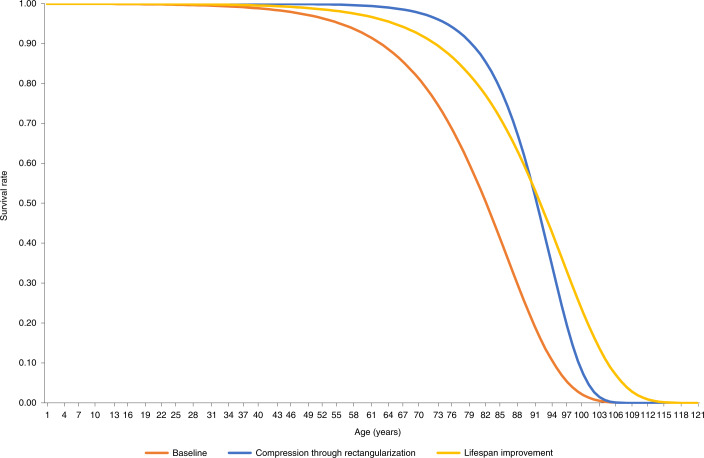
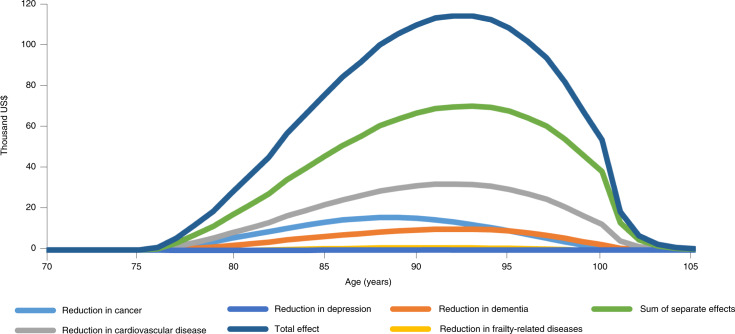
Developments in life expectancy and the growing emphasis on biological and 'healthy' aging raise a number of important questions for health scientists and economists alike. Is it preferable to make lives healthier by compressing morbidity, or longer by extending life? What are the gains from targeting aging itself compared to efforts to eradicate specific diseases? Here we analyze existing data to evaluate the economic value of increases in life expectancy, improvements in health and treatments that target aging. We show that a compression of morbidity that improves health is more valuable than further increases in life expectancy, and that targeting aging offers potentially larger economic gains than eradicating individual diseases. We show that a slowdown in aging that increases life expectancy by 1 year is worth US$38 trillion, and by 10 years, US$367 trillion. Ultimately, the more progress that is made in improving how we age, the greater the value of further improvements.
预期寿命的发展和对生物和“健康”老龄化的日益重视给健康科学家和经济学家都提出了许多重要问题。通过压缩发病来使生命更健康,还是通过延长寿命来使生命更长,哪种方法更可取?与努力消除特定疾病相比,针对衰老本身的收益是什么?在这里,我们分析现有数据来评估增加预期寿命、改善健康和针对衰老的治疗的经济价值。我们表明,改善健康的发病压缩比进一步延长寿命更有价值,并且针对衰老比消除个别疾病具有更大的经济收益。我们表明,减缓衰老使预期寿命增加 1 年的价值为 38 万亿美元,增加 10 年的价值为 3670 万亿美元。最终,在改善我们衰老方式方面取得的进展越多,进一步改善的价值就越大。