Zou Yan, Li Likun, Wang Yanhui, Duan Ruichuan, Dong Hejie, Zhang Yuhan, Du Zhengze, Chen Fajun
Department of Entomology, College of Plant Protection, Nanjing Agricultural University, Nanjing, China.
College of Life Sciences, Nanjing Agricultural University, Nanjing, China.
Front Plant Sci. 2024 May 24;15:1362905. doi: 10.3389/fpls.2024.1362905. eCollection 2024.
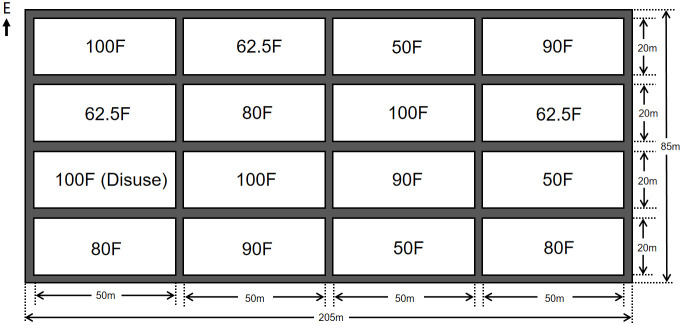
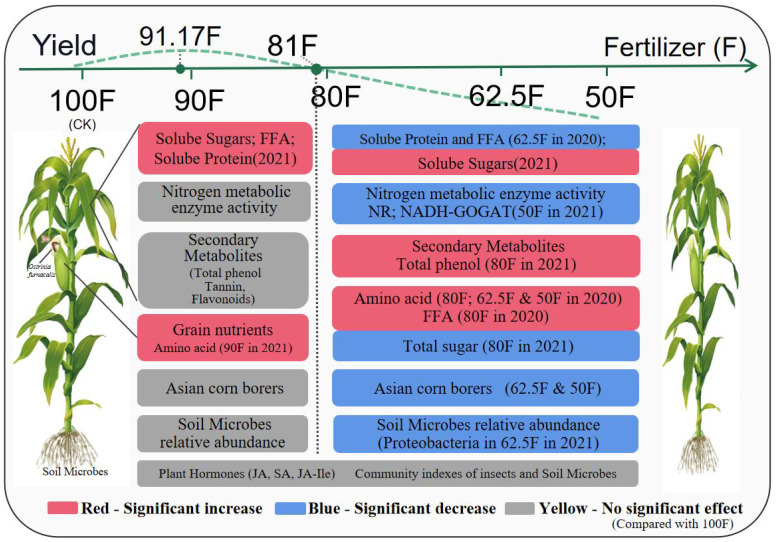
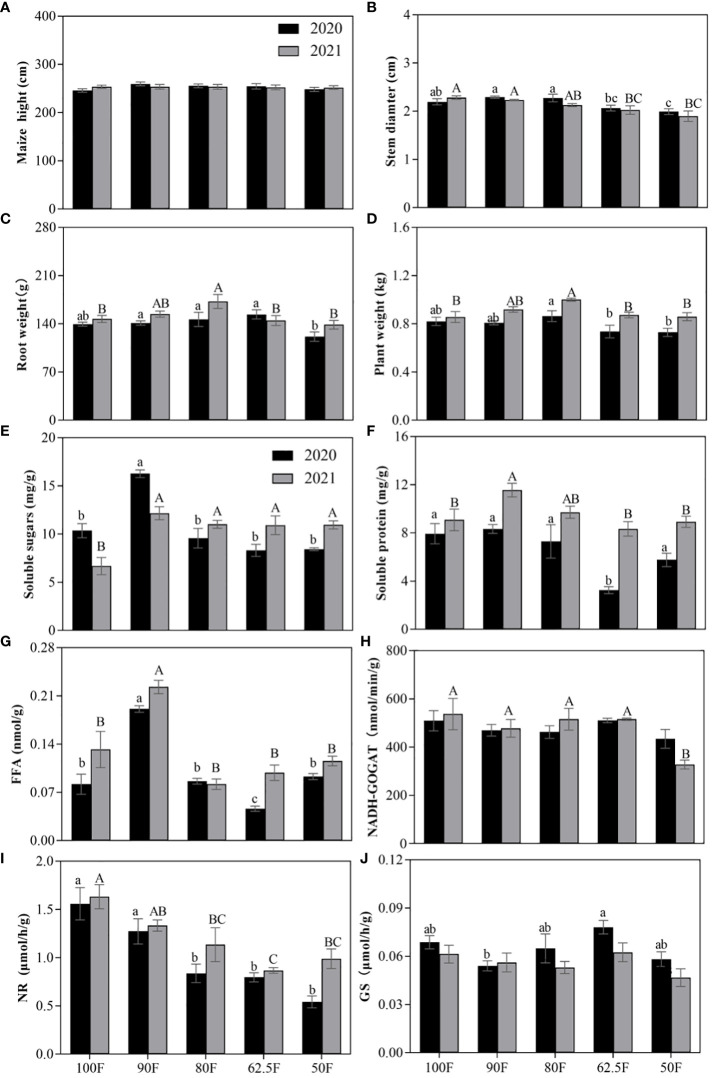
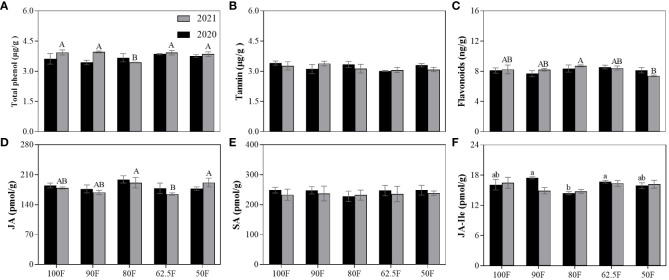
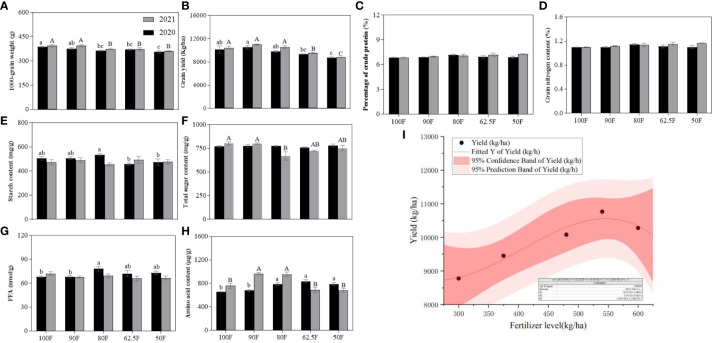
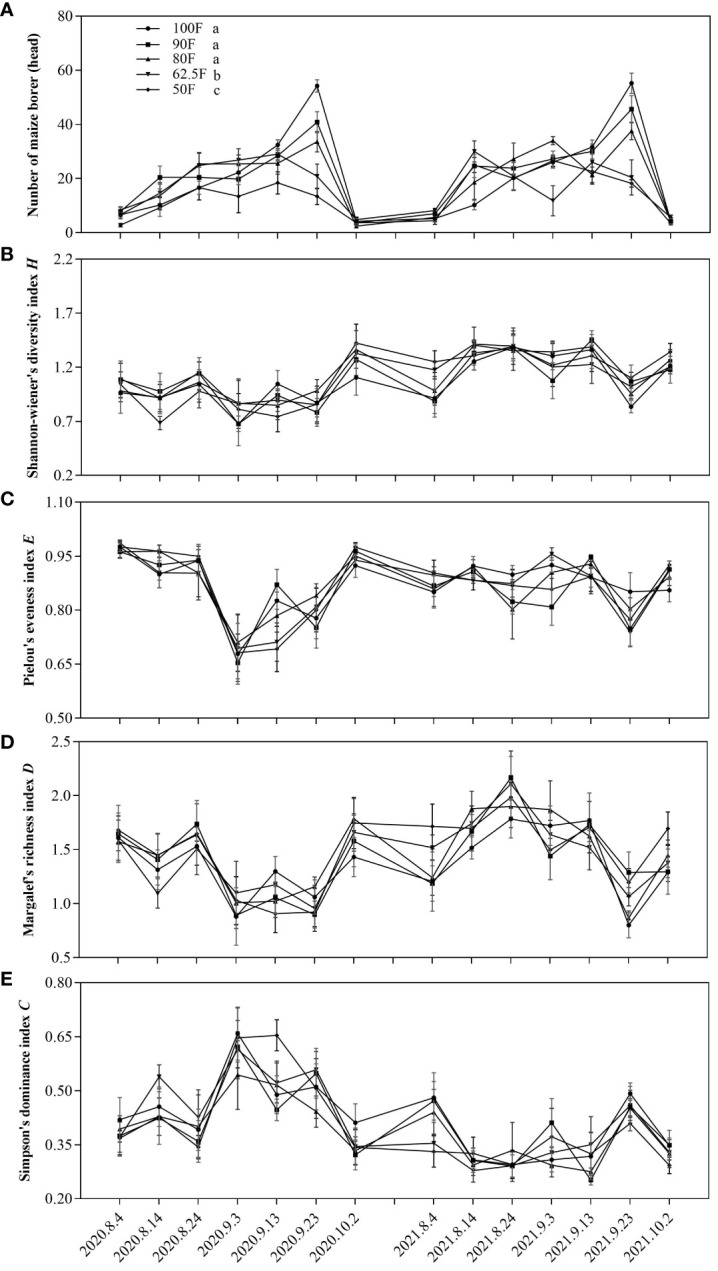
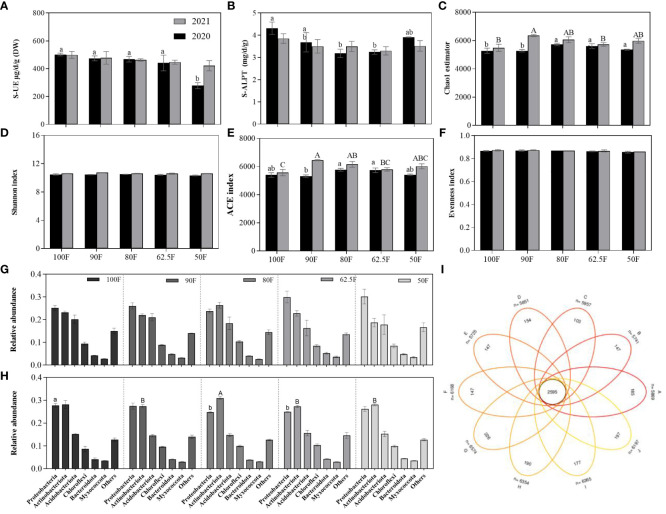
In the North China Plain, farmers are using excessive amounts of fertilizer for the production of high-yield crop yield, which indirectly causes pollution in agricultural production. To investigate an optimal rate of fertilizer application for summer maize, the fertilizer reduction experiments with 600 kg/ha NPK (N: PO: KO = 28: 8: 10) as normal fertilizer application (NFA), (i.e., 100F), were conducted successively during 2020 and 2021 to study the effects of reduced fertilizer rates, including 90% (540 kg/ha; i.e., 90F), 80% (480 kg/ha; i.e., 80F), 62.5% (375 kg/ha; i.e., 62.5F) and 50% (300 kg/ha; i.e., 50F) of NFA, on the plant growth of maize, the dynamics of key population abundances and community diversity of insects, and the composition and diversity of microbial community and finally to find out the N-metabolic enzymes' activity in soil. Our findings revealed that the fertilizer reduction rates by 10% - 20% compared to the current 100% NFA, and it has not significantly affected the plant growth of maize, not only plant growth indexes but also foliar contents of nutrients, secondary metabolites, and N-metabolic enzymes' activity. Further, there was no significant alteration of the key population dynamics of the Asian corn borer () and the community diversity of insects on maize plants. It is interesting to note that the level of N-metabolic enzymes' activity and microbial community diversity in soil were also not affected. While the fertilizer reduction rate by 50% unequivocally reduced field corn yield compared to 100% NFA, significantly decreased the yield by 17.10%. The optimal fertilizer application was calculated as 547 kg/ha (i.e., 91.17% NFA) based on the simulation analysis of maize yields among the five fertilizer application treatments, and the fertilizer application reduced down to 486 kg/ha (i.e., 81.00% NFA) with a significant reduction of maize yield. These results indicated that reduced the fertilizer application by 8.83% - 19.00% is safe and feasible to mitigate pollution and promote sustainable production of maize crops in the region.
在中国华北平原,农民为了实现作物高产而过量施用化肥,这间接导致了农业生产中的污染。为了探究夏玉米的最佳施肥量,于2020年和2021年连续开展了以600千克/公顷氮磷钾(N:P₂O₅:K₂O = 28:8:10)作为常规施肥量(NFA)(即100F)的减施化肥试验,研究减施化肥量(包括NFA的90%(540千克/公顷;即90F)、80%(480千克/公顷;即80F)、62.5%(375千克/公顷;即62.5F)和50%(300千克/公顷;即50F))对玉米植株生长、昆虫关键种群数量动态和群落多样性以及微生物群落组成和多样性的影响,最终探究土壤中氮代谢酶的活性。我们的研究结果表明,相较于当前的100% NFA,减施10% - 20%的化肥,对玉米植株生长没有显著影响,不仅植株生长指标未受影响,而且叶片中的养分、次生代谢产物含量以及氮代谢酶活性也未受影响。此外,亚洲玉米螟(Ostrinia furnacalis)的关键种群动态以及玉米植株上昆虫的群落多样性也没有显著变化。值得注意的是,土壤中氮代谢酶活性水平和微生物群落多样性同样未受影响。然而,与100% NFA相比,减施50%的化肥明确降低了田间玉米产量,显著减产17.10%。基于五种施肥处理间玉米产量的模拟分析,计算得出最佳施肥量为547千克/公顷(即91.17% NFA),施肥量降至486千克/公顷(即81.00% NFA)时玉米产量显著降低。这些结果表明,减少8.83% - 19.00%的化肥施用量对于减轻该地区污染和促进玉米作物可持续生产是安全可行的。