Nguyen Trung Duc, Chen Yuan-I, Nguyen Anh-Thu, Yonas Siem, Sripati Manasa P, Kuo Yu-An, Hong Soonwoo, Litvinov Mitchell, He Yujie, Yeh Hsin-Chih, Grady Rylander H
Department of Biomedical Engineering, University of Texas at Austin, Austin, TX, USA.
Texas Materials Institute, University of Texas at Austin, Austin, TX, USA.
Biomed Opt Express. 2024 Apr 17;15(5):3094-3111. doi: 10.1364/BOE.511806. eCollection 2024 May 1.
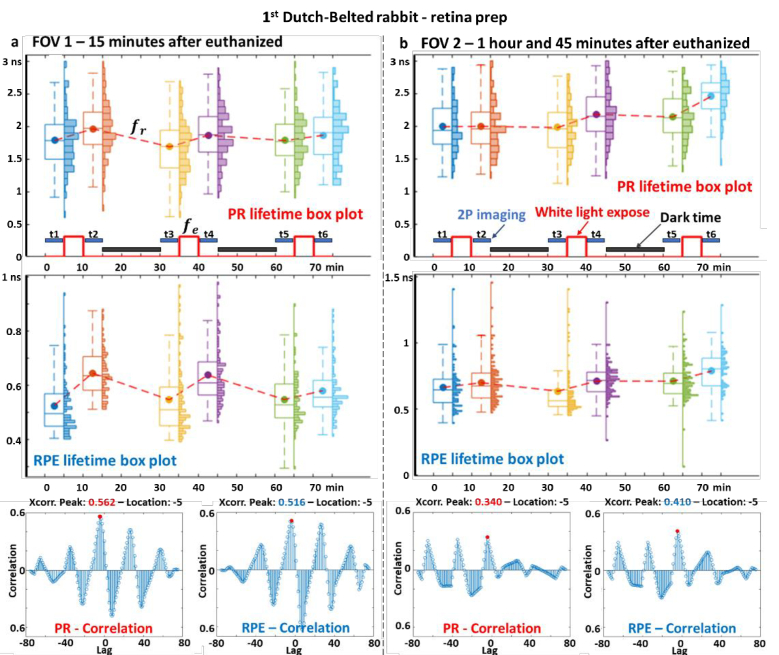
Two-photon excited fluorescence (TPEF) is a powerful technique that enables the examination of intrinsic retinal fluorophores involved in cellular metabolism and the visual cycle. Although previous intensity-based TPEF studies in non-human primates have successfully imaged several classes of retinal cells and elucidated aspects of both rod and cone photoreceptor function, fluorescence lifetime imaging (FLIM) of the retinal cells under light-dark visual cycle has yet to be fully exploited. Here we demonstrate a FLIM assay of photoreceptors and retinal pigment epithelium (RPE) that reveals key insights into retinal physiology and adaptation. We found that photoreceptor fluorescence lifetimes increase and decrease in sync with light and dark exposure, respectively. This is likely due to changes in all-trans-retinol and all-trans-retinal levels in the outer segments, mediated by phototransduction and visual cycle activity. During light exposure, RPE fluorescence lifetime was observed to increase steadily over time, as a result of all-trans-retinol accumulation during the visual cycle and decreasing metabolism caused by the lack of normal perfusion of the sample. Our system can measure the fluorescence lifetime of intrinsic retinal fluorophores on a cellular scale, revealing differences in lifetime between retinal cell classes under different conditions of light and dark exposure.
双光子激发荧光(TPEF)是一种强大的技术,可用于检测参与细胞代谢和视觉循环的视网膜内源性荧光团。尽管先前在非人类灵长类动物中基于强度的TPEF研究已成功对几类视网膜细胞进行成像,并阐明了视杆和视锥光感受器功能的各个方面,但在明暗视觉循环下对视网膜细胞的荧光寿命成像(FLIM)尚未得到充分利用。在此,我们展示了一种对光感受器和视网膜色素上皮(RPE)的FLIM检测方法,该方法揭示了对视网膜生理学和适应性的关键见解。我们发现,光感受器的荧光寿命分别随着光照和黑暗暴露而增加和减少。这可能是由于外段中全反式视黄醇和全反式视黄醛水平的变化,由光转导和视觉循环活动介导。在光照期间,观察到RPE荧光寿命随时间稳步增加,这是由于视觉循环期间全反式视黄醇的积累以及样品缺乏正常灌注导致代谢减少所致。我们的系统可以在细胞水平上测量视网膜内源性荧光团的荧光寿命,揭示在不同明暗暴露条件下视网膜细胞类别之间的寿命差异。