Institute for Quantitative Health Science and Engineering, Michigan State University, East Lansing, Michigan 48824, United States.
Department of Biomedical Engineering, Michigan State University, East Lansing, Michigan 48824, United States.
ACS Appl Mater Interfaces. 2024 Jun 19;16(24):30860-30873. doi: 10.1021/acsami.4c04920. Epub 2024 Jun 11.
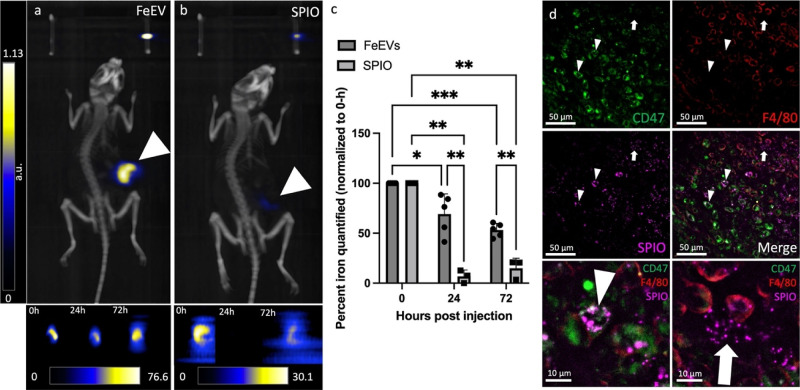
The incidence of breast cancer remains high worldwide and is associated with a significant risk of metastasis to the brain that can be fatal; this is due, in part, to the inability of therapeutics to cross the blood-brain barrier (BBB). Extracellular vesicles (EVs) have been found to cross the BBB and further have been used to deliver drugs to tumors. EVs from different cell types appear to have different patterns of accumulation and retention as well as the efficiency of bioactive cargo delivery to recipient cells in the body. Engineering EVs as delivery tools to treat brain metastases, therefore, will require an understanding of the timing of EV accumulation and their localization relative to metastatic sites. Magnetic particle imaging (MPI) is a sensitive and quantitative imaging method that directly detects superparamagnetic iron. Here, we demonstrate MPI as a novel tool to characterize EV biodistribution in metastatic disease after labeling EVs with superparamagnetic iron oxide (SPIO) nanoparticles. Iron-labeled EVs (FeEVs) were collected from iron-labeled parental primary 4T1 tumor cells and brain-seeking 4T1BR5 cells, followed by injection into the mice with orthotopic tumors or brain metastases. MPI quantification revealed that FeEVs were retained for longer in orthotopic mammary carcinomas compared to SPIOs. MPI signal due to iron could only be detected in brains of mice bearing brain metastases after injection of FeEVs, but not SPIOs, or FeEVs when mice did not have brain metastases. These findings indicate the potential use of EVs as a therapeutic delivery tool in primary and metastatic tumors.
乳腺癌的发病率在全球仍然很高,并且与转移到大脑的风险显著相关,这可能是致命的;部分原因是治疗方法无法穿过血脑屏障 (BBB)。已经发现细胞外囊泡 (EV) 能够穿过血脑屏障,并且进一步被用于将药物递送到肿瘤部位。不同细胞类型的 EV 似乎具有不同的积累和保留模式,以及向体内受体细胞传递生物活性货物的效率。因此,将 EV 工程化为治疗脑转移的递药工具,需要了解 EV 积累的时间及其相对于转移部位的定位。磁粒子成像 (MPI) 是一种敏感且定量的成像方法,可直接检测超顺磁氧化铁。在这里,我们通过用超顺磁氧化铁 (SPIO) 纳米颗粒标记 EV,展示了 MPI 作为一种新型工具来表征转移性疾病中 EV 的生物分布。从铁标记的亲本 4T1 肿瘤细胞和脑靶向 4T1BR5 细胞中收集铁标记的 EV (FeEV),然后将其注射到具有原位肿瘤或脑转移的小鼠中。MPI 定量分析显示,与 SPIO 相比,FeEV 在原位乳腺癌中保留时间更长。仅在注射 FeEV 后,在患有脑转移的小鼠的大脑中可以检测到由于铁引起的 MPI 信号,但在没有脑转移的小鼠中,无论是注射 SPIO 还是 FeEV,都无法检测到。这些发现表明 EV 作为原发性和转移性肿瘤治疗性递药工具的潜在用途。