School of Life Sciences, Arizona State University, Tempe, Arizona 85287-4501, USA.
Department of Biology, Juniata College, Huntingdon, Pennsylvania 16652, USA.
Learn Mem. 2024 Jun 11;31(5). doi: 10.1101/lm.053915.124. Print 2024 May.
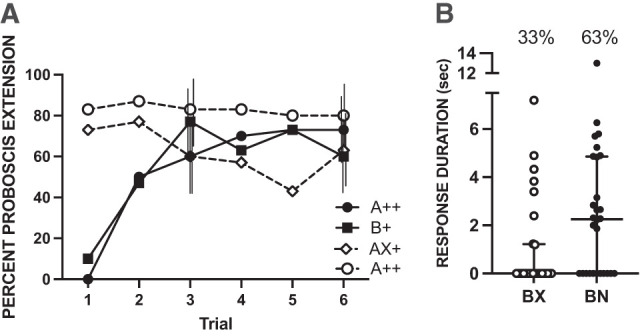
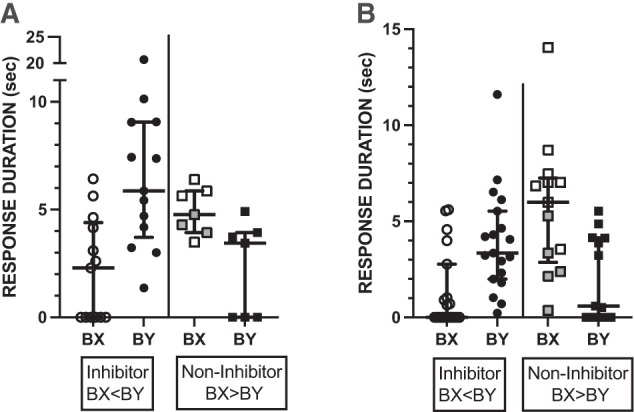
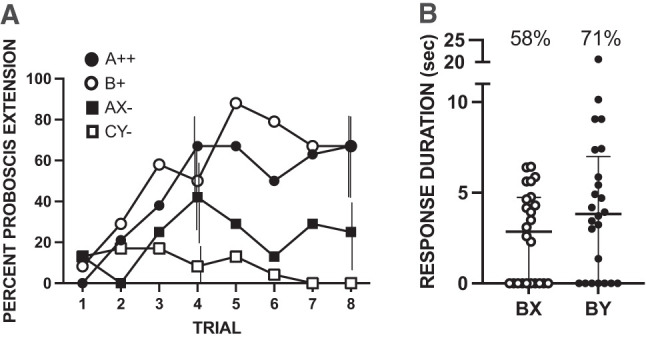
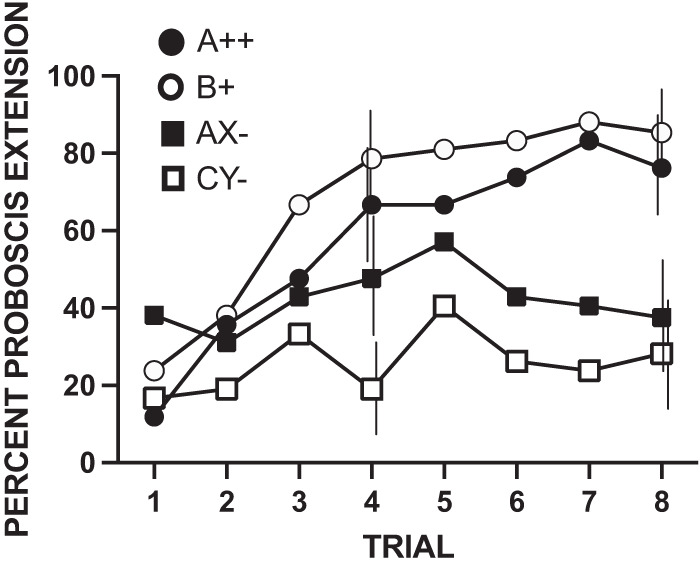
When animals learn the association of a conditioned stimulus (CS) with an unconditioned stimulus (US), later presentation of the CS invokes a representation of the US. When the expected US fails to occur, theoretical accounts predict that conditioned inhibition can accrue to any other stimuli that are associated with this change in the US. Empirical work with mammals has confirmed the existence of conditioned inhibition. But the way it is manifested, the conditions that produce it, and determining whether it is the opposite of excitatory conditioning are important considerations. Invertebrates can make valuable contributions to this literature because of the well-established conditioning protocols and access to the central nervous system (CNS) for studying neural underpinnings of behavior. Nevertheless, although conditioned inhibition has been reported, it has yet to be thoroughly investigated in invertebrates. Here, we evaluate the role of the US in producing conditioned inhibition by using proboscis extension response conditioning of the honeybee (). Specifically, using variations of a "feature-negative" experimental design, we use downshifts in US intensity relative to US intensity used during initial excitatory conditioning to show that an odorant in an odor-odor mixture can become a conditioned inhibitor. We argue that some alternative interpretations to conditioned inhibition are unlikely. However, we show variation across individuals in how strongly they show conditioned inhibition, with some individuals possibly revealing a different means of learning about changes in reinforcement. We discuss how the resolution of these differences is needed to fully understand whether and how conditioned inhibition is manifested in the honeybee, and whether it can be extended to investigate how it is encoded in the CNS. It is also important for extension to other insect models. In particular, work like this will be important as more is revealed of the complexity of the insect brain from connectome projects.
当动物学会将条件刺激 (CS) 与非条件刺激 (US) 联系起来时,随后呈现 CS 会引发对 US 的表示。当预期的 US 未发生时,理论解释预测,任何与 US 变化相关的其他刺激都会产生条件抑制。哺乳动物的实证工作证实了条件抑制的存在。但是,它的表现方式、产生它的条件以及确定它是否与兴奋性条件反射相反,都是重要的考虑因素。无脊椎动物可以为这一文献做出有价值的贡献,因为它们具有成熟的条件反射方案,并可以进入中枢神经系统 (CNS) 研究行为的神经基础。尽管已经报道了条件抑制,但在无脊椎动物中尚未对其进行彻底研究。在这里,我们通过使用蜜蜂的触角延伸反应()来评估 US 在产生条件抑制中的作用。具体来说,我们使用“特征负”实验设计的变体,使用相对于初始兴奋性条件反射期间使用的 US 强度的 US 强度下降来显示气味混合物中的一种气味可以成为条件抑制剂。我们认为,条件抑制的一些替代解释不太可能。然而,我们表明,个体之间在表现出条件抑制的强度上存在差异,有些个体可能会以不同的方式了解强化的变化。我们讨论了如何解决这些差异,以充分了解条件抑制在蜜蜂中是否以及如何表现出来,以及它是否可以扩展到研究它在 CNS 中是如何编码的。这对于扩展到其他昆虫模型也很重要。特别是,随着昆虫大脑连接组项目揭示出昆虫大脑的复杂性,此类工作将变得非常重要。