
结合转录组和代谢组分析理解高粱对麦长管蚜的响应。
Combining transcriptome and metabolome analysis to understand the response of sorghum to Melanaphis sacchari.
机构信息
College of Agronomy, Hebei Agricultural University, Baoding, 071000, China.
North China Key Laboratory for Crop Germplasm Resources of Education Ministry, Baoding, 071000, China.
出版信息
BMC Plant Biol. 2024 Jun 11;24(1):529. doi: 10.1186/s12870-024-05229-8.
BACKGROUND
The sorghum aphid Melanaphis sacchari (Zehntner) (Homoptera: Aphididae) is an important insect in the late growth phase of sorghum (Sorghum bicolor L.). However, the mechanisms of sorghum response to aphid infestation are unclear.
RESULTS
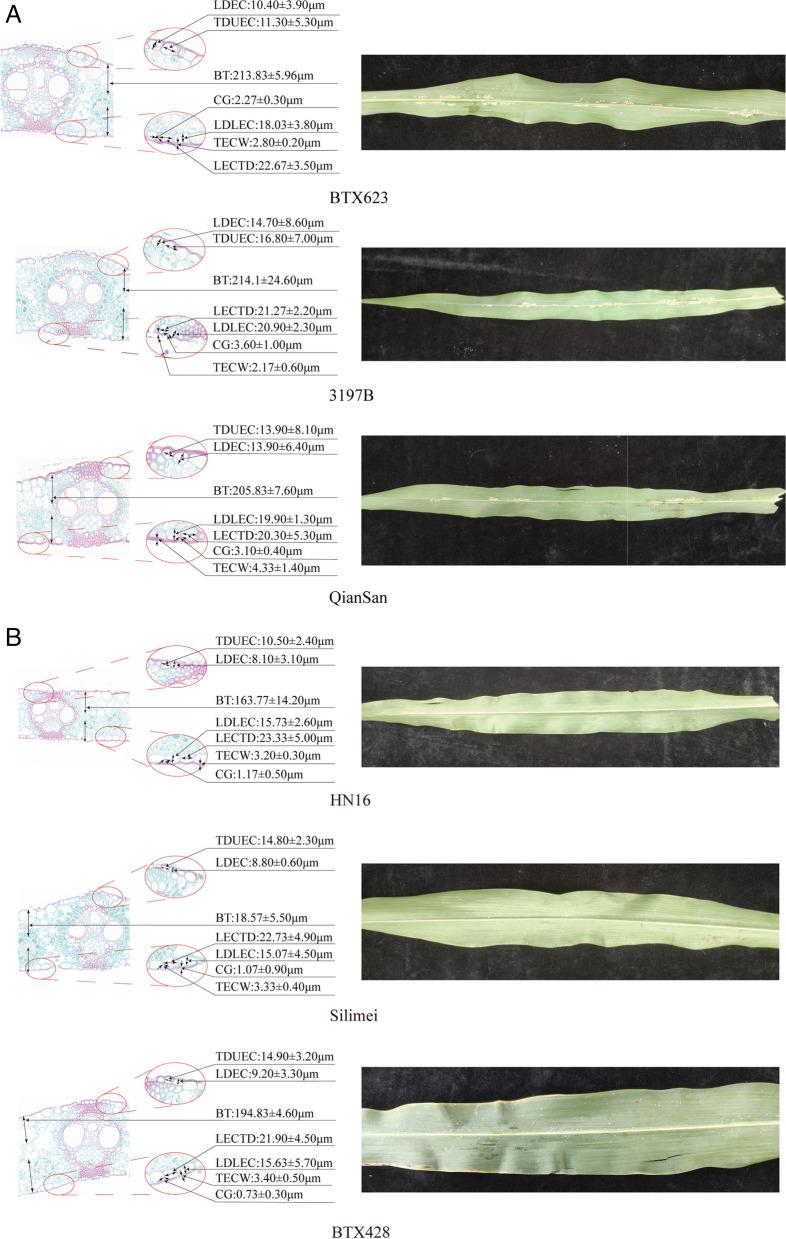
In this paper, the mechanisms of aphid resistance in different types of sorghum varieties were revealed by studying the epidermal cell structure and performing a transcriptome and metabolome association analysis of aphid-resistant and aphid-susceptible varieties. The epidermal cell results showed that the resistance of sorghum to aphids was positively correlated with epidermal cell regularity and negatively correlated with the intercellular space and leaf thickness. Transcriptome and metabolomic analyses showed that differentially expressed genes in the resistant variety HN16 and susceptible variety BTX623 were mainly enriched in the flavonoid biosynthesis pathway and differentially expressed metabolites were mainly related to isoflavonoid biosynthesis and flavonoid biosynthesis. The q-PCR results of key genes were consistent with the transcriptome expression results. Meanwhile, the metabolome test results showed that after aphidinfestation, naringenin and genistein were significantly upregulated in the aphid-resistant variety HN16 and aphid-susceptible variety BTX623 while luteolin was only significantly upregulated in BTX623. These results show that naringenin, genistein, and luteolin play important roles in plant resistance to aphid infestation. The results of exogenous spraying tests showed that a 1‰ concentration of naringenin and genistein is optimal for improving sorghum resistance to aphid feeding.
CONCLUSIONS
In summary, the physical properties of the sorghum leaf structure related to aphid resistance were studied to provide a reference for the breeding of aphid-resistant varieties. The flavonoid biosynthesis pathway plays an important role in the response of sorghum aphids and represents an important basis for the biological control of these pests. The results of the spraying experiment provide insights for developing anti-aphid substances in the future.
背景
高粱蚜虫(Melanaphis sacchari(Zehntner))(同翅目:蚜科)是高粱生长后期的重要昆虫。然而,高粱对蚜虫侵害的反应机制尚不清楚。
结果
本文通过研究不同类型高粱品种的表皮细胞结构,并对抗蚜和感蚜品种进行转录组和代谢组关联分析,揭示了高粱抗蚜的机制。表皮细胞结果表明,高粱对蚜虫的抗性与表皮细胞的规则性呈正相关,与细胞间隙和叶片厚度呈负相关。转录组和代谢组分析表明,抗性品种 HN16 和感病品种 BTX623 中的差异表达基因主要富集在类黄酮生物合成途径中,差异表达代谢物主要与异黄酮生物合成和类黄酮生物合成有关。关键基因的 q-PCR 结果与转录组表达结果一致。同时,代谢组测试结果表明,在蚜虫侵害后,HN16 和 BTX623 中的柚皮素和染料木黄酮明显上调,而 BTX623 中仅芦丁明显上调。这些结果表明,柚皮素、染料木黄酮和芦丁在植物抵抗蚜虫侵害中发挥重要作用。外源喷施试验结果表明,1‰浓度的柚皮素和染料木黄酮最有利于提高高粱对蚜虫取食的抗性。
结论
综上所述,研究了与高粱抗蚜性相关的叶片结构的物理性质,为抗蚜品种的选育提供了参考。类黄酮生物合成途径在高粱蚜虫的反应中起重要作用,代表了这些害虫生物防治的重要基础。喷施试验结果为今后开发抗蚜物质提供了思路。


 Zotero 插件