Gao Yushuo, Regad Farid, Li Zhengguo, Pirrello Julien, Bouzayen Mondher, Van Der Rest Benoît
Laboratoire de Recherche en Sciences Veígeítales - Génomique et Biotechnologie des Fruits, Universiteí de Toulouse, Centre national de la recherche scientifique (CNRS), Université Toulouse III - Paul Sabatier (UPS), Toulouse-Institut National Polytechnique (INP), Toulouse, France.
Key Laboratory of Plant Hormones and Development Regulation of Chongqing, School of Life Sciences, Chongqing University, Chongqing, China.
Front Plant Sci. 2024 May 28;15:1411341. doi: 10.3389/fpls.2024.1411341. eCollection 2024.
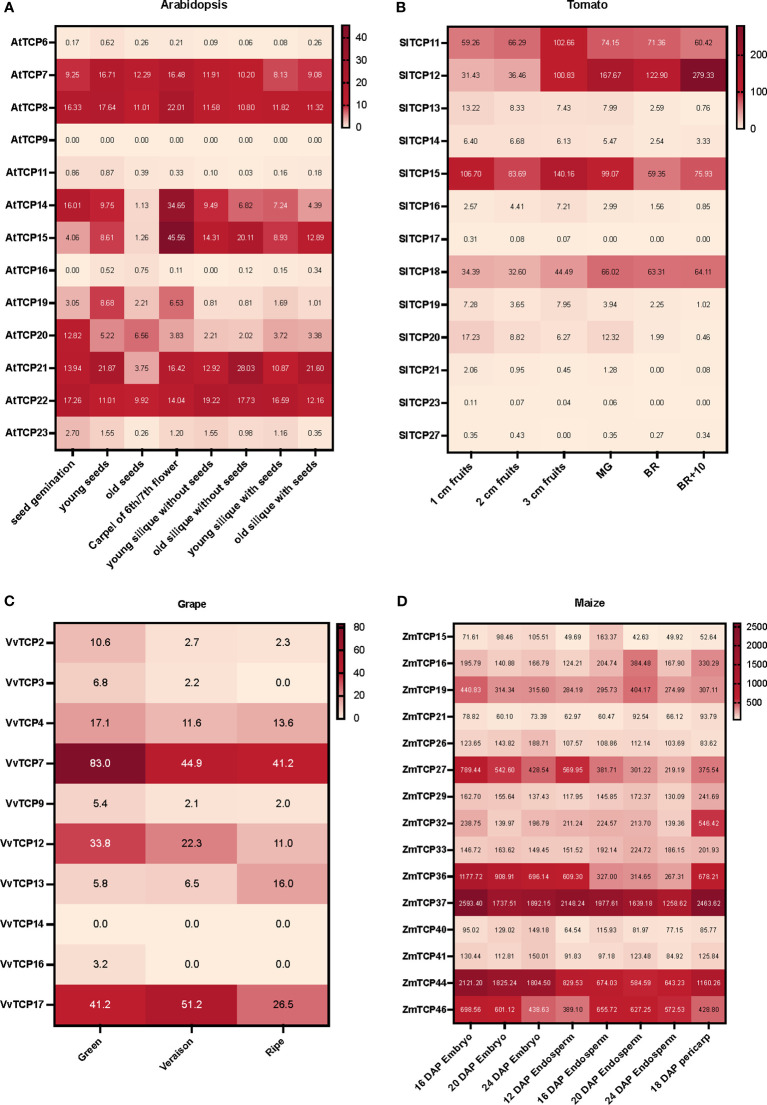
Fruit development can be viewed as the succession of three main steps consisting of the fruit initiation, growth and ripening. These processes are orchestrated by different factors, notably the successful fertilization of flowers, the environmental conditions and the hormones whose action is coordinated by a large variety of transcription factors. Among the different transcription factor families, TEOSINTE BRANCHED 1, CYCLOIDEA, PROLIFERATING CELL FACTOR (TCP) family has received little attention in the frame of fruit biology despite its large effects on several developmental processes and its action as modulator of different hormonal pathways. In this respect, the comprehension of TCP functions in fruit development remains an incomplete puzzle that needs to be assembled. Building on the abundance of genomic and transcriptomic data, this review aims at collecting available expression data to allow their integration in the light of the different functional genetic studies reported so far. This reveals that several Class I genes, already known for their involvement in the cell proliferation and growth, display significant expression levels in developing fruit, although clear evidence supporting their functional significance in this process remains scarce. The extensive expression data compiled in our study provide convincing elements that shed light on the specific involvement of Class I genes in fruit ripening, once these reproductive organs acquire their mature size. They also emphasize their putative role in the control of specific biological processes such as fruit metabolism and hormonal dialogue.
果实发育可视为由果实起始、生长和成熟这三个主要阶段组成的连续过程。这些过程由不同因素精心调控,特别是花朵的成功受精、环境条件以及激素,其作用由多种转录因子协调。在不同的转录因子家族中,尽管TEOSINTE BRANCHED 1、CYCLOIDEA、增殖细胞因子(TCP)家族对多个发育过程有重大影响且作为不同激素途径的调节因子发挥作用,但在果实生物学领域却很少受到关注。在这方面,对TCP在果实发育中的功能理解仍然是一个有待拼凑完整的谜题。基于丰富的基因组和转录组数据,本综述旨在收集现有的表达数据,以便根据目前已报道的不同功能基因研究进行整合。这表明,一些已知参与细胞增殖和生长的I类基因在发育中的果实中呈现出显著的表达水平,尽管支持其在此过程中功能重要性的明确证据仍然稀少。我们研究中汇编的大量表达数据提供了令人信服的证据,揭示了I类基因在这些生殖器官达到成熟大小时对果实成熟的具体参与情况。这些数据还强调了它们在控制果实代谢和激素对话等特定生物学过程中的假定作用。