Kingsbury Célia, Buzzi Marie, Chaix Basile, Kanning Martina, Khezri Sadun, Kiani Behzad, Kirchner Thomas R, Maurel Allison, Thierry Benoît, Kestens Yan
École de santé publique, Université de Montréal (ESPUM), 7101 Av. du Parc, Montréal, H3N 1X9, Québec, Canada.
Centre de recherche de santé publique (CReSP), 7101, Av. du Parc, Montréal, H3N 1X9, Québec, Canada.
Arch Public Health. 2024 Jun 13;82(1):84. doi: 10.1186/s13690-024-01310-8.
While a growing body of research has been demonstrating how exposure to social and built environments relate to various health outcomes, specific pathways generally remain poorly understood. But recent technological advancements have enabled new study designs through continuous monitoring using mobile sensors and repeated questionnaires. Such geographically explicit momentary assessments (GEMA) make it possible to link momentary subjective states, behaviors, and physiological parameters to momentary environmental conditions, and can help uncover the pathways linking place to health. Despite its potential, there is currently no review of GEMA studies detailing how location data is used to measure environmental exposure, and how this in turn is linked to momentary outcomes of interest. Moreover, a lack of standard reporting of such studies hampers comparability and reproducibility.
The objectives of this research were twofold: 1) conduct a systematic review of GEMA studies that link momentary measurement with environmental data obtained from geolocation data, and 2) develop a STROBE extension guideline for GEMA studies.
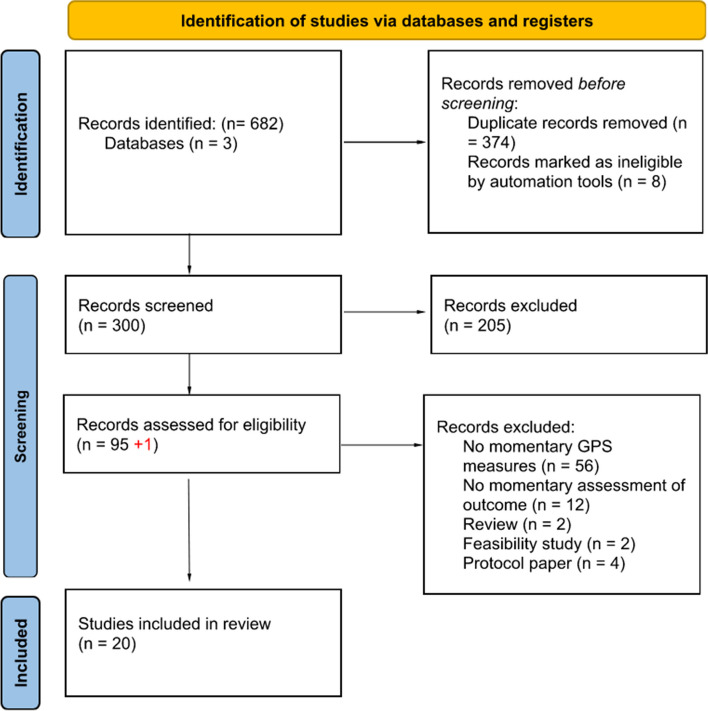
The review followed the Preferred Reporting Items for Systematic Reviews and Meta-Analyses (PRISMA) guidelines. Inclusion criteria consisted of a combination of repeated momentary measurements of a health state or behavior with GPS coordinate collection, and use of these location data to derive momentary environmental exposures. To develop the guideline, the variables extracted for the systematic review were compared to elements of the STROBE (Strengthening the Reporting of Observational Studies in Epidemiology) and CREMAS (CRedibility of Evidence from Multiple Analyses of the Same data) checklists, to provide a new guideline for GEMA studies. An international panel of experts participated in a consultation procedure to collectively develop the proposed checklist items. RESULTS AND DEVELOPED TOOLS: A total of 20 original GEMA studies were included in the review. Overall, several key pieces of information regarding the GEMA methods were either missing or reported heterogeneously. Our guideline provides a total of 27 categories (plus 4 subcategories), combining a total of 70 items. The 22 categories and 32 items from the original STROBE guideline have been integrated in our GEMA guideline. Eight categories and 6 items from the CREMAS guideline have been included to our guideline. We created one new category (namely "Consent") and added 32 new items specific to GEMA studies.
This study offers a systematic review and a STROBE extension guideline for the reporting of GEMA studies. The latter will serve to standardize the reporting of GEMA studies, as well as facilitate the interpretation of results and their generalizability. In short, this work will help researchers and public health professionals to make the most of this method to advance our understanding of how environments influence health.
虽然越来越多的研究表明接触社会和建筑环境与各种健康结果之间的关系,但具体途径通常仍知之甚少。但最近的技术进步使得通过使用移动传感器进行持续监测和重复问卷调查来设计新的研究成为可能。这种地理明确的即时评估(GEMA)使得将即时主观状态、行为和生理参数与即时环境条件联系起来成为可能,并有助于揭示将地点与健康联系起来的途径。尽管GEMA有其潜力,但目前尚无对GEMA研究的综述详细说明位置数据是如何用于测量环境暴露的,以及这反过来又是如何与感兴趣的即时结果联系起来的。此外,此类研究缺乏标准报告妨碍了可比性和可重复性。
本研究的目标有两个:1)对将即时测量与从地理位置数据获得的环境数据联系起来的GEMA研究进行系统综述,2)为GEMA研究制定一份STROBE扩展指南。
该综述遵循系统评价和荟萃分析的首选报告项目(PRISMA)指南。纳入标准包括对健康状态或行为的重复即时测量与GPS坐标收集相结合,以及使用这些位置数据得出即时环境暴露。为了制定该指南,将为系统综述提取的变量与STROBE(加强流行病学观察性研究报告)和CREMAS(来自同一数据多次分析的证据可信度)清单的要素进行比较,以提供一份GEMA研究的新指南。一个国际专家小组参与了一个咨询程序,共同制定拟议的清单项目。结果与开发的工具:该综述共纳入20项原始GEMA研究。总体而言,关于GEMA方法的几个关键信息要么缺失,要么报告方式各异。我们的指南总共提供了27个类别(外加4个子类别),共70项。原始STROBE指南的22个类别和32项已纳入我们的GEMA指南。CREMAS指南的8个类别和6项已纳入我们的指南。我们创建了一个新类别(即“同意”),并添加了32项特定于GEMA研究的新项目。
本研究为GEMA研究的报告提供了系统综述和STROBE扩展指南。后者将有助于规范GEMA研究的报告,以及促进结果的解释及其普遍性。简而言之,这项工作将帮助研究人员和公共卫生专业人员充分利用这种方法,以推进我们对环境如何影响健康的理解。