Bollenbach Lukas, Schmitz Julian, Niermann Christina, Kanning Martina
Department of Health and Social Sciences in Sport Science, University of Konstanz, Konstanz, Baden-Württemberg, Germany.
Research Institute for Regional and Urban Development gGmbH, Dortmund, Germany.
Front Psychol. 2022 Sep 26;13:970336. doi: 10.3389/fpsyg.2022.970336. eCollection 2022.
Light to moderate physical activity, which includes walking, is associated with positive effects on physical and mental health. However, concerning mental health, social and physical environmental factors are likely to play an important role in this association. This study investigates person-place interactions between environmental characteristics (greenness, social interaction) and momentary affective states during walking episodes. A within-subject design is implemented, in which affective states and environmental characteristics are assessed while participants are walking outside.
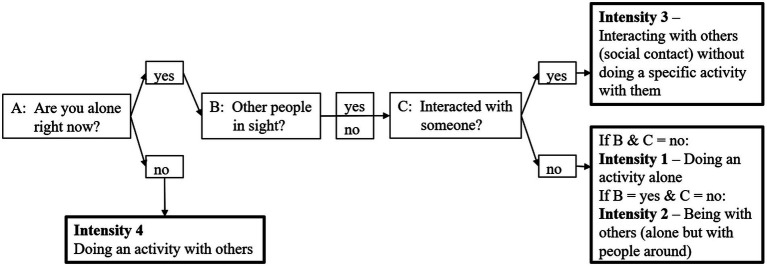
On smartphones, coupled with a motion sensor (move3), e-diaries were triggered as soon as people walked 100 m outside. E-diaries assessed momentary affective states (valence, calmness, energetic arousal), and social interaction (walking alone; seeing other people while walking; interacting with other people; walking with a known person) between 6 am and 10 pm over nine days. The percentage of greenness was determined afterward from recorded GPS and GIS data. Demographics were collected in advance an online questionnaire. Multilevel models were calculated with R for 46 individuals (age = 41.2, ± 13.2; 52% female).
Affective state dimension energetic arousal showed a significant association with social interaction and greenness, i.e., participants rated energetic arousal lower when walking alone, and if there was less greenness vs. when interacting shortly with someone while walking ( = 0.13, = 0.02), and being in situations with more greenness ( = 0.08, = 0.02). Furthermore, associations with social interaction and greenness were found for dimension calmness: walking together with someone was associated with higher calmness ( = 0.16, = 0.02), and the higher the proportion of surrounding greenness during a walk, the higher calmness was rated, i.e., participants were calmer ( = 0.09, = 0.01). Significant associations with valence were not present.
The findings indicate that the affective states varied significantly due to different social and physical environmental factors. In the future, the importance of environmental factors should be further investigated, e.g., by assessing environmental factors right in situations contrary to a subsequent imputation. Within-subject designs, and in particular triggered assessments with the addition of GPS, can aid in developing interventions for health-promoting urban environments.
包括步行在内的轻度至中度身体活动对身心健康具有积极影响。然而,就心理健康而言,社会和物理环境因素可能在这种关联中发挥重要作用。本研究调查了步行过程中环境特征(绿化程度、社会互动)与瞬时情感状态之间的人-环境交互作用。采用了一种被试内设计,即在参与者户外行走时评估情感状态和环境特征。
在智能手机上,结合运动传感器(move3),一旦人们在户外行走100米,电子日记就会被触发。电子日记在九天内的上午6点至晚上10点之间评估瞬时情感状态(效价、平静度、精力充沛程度)以及社会互动(独自行走;行走时看到其他人;与其他人互动;与熟人一起行走)。随后根据记录的GPS和GIS数据确定绿化百分比。通过在线问卷提前收集人口统计学信息。使用R软件为46名个体(年龄 = 41.2,±13.2;52%为女性)计算多层模型。
情感状态维度“精力充沛程度”与社会互动和绿化程度存在显著关联,即参与者独自行走时以及绿化程度较低时,对精力充沛程度的评分低于行走时与他人短暂互动时(β = 0.13,p = 0.02)以及处于绿化程度较高的环境中时(β = 0.08,p = 0.02)。此外,在“平静度”维度上也发现了与社会互动和绿化程度的关联:与他人一起行走与更高的平静度相关(β = 0.16,p = 0.02),并且行走过程中周围绿化比例越高,平静度评分越高,即参与者感觉越平静(β = 0.09,p = 0.01)。与效价不存在显著关联。
研究结果表明,情感状态因不同的社会和物理环境因素而有显著差异。未来,应进一步研究环境因素的重要性,例如通过在与后续推算相反的情境中直接评估环境因素。被试内设计,特别是添加了GPS的触发式评估,有助于开发促进健康的城市环境干预措施。