Liao Yue, Skelton Kara, Dunton Genevieve, Bruening Meg
University of Texas MD Anderson Cancer Center, Department of Behavioral Science, Houston, TX, United States.
J Med Internet Res. 2016 Jun 21;18(6):e151. doi: 10.2196/jmir.4954.
Ecological momentary assessment (EMA) is a method of collecting real-time data based on careful timing, repeated measures, and observations that take place in a participant's typical environment. Due to methodological advantages and rapid advancement in mobile technologies in recent years, more studies have adopted EMA in addressing topics of nutrition and physical activity in youth.
The aim of this systematic review is to describe EMA methodology that has been used in studies addressing nutrition and physical activity in youth and provide a comprehensive checklist for reporting EMA studies.
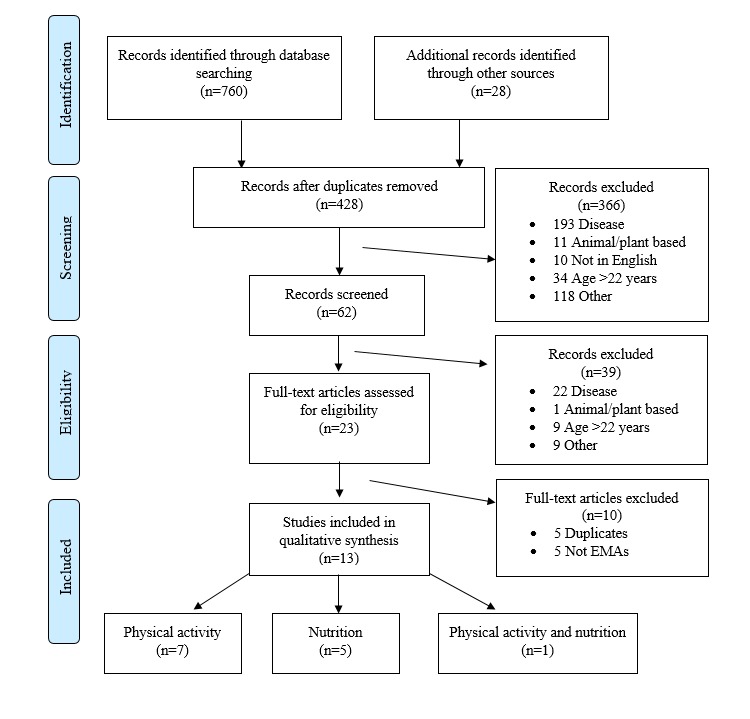
Thirteen studies were reviewed and analyzed for the following 5 areas of EMA methodology: (1) sampling and measures, (2) schedule, (3) technology and administration, (4) prompting strategy, and (5) response and compliance.
Results of this review showed a wide variability in the design and reporting of EMA studies in nutrition and physical activity among youth. The majority of studies (69%) monitored their participants during one period of time, although the monitoring period ranged from 4 to 14 days, and EMA surveys ranged from 2 to 68 times per day. More than half (54%) of the studies employed some type of electronic technology. Most (85%) of the studies used interval-contingent prompting strategy. For studies that utilized electronic devices with interval-contingent prompting strategy, none reported the actual number of EMA prompts received by participants out of the intended number of prompts. About half (46%) of the studies failed to report information about EMA compliance rates. For those who reported, compliance rates ranged from 44-96%, with an average of 71%.
Findings from this review suggest that in order to identify best practices for EMA methodology in nutrition and physical activity research among youth, more standardized EMA reporting is needed. Missing the key information about EMA design features and participant compliance might lead to misinterpretation of results. Future nutrition and physical activity EMA studies need to be more rigorous and thorough in descriptions of methodology and results. A reporting checklist was developed with the goal of enhancing reliability, efficacy, and overall interpretation of the findings for future studies that use EMAs.
生态瞬时评估(EMA)是一种基于精确计时、重复测量以及在参与者典型环境中进行观察来收集实时数据的方法。由于其方法学优势以及近年来移动技术的快速发展,越来越多的研究采用EMA来研究青少年的营养与身体活动话题。
本系统评价的目的是描述已用于研究青少年营养与身体活动的EMA方法,并提供一份用于报告EMA研究的全面清单。
对13项研究进行了审查和分析,涉及EMA方法的以下5个领域:(1)抽样与测量,(2)时间表,(3)技术与管理,(4)提示策略,以及(5)应答与依从性。
本评价结果显示,青少年营养与身体活动方面的EMA研究在设计和报告上存在很大差异。大多数研究(69%)在一个时间段内对参与者进行监测,尽管监测期从4天到14天不等,且EMA调查每天进行2至68次。超过一半(54%)的研究采用了某种类型的电子技术。大多数研究(85%)使用间隔 contingent 提示策略。对于采用间隔 contingent 提示策略的电子设备的研究,没有一项报告参与者实际收到的EMA提示数量与预期提示数量的情况。约一半(46%)的研究未报告EMA依从率信息。对于报告了依从率的研究,依从率范围为44% - 96%,平均为71%。
本评价结果表明,为了确定青少年营养与身体活动研究中EMA方法的最佳实践,需要更标准化的EMA报告。缺少关于EMA设计特征和参与者依从性的关键信息可能导致对结果的误解。未来的青少年营养与身体活动EMA研究在方法学和结果描述上需要更加严谨和全面。制定了一份报告清单,目的是提高未来使用EMA研究结果的可靠性、有效性和整体解读。