Sarafraz Hossein, Nöbauer Tobias, Kim Hyewon, Soldevila Fernando, Gigan Sylvain, Vaziri Alipasha
Laboratory of Neurotechnology and Biophysics, The Rockefeller University, New York, NY, USA.
The Kavli Neural Systems Institute, The Rockefeller University, New York, NY, USA.
Biomed Opt Express. 2024 May 3;15(6):3586-3608. doi: 10.1364/BOE.524521. eCollection 2024 Jun 1.
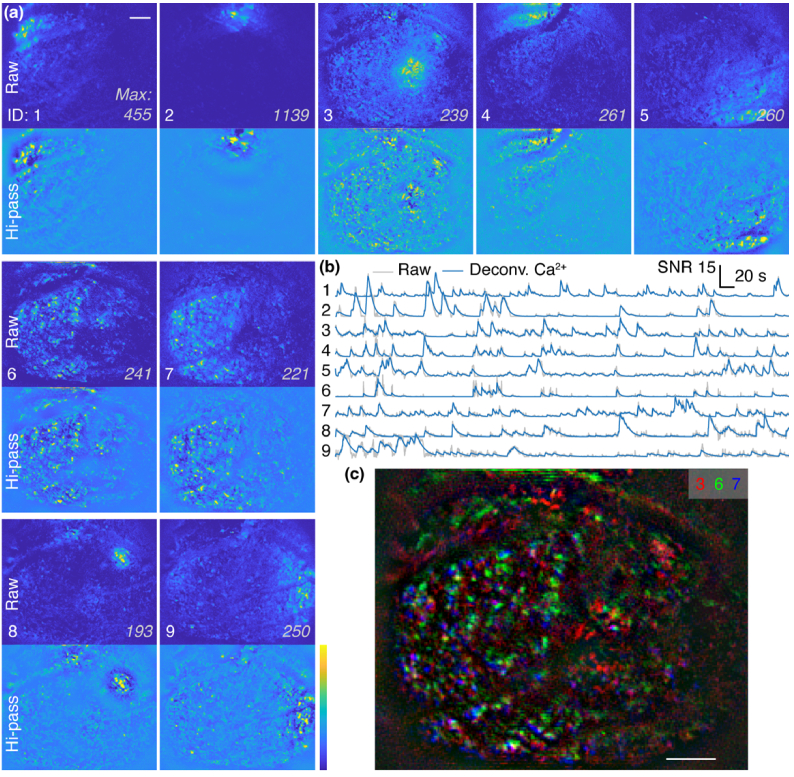
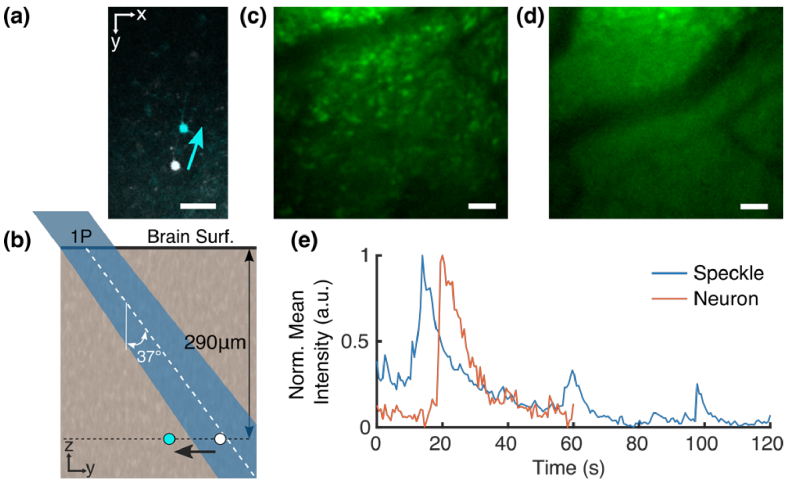
Functional imaging of neuronal activity in awake animals, using a combination of fluorescent reporters of neuronal activity and various types of microscopy modalities, has become an indispensable tool in neuroscience. While various imaging modalities based on one-photon (1P) excitation and parallel (camera-based) acquisition have been successfully used for imaging more transparent samples, when imaging mammalian brain tissue, due to their scattering properties, two-photon (2P) microscopy systems are necessary. In 2P microscopy, the longer excitation wavelengths reduce the amount of scattering while the diffraction-limited 3D localization of excitation largely eliminates out-of-focus fluorescence. However, this comes at the cost of time-consuming serial scanning of the excitation spot and more complex and expensive instrumentation. Thus, functional 1P imaging modalities that can be used beyond the most transparent specimen are highly desirable. Here, we transform light scattering from an obstacle into a tool. We use speckles with their unique patterns and contrast, formed when fluorescence from individual neurons propagates through rodent cortical tissue, to encode neuronal activity. Spatiotemporal demixing of these patterns then enables functional recording of neuronal activity from a group of discriminable sources. For the first time, we provide an experimental, characterization of speckle generation, speckle imaging and speckle-assisted demixing of neuronal activity signals in the scattering mammalian brain tissue. We found that despite an initial fast speckle decorrelation, substantial correlation was maintained over minute-long timescales that contributed to our ability to demix temporal activity traces in the mouse brain Informed by quantifications of speckle patterns from single and multiple neurons excited using 2P scanning excitation, we recorded and demixed activity from several sources excited using 1P oblique illumination. In our proof-of-principle experiments, we demonstrate speckle-assisted demixing of functional signals from groups of sources in a depth range of 220-320 µm in mouse cortex, limited by available speckle contrast. Our results serve as a basis for designing an functional speckle imaging modality and for maximizing the key resource in any such modality, the speckle contrast. We anticipate that our results will provide critical quantitative guidance to the community for designing techniques that overcome light scattering as a fundamental limitation in bioimaging.
利用神经元活动的荧光报告分子与各种显微镜技术相结合,对清醒动物的神经元活动进行功能成像,已成为神经科学中不可或缺的工具。虽然基于单光子(1P)激发和平行(基于相机)采集的各种成像技术已成功用于对更透明的样本进行成像,但在对哺乳动物脑组织进行成像时,由于其散射特性,需要双光子(2P)显微镜系统。在2P显微镜中,较长的激发波长减少了散射量,而激发的衍射极限三维定位在很大程度上消除了离焦荧光。然而,这是以激发光斑的耗时串行扫描以及更复杂和昂贵的仪器为代价的。因此,非常需要能够用于除最透明样本之外的功能1P成像技术。在这里,我们将光散射从一个障碍转化为一种工具。我们利用当单个神经元的荧光传播通过啮齿动物皮质组织时形成的具有独特图案和对比度的散斑,来编码神经元活动。然后,这些图案的时空解混使得能够从一组可分辨的源进行神经元活动的功能记录。我们首次提供了在散射的哺乳动物脑组织中散斑产生、散斑成像和神经元活动信号的散斑辅助解混的实验表征。我们发现,尽管最初散斑去相关很快,但在长达数分钟的时间尺度上仍保持了显著的相关性,这有助于我们在小鼠大脑中解混时间活动轨迹的能力。通过对使用2P扫描激发激发的单个和多个神经元的散斑图案进行量化,我们记录并解混了使用1P斜照激发的几个源的活动。在我们的原理验证实验中,我们展示了在小鼠皮层220 - 320 µm深度范围内,受可用散斑对比度限制,从源组中进行功能信号的散斑辅助解混。我们的结果为设计一种功能散斑成像技术以及最大化任何此类技术中的关键资源——散斑对比度奠定了基础。我们预计,我们的结果将为该领域提供关键的定量指导,以设计克服光散射这一生物成像基本限制的技术。