Faculty of Law, The Chinese University of Hong Kong, Hong Kong, China.
JC School of Public Health and Primary Care, The Chinese University of Hong Kong, Hong Kong, China.
Int J Equity Health. 2024 Jun 14;23(1):123. doi: 10.1186/s12939-024-02205-4.
Although it is widely acknowledged that access to civil justice (ATJ) is a key social determinant of health (SDOH), the existing literature lacks empirical evidence supporting ATJ as a SDOH for specific dimensions of health.
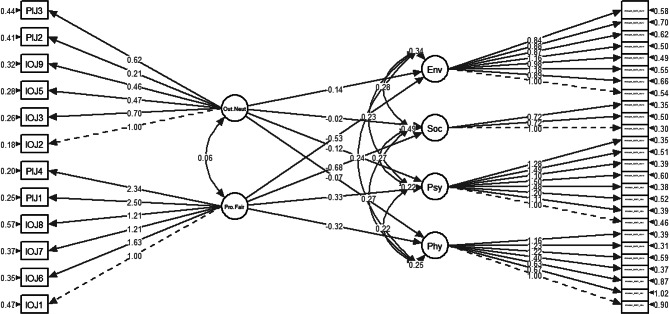
A legal epidemiological, cross-sectional, postal survey was conducted on n = 908 randomly sampled participants in Hong Kong in March 2023. Data collected were perceptions of the civil justice system, health, and sociodemographics. Perceived ATJ was assessed using a modified version of the Inaccessibility of Justice scale (IOJ) and Perceived Inequality of Justice scale (PIJ), i.e. the "modified IOJ-PIJ", consisting of 12 of the original 13 items from both scales divided into two subdomains: "procedural fairness", and "outcome neutrality". For health data, quality of life was assessed using the Hong Kong version of the Abbreviated World Health Organization Quality of Life questionnaire (WHOQOL-BREF(HK)), psychological distress (including symptoms of anxiety and depression) was assessed using the four-Item Patient Health Questionnaire (PHQ-4), and having comorbidities was assessed using Sangha's Self-Administered Comorbidity Questionnaire (SCQ). Structural equation modelling (SEM) was used to investigate the relationships between perceived ATJ and the measured health outcomes.
SEM demonstrated that both subdomains for ATJ had significantly negative associations (B < 0; p < 0.05) with all quality-of-life subdomains, except for between outcome neutrality with social relationships; both subdomains for ATJ had significantly positive association (B > 0; p < 0.05) with both anxiety and depression; and, after adjusting for age, only "procedural fairness" had significantly positive association (B > 0; p < 0.05) with having comorbidities.
This study provided empirical evidence that ATJ is a SDOH for specific dimensions of health. The results of this study encourage laws, policies, and initiatives aimed at improving ATJ, as well as collaborative efforts from the legal and health sectors through health-justice partnerships, and from the broader community, to safeguard and promote public health by strengthening ATJ.
尽管人们普遍认识到诉诸民事司法(ATJ)是健康的一个关键社会决定因素(SDOH),但现有文献缺乏支持 ATJ 作为特定健康维度的 SDOH 的经验证据。
2023 年 3 月,在香港对 908 名随机抽样的参与者进行了一项法律流行病学、横断面、邮寄调查。收集的数据包括对民事司法系统、健康和社会人口统计学的看法。使用司法不公感知量表(IOJ)和司法不公感知量表(PIJ)的修改版本评估感知到的 ATJ,即“修改后的 IOJ-PIJ”,由两个子领域组成:“程序公平”和“结果中立性”。对于健康数据,使用香港版简明世界卫生组织生活质量问卷(WHOQOL-BREF(HK))评估生活质量,使用四项目患者健康问卷(PHQ-4)评估心理困扰(包括焦虑和抑郁症状),使用 Sangha 自我管理合并症问卷(SCQ)评估合并症。结构方程模型(SEM)用于研究感知到的 ATJ 与测量的健康结果之间的关系。
SEM 表明,ATJ 的两个子领域与所有生活质量子领域均呈显著负相关(B<0;p<0.05),除结果中立性与人际关系之间的关系外;ATJ 的两个子领域均与焦虑和抑郁呈显著正相关(B>0;p<0.05);并且,在调整年龄后,只有“程序公平”与合并症呈显著正相关(B>0;p<0.05)。
本研究提供了经验证据,证明 ATJ 是健康特定维度的 SDOH。这项研究的结果鼓励从法律、政策和倡议方面努力改善 ATJ,以及法律和卫生部门通过健康司法伙伴关系以及更广泛的社区合作,通过加强 ATJ 来维护和促进公共健康。