State Key Laboratory of Oral Diseases & National Center for Stomatology & National Clinical Research Center for Oral Diseases & Research Unit of Oral Carcinogenesis and Management, Chinese Academy of Medical Sciences, West China Hospital of Stomatology, Sichuan University, Chengdu, China.
Key Laboratory of Oral Biomedical Research of Zhejiang Province, Affiliated Stomatology Hospital, Zhejiang University School of Stomatology, Hangzhou, China.
Int J Oral Sci. 2024 Jun 18;16(1):46. doi: 10.1038/s41368-024-00308-w.
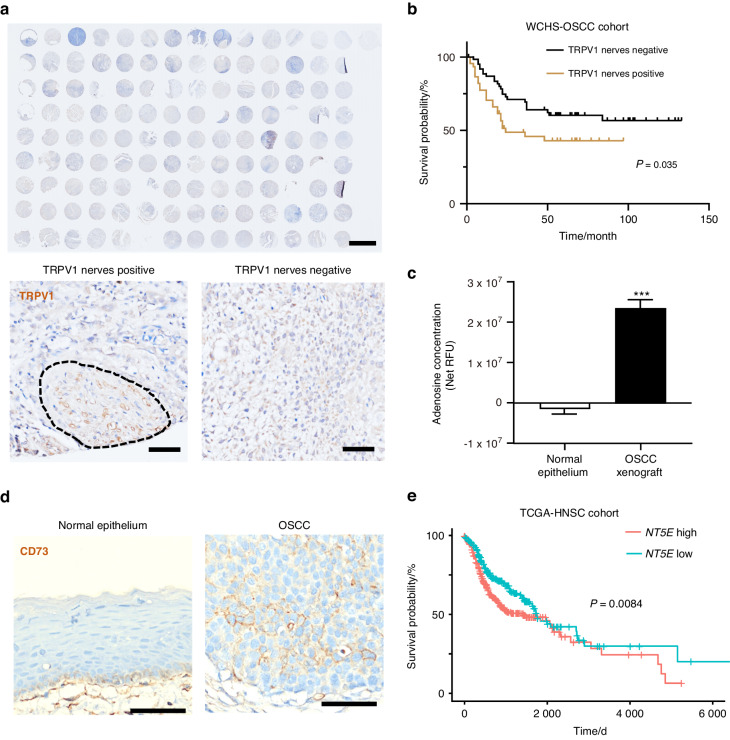
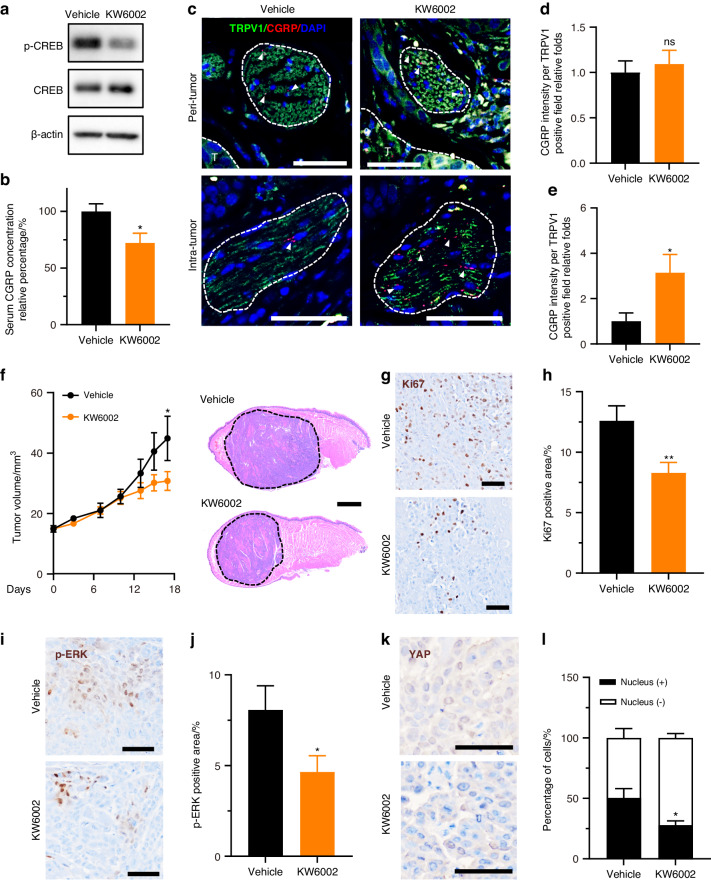
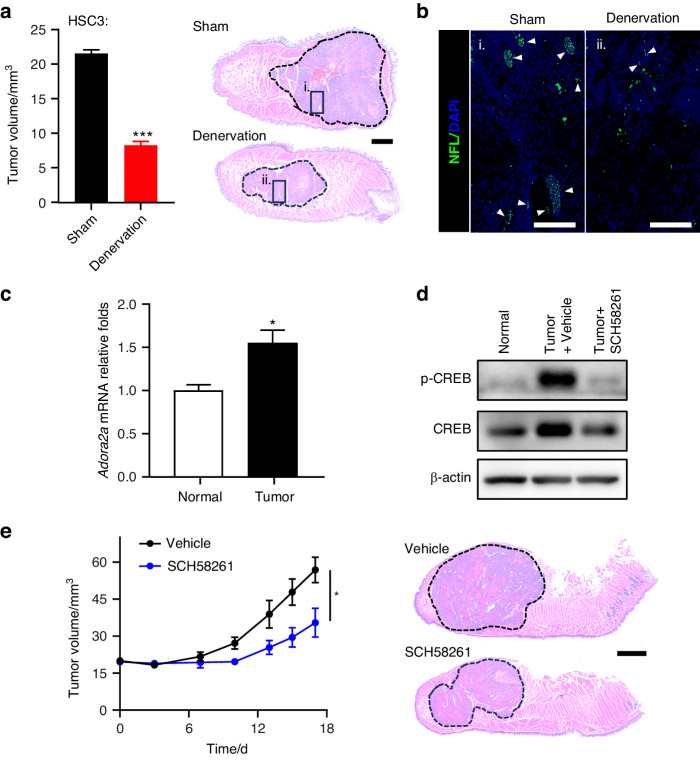
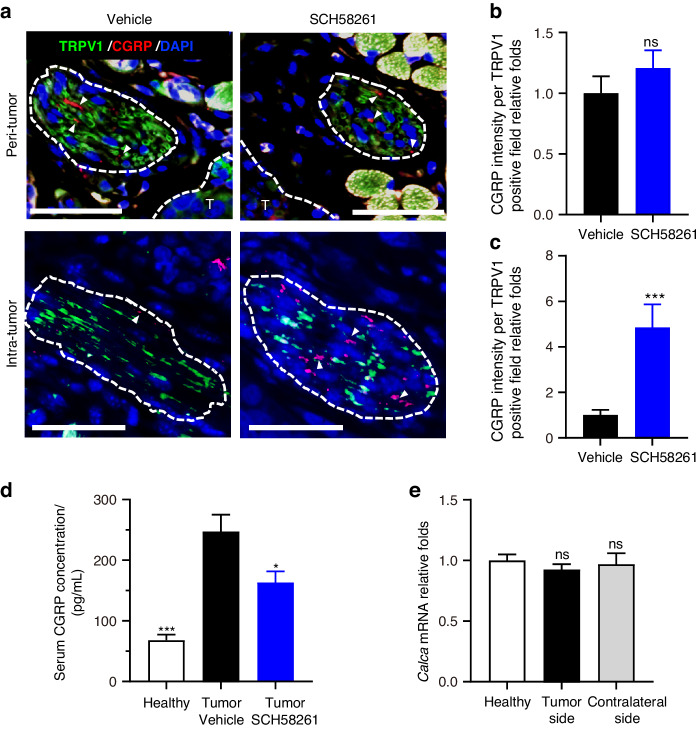
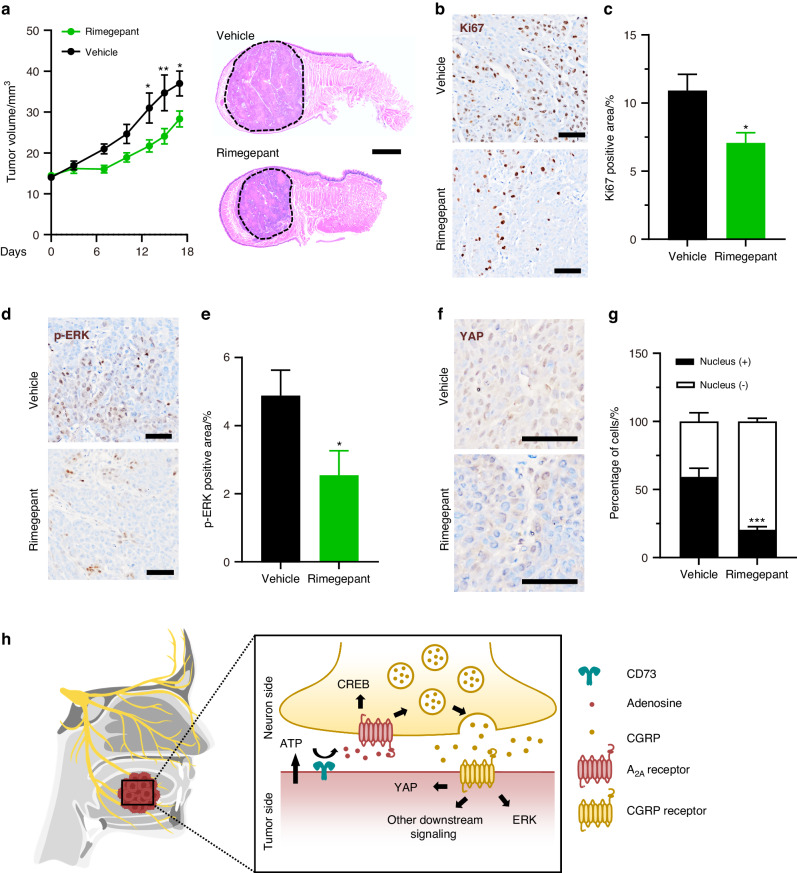
Oral squamous cell carcinoma (OSCC) associated pain commonly predicts adverse events among patients. This clinical feature indicates the engagement of nociceptors on sensory neurons during the development of malignancy. However, it is yet to be determined if targeting oncometabolite-associated nociception processes can hinder OSCC progression. In this study, we reported that nociceptive endings infiltrating both clinical samples and mouse tumor xenografts were associated with poorer clinical outcomes and drove tumor progression in vivo, as evidenced by clinical tissue microarray analysis and murine lingual denervation. We observed that the OSCC microenvironment was characteristic of excessive adenosine due to CD73 upregulation which negatively predicted clinical outcomes in the TCGA-HNSC patient cohort. Notably, such adenosine concentrative OSCC niche was associated with the stimulation of adenosine A receptor (AR) on trigeminal ganglia. Antagonism of trigeminal AR with a selective AR inhibitor SCH58261 resulted in impeded OSCC growth in vivo. We showed that trigeminal AR overstimulation in OSCC xenograft did not entail any changes in the transcription level of CGRP in trigeminal ganglia but significantly triggered the release of CGRP, an effect counteracted by SCH58261. We further demonstrated the pro-tumor effect of CGRP by feeding mice with the clinically approved CGRP receptor antagonist rimegepant which inhibited the activation of ERK and YAP. Finally, we diminished the impact of CGRP on OSCC with istradefylline, a clinically available drug that targets neuronal AR. Therefore, we established trigeminal AR-mediated CGRP release as a promising druggable circuit in OSCC treatment.
口腔鳞状细胞癌(OSCC)相关疼痛通常预示着患者不良事件的发生。这种临床特征表明,在恶性肿瘤发展过程中,感觉神经元上的伤害感受器被激活。然而,目前尚不清楚是否可以通过靶向致癌代谢物相关的伤害感受过程来阻止 OSCC 的进展。在这项研究中,我们报告称,浸润临床样本和小鼠肿瘤异种移植物的伤害感受器与较差的临床结果相关,并在体内驱动肿瘤进展,这可通过临床组织微阵列分析和小鼠舌神经切断术得到证明。我们观察到,由于 CD73 的上调,OSCC 微环境中存在大量的腺苷,这对 TCGA-HNSC 患者队列的临床结果产生负面影响。值得注意的是,这种腺苷浓缩的 OSCC 生态位与三叉神经节上的腺苷 A 受体(AR)的刺激有关。用选择性 AR 抑制剂 SCH58261 拮抗三叉神经 AR 导致体内 OSCC 生长受阻。我们表明,OSCC 异种移植物中三叉神经 AR 的过度刺激不会导致三叉神经节中 CGRP 的转录水平发生任何变化,但会显著触发 CGRP 的释放,SCH58261 可拮抗这种作用。我们通过给小鼠喂食临床上已批准的 CGRP 受体拮抗剂利美尼肽进一步证明了 CGRP 的促肿瘤作用,该药物抑制了 ERK 和 YAP 的激活。最后,我们用伊曲茶碱(一种靶向神经元 AR 的临床可用药物)来减少 CGRP 对 OSCC 的影响。因此,我们确定了三叉神经 AR 介导的 CGRP 释放作为 OSCC 治疗中一种有前途的可药物治疗的回路。