Department of Medicine, Division of Diabetes, Metabolism, and Endocrinology, Anti-Glycation Research Section, Showa University Graduate School of Medicine, Shinagawa 142-8555, Tokyo, Japan.
Department of Medicine, Division of Diabetes, Metabolism, and Endocrinology, Showa University Graduate School of Medicine, Shinagawa 142-8555, Tokyo, Japan.
Int J Mol Sci. 2024 May 29;25(11):5947. doi: 10.3390/ijms25115947.
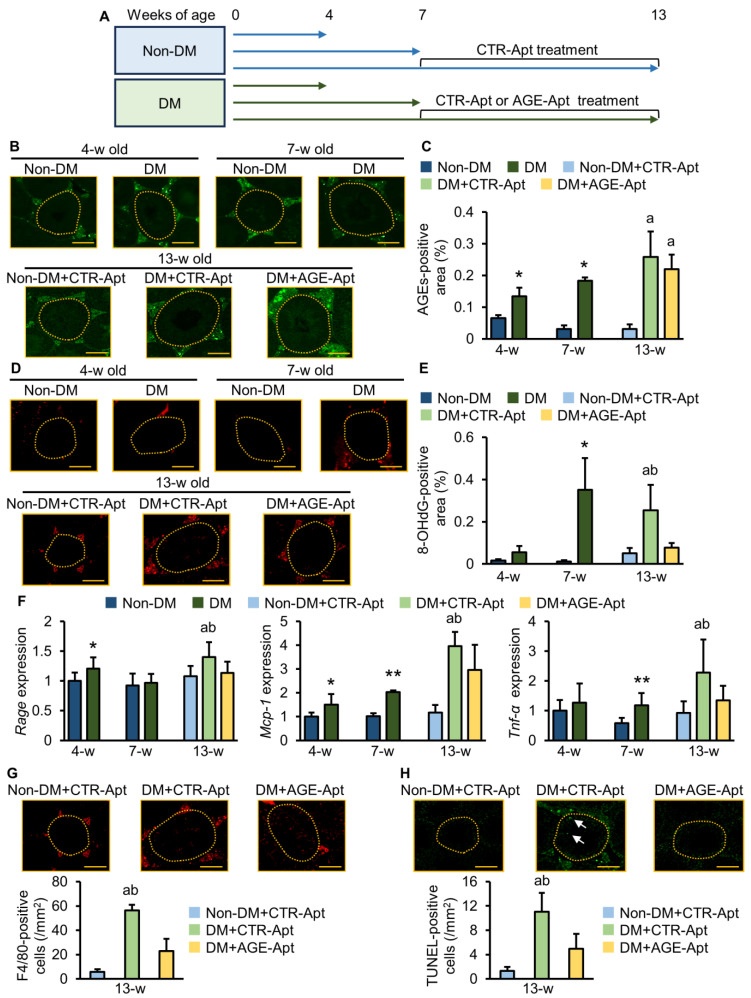
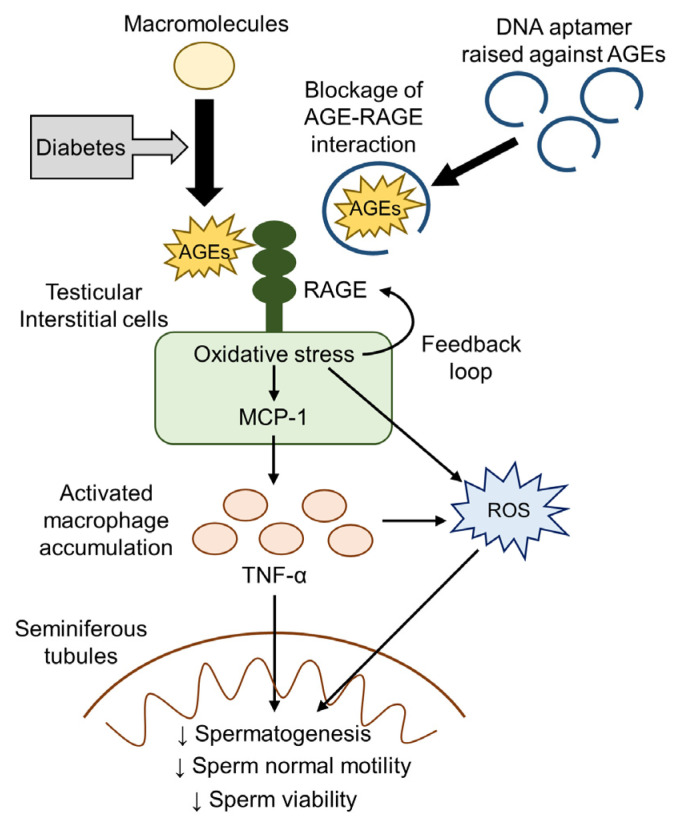
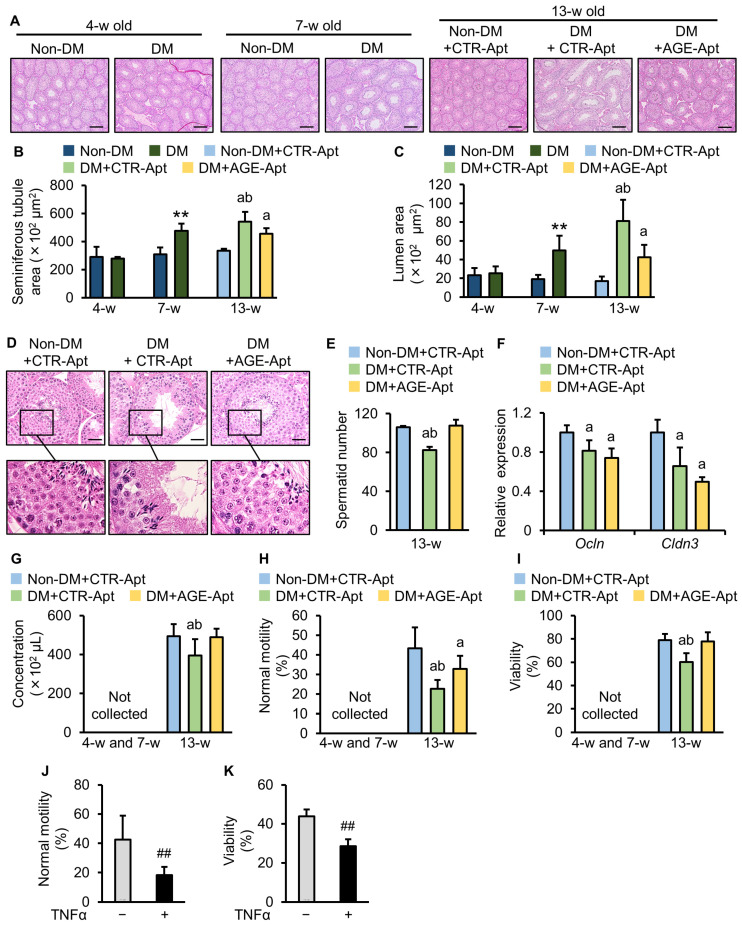
Type 2 diabetes mellitus (T2DM) is a risk factor for male infertility, but the underlying molecular mechanisms remain unclear. Advanced glycation end products (AGEs) are pathogenic molecules for diabetic vascular complications. Here, we investigated the effects of the DNA aptamer raised against AGEs (AGE-Apt) on testicular and sperm abnormalities in a T2DM mouse model. KK-Ay (DM) and wild-type (non-DM) 4- and 7-week-old male mice were sacrificed to collect the testes and spermatozoa for immunofluorescence, RT-PCR, and histological analyses. DM and non-DM 7-week-old mice were subcutaneously infused with the AGE-Apt or control-aptamer for 6 weeks and were then sacrificed. Plasma glucose, testicular AGEs, and gene expression in 4-week-old DM mice and plasma glucose, testicular AGEs, oxidative stress, and pro-inflammatory gene expressions in 7-week-old DM mice were higher than those in age-matched non-DM mice, the latter of which was associated with seminiferous tubular dilation. AGE-Apt did not affect glycemic parameters, but it inhibited seminiferous tubular dilation, reduced the number of testicular macrophages and apoptotic cells, and restored the decrease in sperm concentration, motility, and viability of 13-week-old DM mice. Our findings suggest that AGEs-Apt may improve sperm abnormality by suppressing AGE-RAGE-induced oxidative stress and inflammation in the testes of DM mice.
2 型糖尿病(T2DM)是男性不育的一个危险因素,但潜在的分子机制尚不清楚。晚期糖基化终产物(AGEs)是糖尿病血管并发症的致病分子。在这里,我们研究了针对 AGEs 的 DNA 适体(AGE-Apt)对 T2DM 小鼠模型睾丸和精子异常的影响。KK-Ay(DM)和野生型(非 DM)4 周和 7 周龄雄性小鼠被处死以收集睾丸和精子进行免疫荧光、RT-PCR 和组织学分析。DM 和非 DM 7 周龄小鼠皮下注射 AGE-Apt 或对照适体 6 周后处死。与同龄非 DM 小鼠相比,4 周龄 DM 小鼠的血浆葡萄糖、睾丸 AGEs 和 基因表达以及 7 周龄 DM 小鼠的血浆葡萄糖、睾丸 AGEs、氧化应激和促炎基因表达均升高,后者与精曲小管扩张有关。AGE-Apt 不影响血糖参数,但可抑制精曲小管扩张,减少睾丸巨噬细胞和凋亡细胞数量,并恢复 13 周龄 DM 小鼠精子浓度、活力和活力的降低。我们的研究结果表明,AGEs-Apt 可能通过抑制 DM 小鼠睾丸中 AGE-RAGE 诱导的氧化应激和炎症来改善精子异常。