Guzmán-León Alan E, Avila-Prado Jessica, Bracamontes-Picos Leslie R, Haby Michelle M, Stein Katja, Astiazaran-Garcia Humberto, Lopez-Teros Veronica
Department of Chemical and Biological Sciences, Universidad de Sonora, Blvd. Luis Encinas y Rosales S/N, Hermosillo , 83000, Sonora, Mexico.
School of Population and Global Health, Centre for Health Policy, The University of Melbourne, Melbourne, VIC, Australia.
BMC Nutr. 2024 Jun 19;10(1):89. doi: 10.1186/s40795-024-00892-4.
A compromised nutritional status jeopardizes a positive prognosis in acute lymphoblastic leukemia (ALL) patients. In low- and middle-income countries, ~ 50% of children with ALL are malnourished at diagnosis time, and undergoing antineoplastic treatment increases the risk of depleting their nutrient stores. Nutrition interventions are implemented in patients with cancer related malnutrition. We aimed to evaluate the effect of nutrition interventions in children diagnosed with ALL under treatment.
Using a predefined protocol, we searched for published or unpublished randomized controlled trials in: Cochrane CENTRAL, MEDLINE, EMBASE, LILACS, and SciELO, and conducted complementary searches. Studies where at least 50% of participants had an ALL diagnosis in children ≤ 18 years, active antineoplastic treatment, and a nutrition intervention were included. Study selection and data extraction were conducted independently by three reviewers, and assessment of the risk of bias by two reviewers. Results were synthesized in both tabular format and narratively.
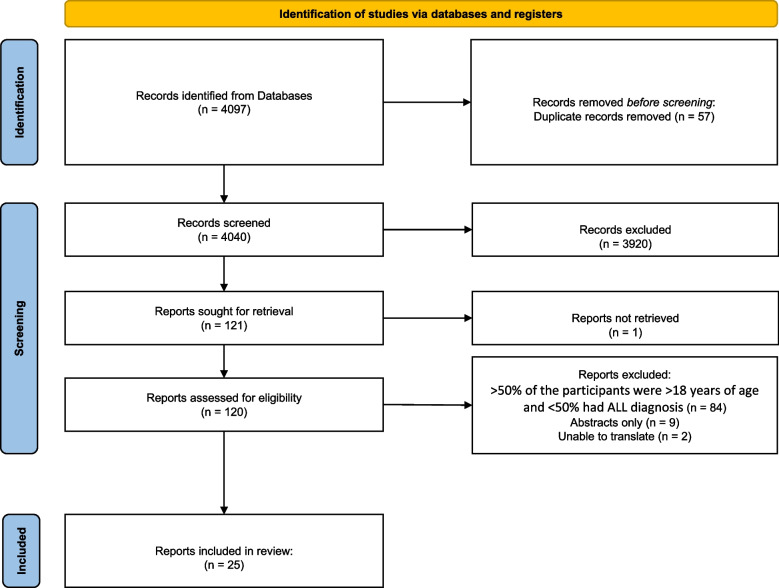
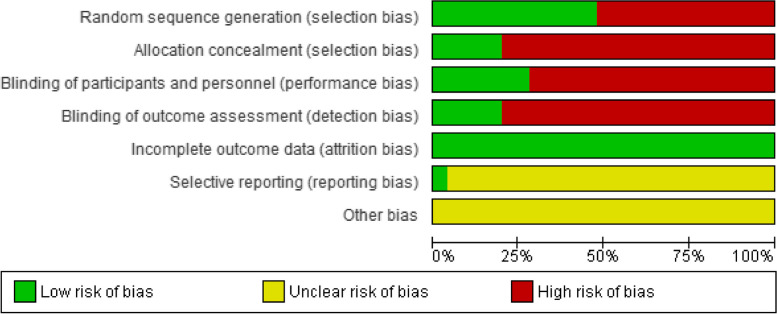
Twenty-five studies (out of 4097 records) satisfied the inclusion requirements. There was a high risk of bias in eighteen studies. Interventions analyzed were classified by compound/food (n = 14), micronutrient (n = 8), and nutritional support (n = 3). Within each group the interventions and components (dose and time) tested were heterogeneous. In relation to our primary outcomes, none of the studies reported fat-free mass as an outcome. Inflammatory and metabolic markers related to nutritional status and anthropometric measurements were reported in many studies but varied greatly across the studies. For our secondary outcomes, fat mass or total body water were not reported as an outcome in any of the studies. However, some different adverse events were reported in some studies.
This review highlights the need to conduct high-quality randomized controlled trials for nutrition interventions in children with ALL, based on their limited number and heterogeneous outcomes.
Guzmán-León AE, Lopez-Teros V, Avila-Prado J, Bracamontes-Picos L, Haby MM, Stein K. Protocol for a Systematic Review: Nutritional interventions in children with acute lymphoblastic leukemia undergoing an tineoplastic treatment. International prospective register of systematic reviews. 2021; PROSPERO CRD:42,021,266,761 ( https://www.crd.york.ac.uk/prospero/display_record.php?RecordID=266761 ).
营养状况不佳会危及急性淋巴细胞白血病(ALL)患者的良好预后。在低收入和中等收入国家,约50%的ALL患儿在确诊时营养不良,而接受抗肿瘤治疗会增加其营养储备耗尽的风险。针对癌症相关营养不良的患者实施了营养干预措施。我们旨在评估营养干预对接受治疗的ALL确诊患儿的影响。
按照预定义方案,我们在Cochrane CENTRAL、MEDLINE、EMBASE、LILACS和SciELO中检索已发表或未发表的随机对照试验,并进行补充检索。纳入至少50%的参与者为18岁及以下儿童且确诊为ALL、正在接受积极抗肿瘤治疗并接受营养干预的研究。由三位评审员独立进行研究筛选和数据提取,由两位评审员评估偏倚风险。结果以表格形式和叙述形式进行综合。
4097条记录中有25项研究符合纳入要求。18项研究存在高偏倚风险。所分析的干预措施按化合物/食物(n = 14)、微量营养素(n = 8)和营养支持(n = 3)分类。每组中所测试的干预措施和成分(剂量和时间)各不相同。关于我们的主要结局,没有研究将去脂体重作为结局进行报告。许多研究报告了与营养状况和人体测量相关的炎症和代谢指标,但各研究之间差异很大很大。对于我们的次要结局,没有研究将脂肪量或总体水作为结局进行报告。然而,一些研究报告了一些不同的不良事件。
本综述强调,鉴于营养干预研究数量有限且结果各异,有必要针对ALL患儿开展高质量的随机对照试验。
Guzmán-León AE、Lopez-Teros V、Avila-Prado J、Bracamontes-Picos L、Haby MM、Stein K。系统评价方案:对接受抗肿瘤治疗的急性淋巴细胞白血病患儿的营养干预。国际系统评价前瞻性注册库。2021年;PROSPERO CRD编号:42,021,266,761(https://www.crd.york.ac.uk/prospero/display_record.php?RecordID=266761)