Department of Endocrinology and Metabolism, The Affiliated Hospital of Qingdao University, Qingdao, China.
Frontier Medical Training Brigade, Third Military Medical University (Army Medical University), Xinjiang, China.
Front Endocrinol (Lausanne). 2024 Jun 5;15:1377792. doi: 10.3389/fendo.2024.1377792. eCollection 2024.
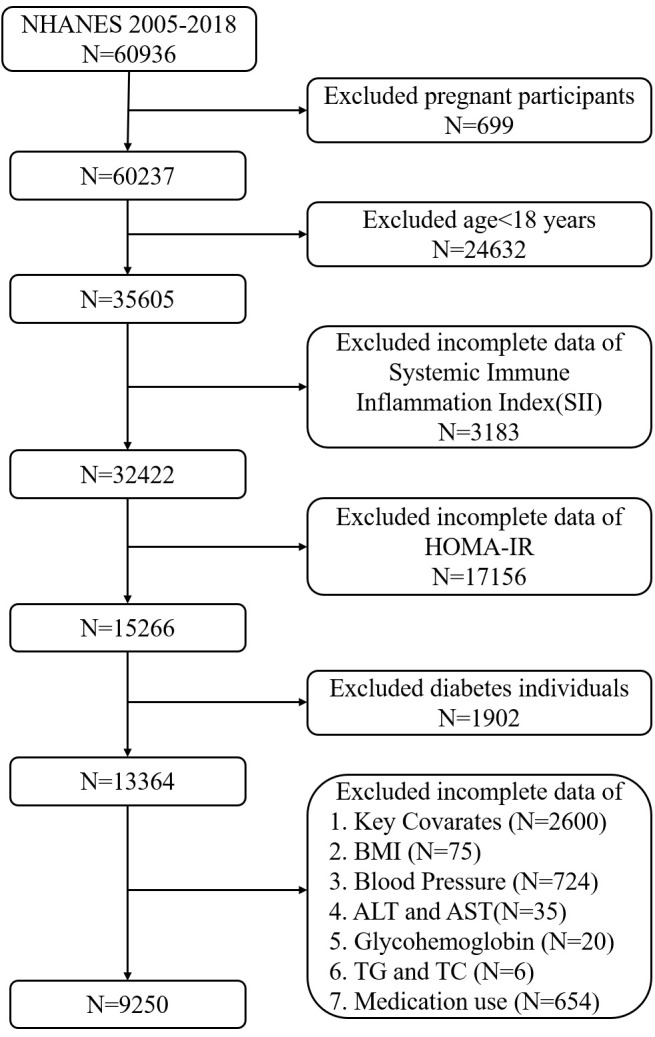
Previous research suggested a relationship between the Systemic Immune-Inflammation Index (SII) and multiple adverse health conditions. However, the role of SII in prediabetes and insulin resistance (IR) remains poorly understood. Therefore, this study aims to explore the potential relationship between SII and prediabetes and IR, providing data support for effective diabetes prevention by reducing systemic inflammation.
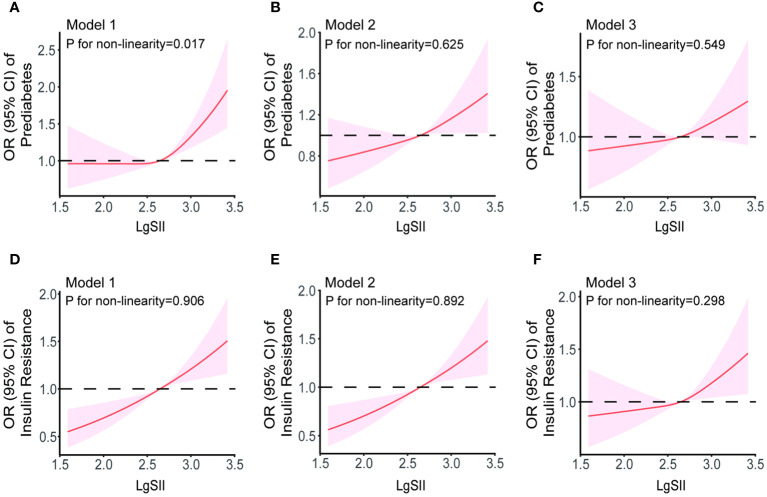
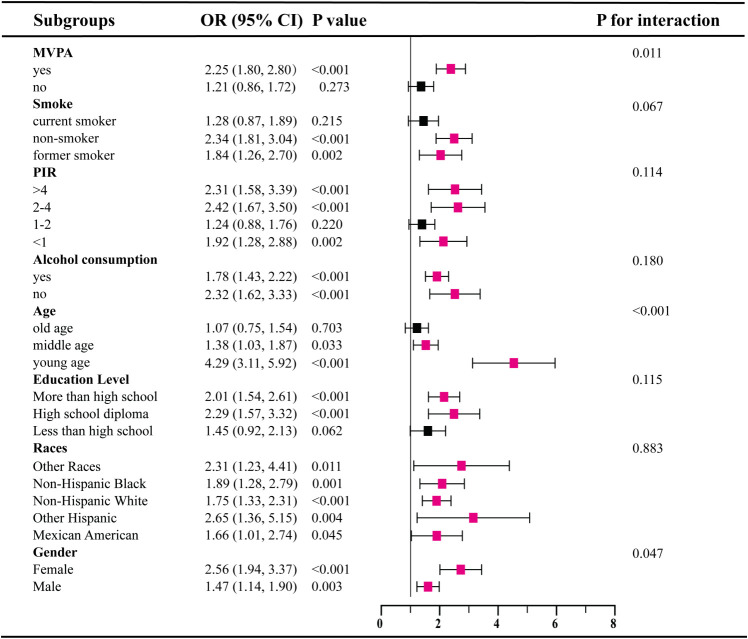
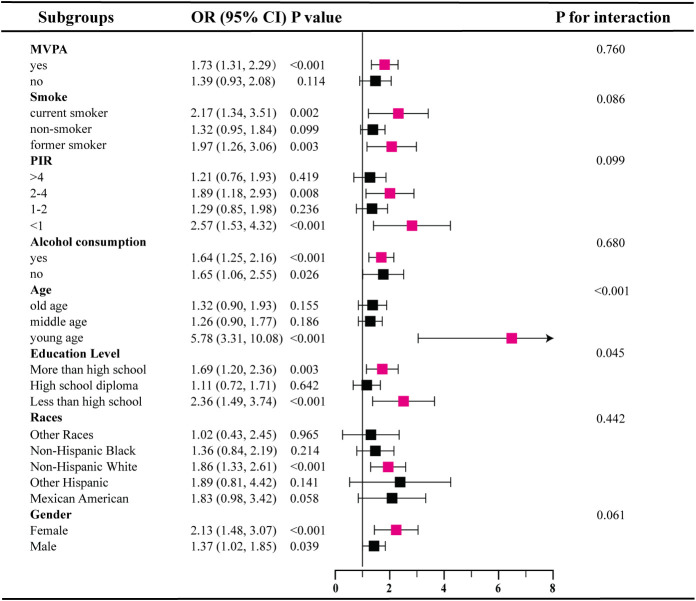
Linear regression models were used to assess the correlation between continuous SII and risk markers for type 2 diabetes (T2D). Subsequently, multivariate logistic regression models and subgroup analyses were employed to evaluate the association between SII tertiles and prediabetes and IR, controlling for various confounding factors. Finally, restricted cubic spline graphs were used to analyze the nonlinear relationship between SII and IR and prediabetes.
After controlling for multiple potential confounders, SII was positively correlated with fasting blood glucose (FBG) (β: 0.100; 95% CI: 0.040 to 0.160), fasting serum insulin (FSI) (β: 1.042; 95% CI: 0.200 to 1.885), and homeostasis model assessment of insulin resistance (HOMA-IR) (β: 0.273; 95% CI: 0.022 to 0.523). Compared to participants with lower SII, those in the highest tertile had increased odds of prediabetes (OR: 1.17; 95% CI: 1.02-1.34; p for trend < 0.05) and IR (OR: 1.35; 95% CI: 1.18 to 1.51; p for trend<0.001).
Our study results demonstrate an elevated association between SII levels and both IR and prediabetes, indicating SII as a straightforward and cost-effective method identifying individuals with IR and prediabetes.
先前的研究表明,全身免疫炎症指数(SII)与多种健康不良状况之间存在关联。然而,SII 在糖尿病前期和胰岛素抵抗(IR)中的作用仍知之甚少。因此,本研究旨在探讨 SII 与糖尿病前期和 IR 之间的潜在关系,为通过降低全身炎症有效预防糖尿病提供数据支持。
采用线性回归模型评估 SII 与 2 型糖尿病(T2D)风险标志物之间的相关性。随后,采用多变量 logistic 回归模型和亚组分析评估 SII 三分位与糖尿病前期和 IR 之间的关系,同时控制多种混杂因素。最后,采用受限立方样条图分析 SII 与 IR 和糖尿病前期之间的非线性关系。
在控制多个潜在混杂因素后,SII 与空腹血糖(FBG)(β:0.100;95%CI:0.040 至 0.160)、空腹血清胰岛素(FSI)(β:1.042;95%CI:0.200 至 1.885)和稳态模型评估的胰岛素抵抗(HOMA-IR)(β:0.273;95%CI:0.022 至 0.523)呈正相关。与 SII 较低的参与者相比,SII 最高三分位组的糖尿病前期(OR:1.17;95%CI:1.02-1.34;p 趋势<0.05)和 IR(OR:1.35;95%CI:1.18 至 1.51;p 趋势<0.001)发生的比值比更高。
本研究结果表明,SII 水平与 IR 和糖尿病前期之间存在显著关联,提示 SII 是一种简单、经济有效的方法,可用于识别存在 IR 和糖尿病前期的个体。