Smolin Natalie, Dombrovski Mark, Hina Bryce W, Moreno-Sanchez Anthony, Gossart Ryan, Carmona Catherine R, Rehan Aadil, Hussein Roni H, Mirshahidi Parmis, Ausborn Jessica, Kurmangaliyev Yerbol Z, von Reyn Catherine R
School of Biomedical Engineering, Science and Health Systems, Drexel University, Philadelphia, PA.
Howard Hughes Medical Institute, Department of Biological Chemistry, David Geffen School of Medicine, University of California, Los Angeles, CA.
bioRxiv. 2024 Jun 14:2024.06.14.598883. doi: 10.1101/2024.06.14.598883.
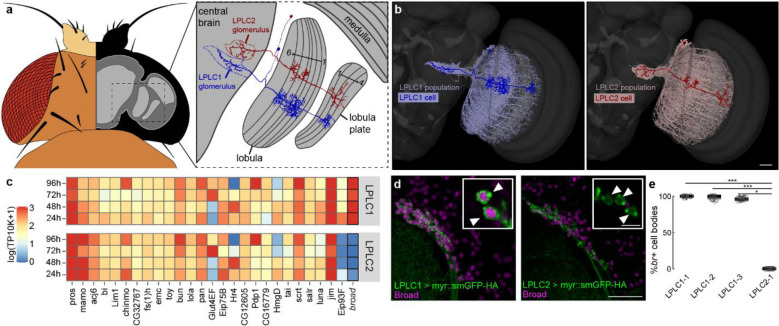
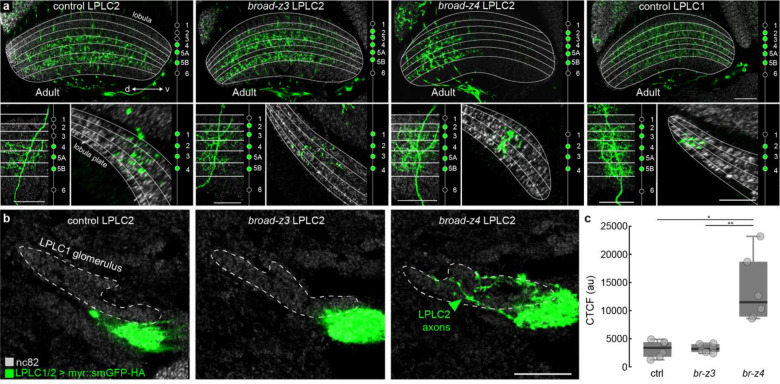
The brain exhibits remarkable neuronal diversity which is critical for its functional integrity. From the sheer number of cell types emerging from extensive transcriptional, morphological, and connectome datasets, the question arises of how the brain is capable of generating so many unique identities. 'Terminal selectors' are transcription factors hypothesized to determine the final identity characteristics in post-mitotic cells. Which transcription factors function as terminal selectors and the level of control they exert over different terminal characteristics are not well defined. Here, we establish a novel role for the transcription factor as a terminal selector in . We capitalize on existing large sequencing and connectomics datasets and employ a comprehensive characterization of terminal characteristics including Perturb-seq and whole-cell electrophysiology. We find a single isoform serves as the switch between the identity of two visual projection neurons LPLC1 and LPLC2. is natively expressed in LPLC1, and is capable of transforming the transcriptome, morphology, and functional connectivity of LPLC2 cells into LPLC1 cells when perturbed. Our comprehensive work establishes a single isoform as the smallest unit underlying an identity switch, which may serve as a conserved strategy replicated across developmental programs.
大脑呈现出显著的神经元多样性,这对其功能完整性至关重要。从大量转录、形态学和连接组数据集中涌现出的细胞类型数量之多,引发了一个问题:大脑如何能够产生如此多独特的身份特征。“终端选择器”是一种转录因子,被认为可以决定有丝分裂后细胞的最终身份特征。哪些转录因子作为终端选择器发挥作用以及它们对不同终端特征的控制水平尚未明确界定。在这里,我们确立了转录因子在……中作为终端选择器的新作用。我们利用现有的大型测序和连接组数据集,并采用包括Perturb-seq和全细胞电生理学在内的终端特征综合表征方法。我们发现单一异构体作为两种视觉投射神经元LPLC1和LPLC2身份之间的开关。……在LPLC1中天然表达,当受到干扰时,能够将LPLC2细胞的转录组、形态和功能连接性转化为LPLC1细胞。我们的综合研究确立了单一异构体作为身份转换的最小单位,这可能是一种在整个发育程序中重复的保守策略。