Matsliah Arie, Yu Szi-Chieh, Kruk Krzysztof, Bland Doug, Burke Austin T, Gager Jay, Hebditch James, Silverman Ben, Willie Kyle Patrick, Willie Ryan, Sorek Marissa, Sterling Amy R, Kind Emil, Garner Dustin, Sancer Gizem, Wernet Mathias F, Kim Sung Soo, Murthy Mala, Seung H Sebastian
Princeton Neuroscience Institute, Princeton University, Princeton, NJ, USA.
Independent researcher, Kielce, Poland.
Nature. 2024 Oct;634(8032):166-180. doi: 10.1038/s41586-024-07981-1. Epub 2024 Oct 2.
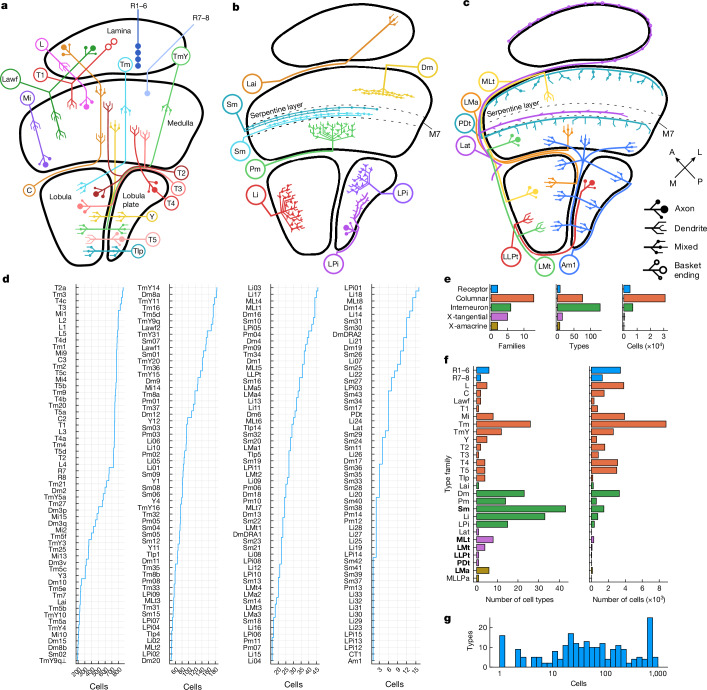
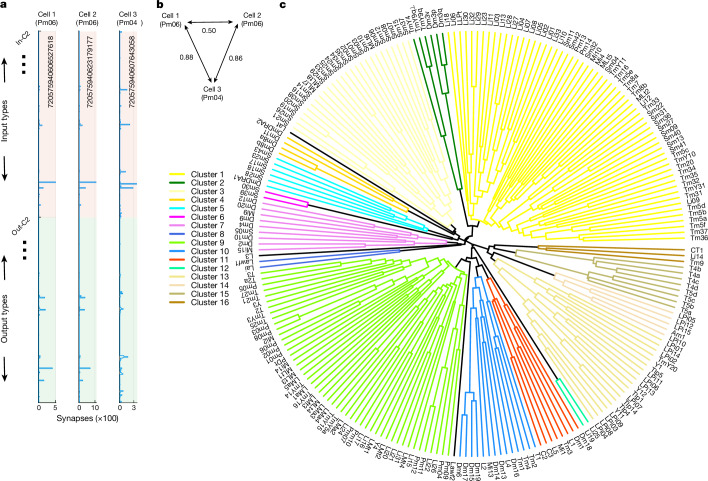
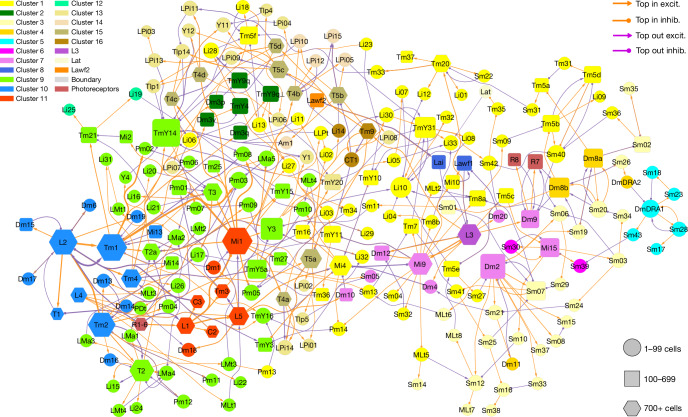
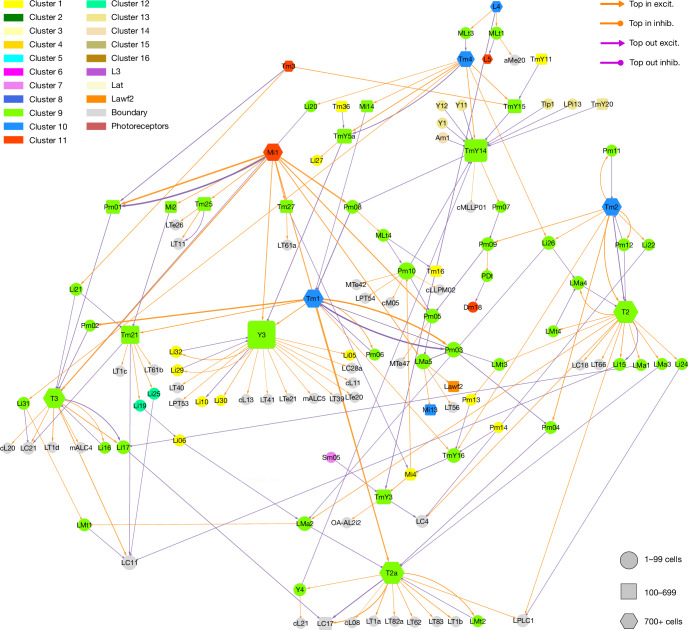
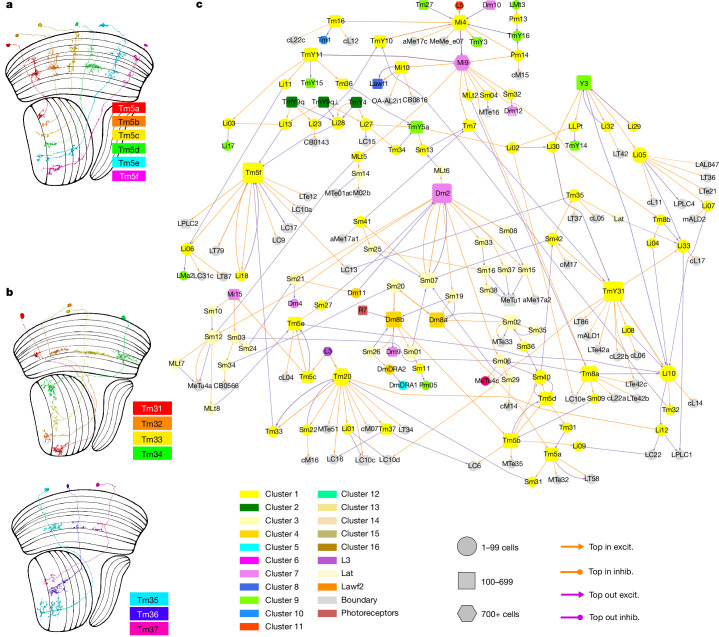
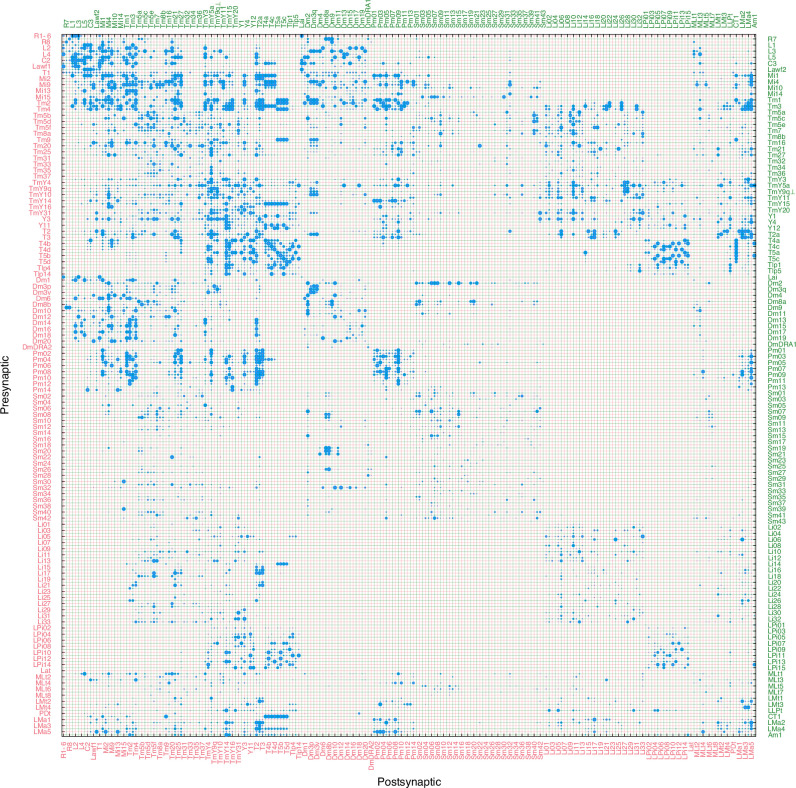
A catalogue of neuronal cell types has often been called a 'parts list' of the brain, and regarded as a prerequisite for understanding brain function. In the optic lobe of Drosophila, rules of connectivity between cell types have already proven to be essential for understanding fly vision. Here we analyse the fly connectome to complete the list of cell types intrinsic to the optic lobe, as well as the rules governing their connectivity. Most new cell types contain 10 to 100 cells, and integrate information over medium distances in the visual field. Some existing type families (Tm, Li, and LPi) at least double in number of types. A new serpentine medulla (Sm) interneuron family contains more types than any other. Three families of cross-neuropil types are revealed. The consistency of types is demonstrated by analysing the distances in high-dimensional feature space, and is further validated by algorithms that select small subsets of discriminative features. We use connectivity to hypothesize about the functional roles of cell types in motion, object and colour vision. Connectivity with 'boundary types' that straddle the optic lobe and central brain is also quantified. We showcase the advantages of connectomic cell typing: complete and unbiased sampling, a rich array of features based on connectivity and reduction of the connectome to a substantially simpler wiring diagram of cell types, with immediate relevance for brain function and development.
神经元细胞类型目录常被称为大脑的“部件清单”,并被视为理解大脑功能的先决条件。在果蝇的视叶中,细胞类型之间的连接规则已被证明对理解果蝇视觉至关重要。在这里,我们分析果蝇连接体,以完善视叶固有的细胞类型清单及其连接规则。大多数新的细胞类型包含10到100个细胞,并在视野的中等距离上整合信息。一些现有的类型家族(Tm、Li和LPi)的类型数量至少增加了一倍。一个新的蛇形髓质(Sm)中间神经元家族包含的类型比其他任何家族都多。揭示了三个跨神经纤维类型家族。通过分析高维特征空间中的距离来证明类型的一致性,并通过选择判别特征小子集的算法进一步验证。我们利用连接性来推测细胞类型在运动、物体和颜色视觉中的功能作用。还对跨越视叶和中枢脑的“边界类型”的连接性进行了量化。我们展示了连接体细 胞分型的优势:完整且无偏的采样、基于连接性的丰富特征阵列,以及将连接体简化为一个实质上更简单的细胞类型布线图,这与脑功能和发育直接相关。