Topaloglu Mahir, Şen Ekin İlke, Sarıkaya Deniz, Dıraçoğlu Demirhan
Department of Physical Medicine and Rehabilitation, Koç University School of Medicine, Istanbul, Türkiye.
Department of Physical Medicine and Rehabilitation, Istanbul University, Istanbul Faculty of Medicine, Istanbul, Türkiye.
Turk J Phys Med Rehabil. 2024 May 17;70(2):212-220. doi: 10.5606/tftrd.2024.13855. eCollection 2024 Jun.
This study aims to compare the efficacy of intra-articular platelet-rich plasma (PRP) injections over a saline placebo in terms of reduction of pain and impact on quality of life among patients with hip osteoarthritis.
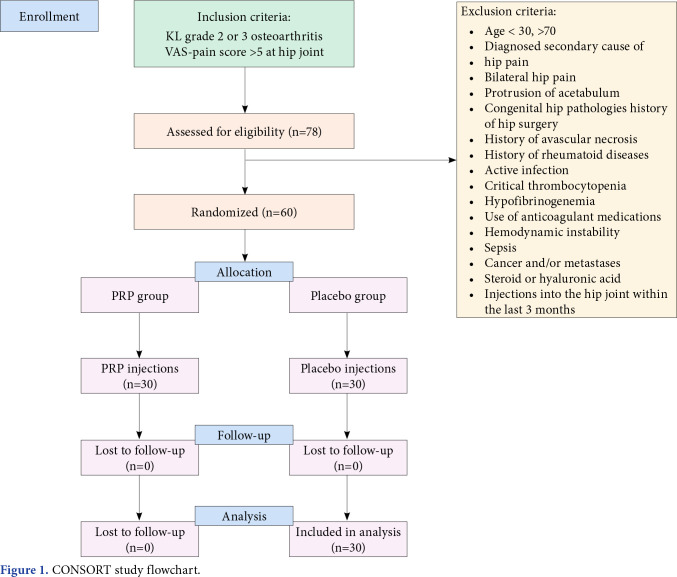
A total of 60 patients (29 males, 31 females, mean age: 57.9±7.3 years; range, 47 to 69 years) with known hip osteoarthritis of Kellgren-Lawrance (KL) Grades 2/3 were randomized into placebo (n=30) and PRP groups (n=30) between June 2014 and June 2015. Both groups received intra-articular injections into the hip joint under ultrasound guidance for three consecutive weeks. The patients were followed for six months, and pain reduction was assessed using the Visual Analog Scale (VAS), Western Ontario and McMaster Universities Arthritis Index (WOMAC) questionnaire, and Short Form Health Survey-36 (SF-36).
Intra-articular PRP treatment showed no advantage over a saline placebo in terms of VAS scores during activity. Both groups showed a significant improvement in VAS activity scores at one and six months. The placebo group showed improvements in VAS resting scores, whereas the PRP group did not. Both groups showed no improvement in WOMAC-total scores. Both groups showed no significant improvement across most SF-36 domains with the exception of improved physical role functioning at one month and general health at one and six months in the placebo group.
Intra-articular injections of PRP show no significant difference compared to a saline placebo over a period of six months on pain, function, and quality of life scores in patients with hip osteoarthritis.
本研究旨在比较关节腔内注射富血小板血浆(PRP)与生理盐水安慰剂在减轻髋骨关节炎患者疼痛及对生活质量影响方面的疗效。
2014年6月至2015年6月期间,共有60例已知为Kellgren-Lawrance(KL)2/3级髋骨关节炎患者(29例男性,31例女性,平均年龄:57.9±7.3岁;范围47至69岁)被随机分为安慰剂组(n = 30)和PRP组(n = 30)。两组均在超声引导下连续三周接受髋关节腔内注射。对患者随访6个月,使用视觉模拟量表(VAS)、西安大略和麦克马斯特大学骨关节炎指数(WOMAC)问卷以及简明健康调查问卷36(SF - 36)评估疼痛减轻情况。
在活动期间的VAS评分方面,关节腔内PRP治疗相较于生理盐水安慰剂并无优势。两组在1个月和6个月时VAS活动评分均有显著改善。安慰剂组VAS静息评分有所改善,而PRP组则未改善。两组WOMAC总分均未改善。除安慰剂组在1个月时身体角色功能改善以及在1个月和6个月时总体健康状况改善外,两组在大多数SF - 36领域均无显著改善。
对于髋骨关节炎患者,在6个月的时间里,关节腔内注射PRP与生理盐水安慰剂相比,在疼痛、功能和生活质量评分方面无显著差异。