Reed Tristan T, Kendal Abigail H, Wozniak Katherine J, Simmons Lyle A
Department of Molecular, Cellular, and Developmental Biology, University of Michigan, Ann Arbor, MI 48109.
Present address: Department of Molecular Virology and Microbiology, Baylor College of Medicine, Houston, TX 77030.
bioRxiv. 2024 Jun 18:2024.06.18.599555. doi: 10.1101/2024.06.18.599555.
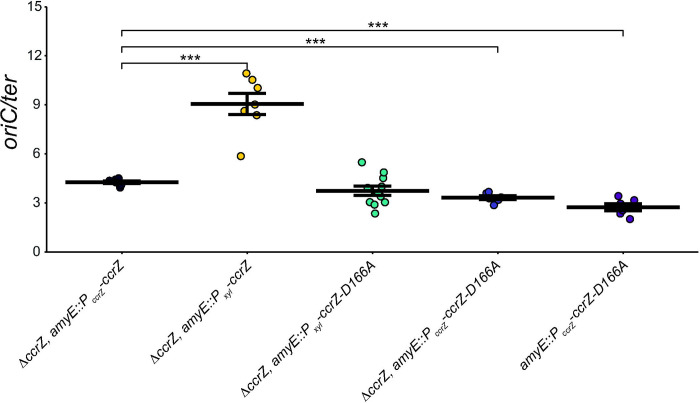
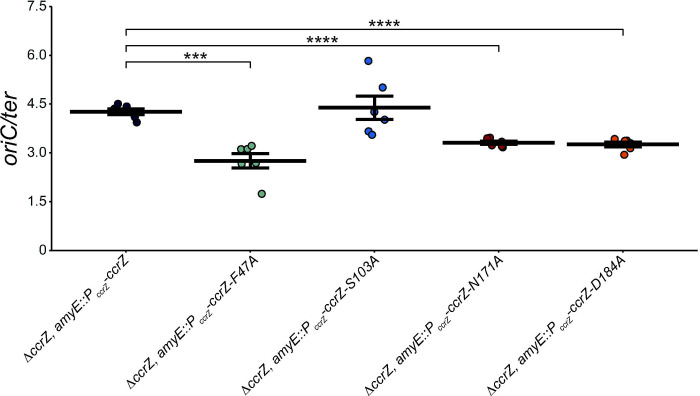
DNA replication is regulated by factors that promote or inhibit initiation. In YabA is a negative regulator of DNA replication initiation while the newly identified kinase CcrZ is a positive regulator. The consequences of under-initiation or over-initiation of DNA replication to genome stability remain unclear. In this work, we measure origin to terminus ratios as a proxy for replication initiation activity. We show that Δ and several alleles under-initiate DNA replication while ablation of or overproduction of CcrZ leads to over-initiation. We find that cells under-initiating DNA replication have few incidents of replication fork stress as determined by low formation of RecA-GFP foci compared with wild type. In contrast, cells over-initiating DNA replication show levels of RecA-GFP foci formation analogous to cells directly challenged with DNA damaging agents. We show that cells under-initiating and over-initiating DNA replication were both sensitive to mitomycin C and that changes in replication initiation frequency cause increased sensitivity to genotoxic stress. With these results, we propose that cells under-initiating DNA replication are sensitive to DNA damage due to a shortage of DNA for repair through homologous recombination. For cells over-initiating DNA replication, we propose that an increase in the number of replication forks leads to replication fork stress which is further exacerbated by chromosomal DNA damage. Together, our study shows that DNA replication initiation frequency must be tightly controlled as changes in initiation influence replication fork fate and the capacity of cells to efficiently repair damage to their genetic material.
DNA复制受促进或抑制起始的因素调控。在[具体细菌名称]中,YabA是DNA复制起始的负调控因子,而新发现的激酶CcrZ是正调控因子。DNA复制起始不足或过度起始对基因组稳定性的影响尚不清楚。在这项研究中,我们测量了起始点与终点的比率,以此作为复制起始活性的指标。我们发现,[具体基因缺失的细菌名称]Δ和几个[具体等位基因名称]等位基因起始DNA复制不足,而敲除[具体基因名称]或过量表达CcrZ会导致起始过度。我们发现,与野生型相比,起始DNA复制不足的细胞中RecA-GFP焦点形成较少,表明复制叉应激事件较少。相反,起始DNA复制过度的细胞中RecA-GFP焦点形成水平与直接受到DNA损伤剂攻击的细胞相似。我们发现,起始DNA复制不足和过度的细胞对丝裂霉素C均敏感,复制起始频率的变化会导致对基因毒性应激的敏感性增加。基于这些结果,我们提出,起始DNA复制不足的细胞对DNA损伤敏感,是因为通过同源重组进行修复的DNA短缺。对于起始DNA复制过度的细胞,我们提出复制叉数量增加会导致复制叉应激,而染色体DNA损伤会进一步加剧这种应激。总之,我们的研究表明,DNA复制起始频率必须严格控制,因为起始的变化会影响复制叉的命运以及细胞有效修复其遗传物质损伤的能力。