Al-Salehi Loay, Kroeker Shannon G, Kerrigan Jason R, Cripton Peter A, Panzer Matthew B, Siegmund Gunter P
Orthopedic and Injury Biomechanics Group, School of Biomedical Engineering, Departments of Orthopaedics and Mechanical Engineering, University of British Columbia, Vancouver, BC, Canada.
MEA Forensic Engineers & Scientists, 23281 Vista Grande Drive, Laguna Hills, CA, 92653, USA.
Inj Epidemiol. 2024 Jul 3;11(1):30. doi: 10.1186/s40621-024-00506-4.
Rollover crashes continue to be a substantial public health issue in North America. Previous research has shown that the cervical spine is the most injured spine segment in rollovers, but much of the past research has focused on risk factors rather than the actual cervical spine injuries. We sought to examine how different types of cervical spine injuries (vertebral and/or cord injury) vary with different occupant-related factors in rollovers and to compare these with non-rollovers.
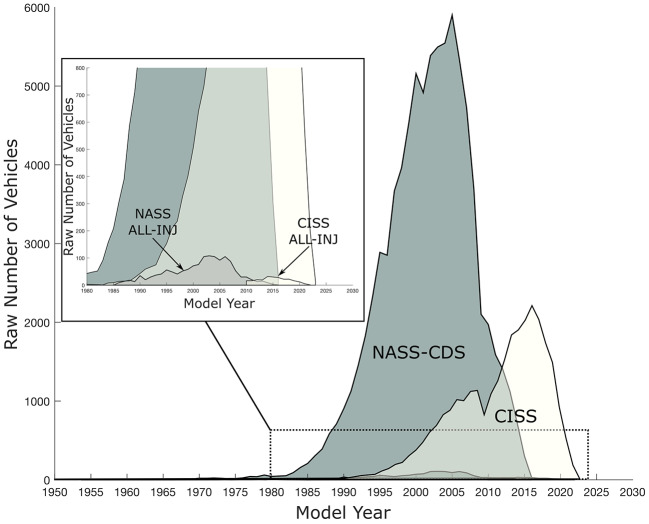
We obtained crash and injury information from the National Automotive Sampling System-Crashworthiness Data System (NASS-CDS) for 2005-2015 and Crash Investigation Sampling System (CISS) for 2017-2022. Based on weighted data, we calculated relative risks to assess how occupant sex, seat belt use, ejection status, and fatal outcome relate to the rate of different cervical spine injuries in rollovers and non-rollovers.
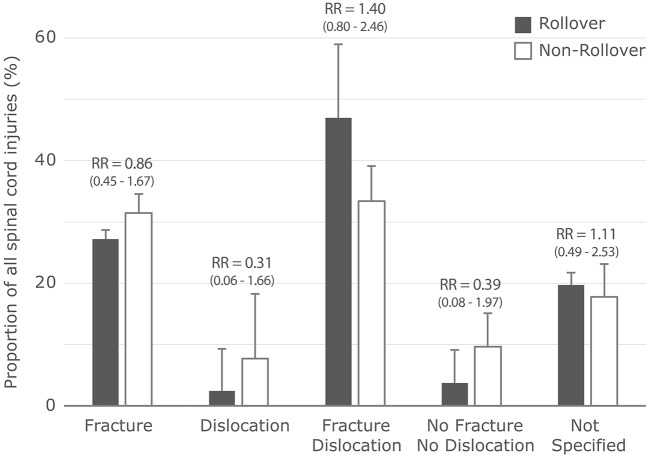
In NASS-CDS occupants with cervical spine injuries (N = 111,040 weighted cases), about 91.5% experienced at least one vertebral injury whereas only 11.3% experienced a spinal cord injury (most of which had a concomitant vertebral fracture). All types of cervical spine injuries we examined were 3.4-5.2 times more likely to occur in rollovers compared to non-rollovers. These relative risks were similar for both sexes, belted and unbelted, non-ejected, and non-fatal occupants. The number of weighted CISS occupants with cervical spine injuries (N = 42,003) was smaller than in the NASS analysis, but cervical spine injuries remained 6.25 to 6.36 times more likely in rollovers compared to non-rollovers despite a more modern vehicle fleet.
These findings underscore the continued need for rollover-specific safety countermeasures, especially those focused on cervical spine injury prevention, and elucidate the frequency, severity and other characteristics of the specific vertebral and spinal cord injuries being sustained in rollovers. Our findings suggest that countermeasures focused on preventing cervical vertebral fractures will also effectively prevent most cervical spinal cord injuries.
翻车事故在北美仍然是一个严重的公共卫生问题。先前的研究表明,颈椎是翻车事故中受伤最严重的脊柱节段,但过去的许多研究都集中在风险因素上,而非实际的颈椎损伤。我们试图研究在翻车事故中,不同类型的颈椎损伤(椎体和/或脊髓损伤)如何随不同的驾乘人员相关因素而变化,并将这些情况与非翻车事故进行比较。
我们从2005 - 2015年的国家汽车抽样系统 - 碰撞安全性数据系统(NASS - CDS)以及2017 - 2022年的碰撞调查抽样系统(CISS)中获取了碰撞和损伤信息。基于加权数据,我们计算了相对风险,以评估驾乘人员的性别、安全带使用情况、弹出状态和致命结果与翻车事故和非翻车事故中不同颈椎损伤发生率之间的关系。
在NASS - CDS中,颈椎受伤的驾乘人员(N = 111,040例加权病例)中,约91.5%至少经历了一次椎体损伤,而只有11.3%经历了脊髓损伤(其中大多数伴有椎体骨折)。与非翻车事故相比,我们所研究的所有类型的颈椎损伤在翻车事故中发生的可能性要高3.4至5.2倍。对于男女、系安全带和未系安全带、未弹出以及非致命的驾乘人员来说,这些相对风险是相似的。加权的CISS中颈椎受伤的驾乘人员数量(N = 42,003)比NASS分析中的要少,但尽管车辆更为现代,与非翻车事故相比,翻车事故中颈椎损伤的可能性仍然高出6.25至6.36倍。
这些发现强调了持续需要针对翻车事故采取特定的安全对策,尤其是那些侧重于预防颈椎损伤的对策,并阐明了翻车事故中特定椎体和脊髓损伤的发生频率、严重程度及其他特征。我们的研究结果表明,侧重于预防颈椎骨折的对策也将有效预防大多数颈椎脊髓损伤。