Department of Biological Sciences, University of Arkansas, Fayetteville, AR, USA.
Interdisciplinary Graduate Program in Cell and Molecular Biology, University of Arkansas, Fayetteville, AR, USA.
BMC Biol. 2024 Jul 4;22(1):149. doi: 10.1186/s12915-024-01945-7.
Organisms frequently experience environmental stresses that occur in predictable patterns and combinations. For wild Saccharomyces cerevisiae yeast growing in natural environments, cells may experience high osmotic stress when they first enter broken fruit, followed by high ethanol levels during fermentation, and then finally high levels of oxidative stress resulting from respiration of ethanol. Yeast have adapted to these patterns by evolving sophisticated "cross protection" mechanisms, where mild 'primary' doses of one stress can enhance tolerance to severe doses of a different 'secondary' stress. For example, in many yeast strains, mild osmotic or mild ethanol stresses cross protect against severe oxidative stress, which likely reflects an anticipatory response important for high fitness in nature.
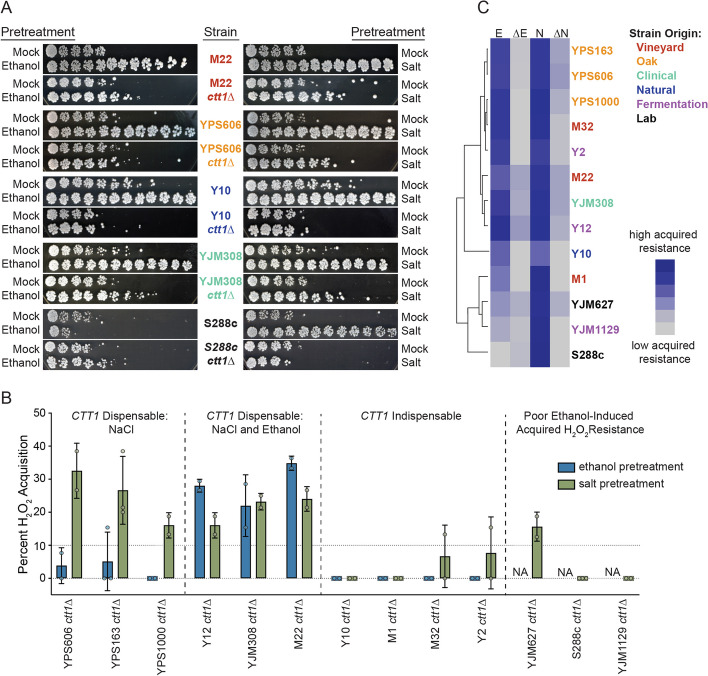
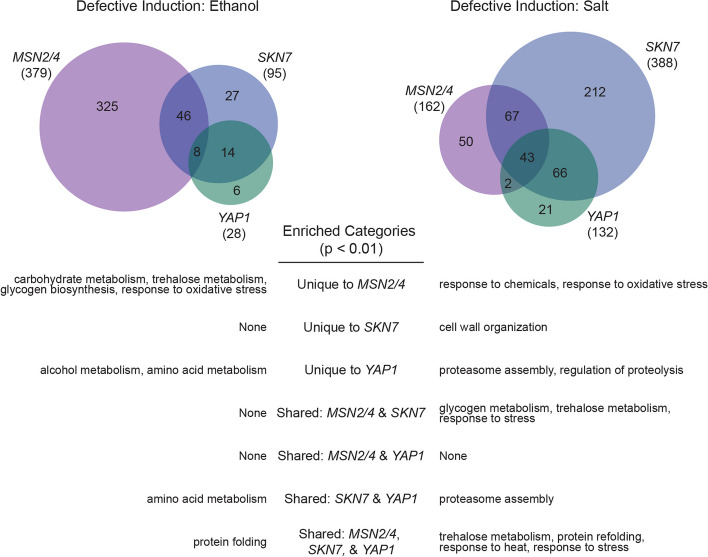
During the course of genetic mapping studies aimed at understanding the mechanisms underlying natural variation in ethanol-induced cross protection against HO, we found that a key HO scavenging enzyme, cytosolic catalase T (Ctt1p), was absolutely essential for cross protection in a wild oak strain. This suggested the absence of other compensatory mechanisms for acquiring HO resistance in that strain background under those conditions. In this study, we found surprising heterogeneity across diverse yeast strains in whether CTT1 function was fully necessary for acquired HO resistance. Some strains exhibited partial dispensability of CTT1 when ethanol and/or salt were used as mild stressors, suggesting that compensatory peroxidases may play a role in acquired stress resistance in certain genetic backgrounds. We leveraged global transcriptional responses to ethanol and salt stresses in strains with different levels of CTT1 dispensability, allowing us to identify possible regulators of these alternative peroxidases and acquired stress resistance in general.
Ultimately, this study highlights how superficially similar traits can have different underlying molecular foundations and provides a framework for understanding the diversity and regulation of stress defense mechanisms.
生物经常会遇到可预测模式和组合的环境压力。对于在自然环境中生长的野生酿酒酵母,当细胞最初进入破裂的果实时,可能会经历高渗透压胁迫,然后在发酵过程中经历高乙醇水平,最后由于乙醇呼吸而经历高水平的氧化胁迫。酵母通过进化出复杂的“交叉保护”机制来适应这些模式,其中轻度的“初级”应激剂量可以增强对不同的“次级”应激的严重剂量的耐受性。例如,在许多酵母菌株中,轻度渗透压或轻度乙醇应激可交叉保护免受严重的氧化应激,这可能反映了对自然高适应性的预期反应。
在旨在了解自然变异机制的遗传图谱研究过程中,我们发现一种关键的 HO 清除酶,细胞质过氧化氢酶 T(Ctt1p),在野生 oak 菌株中对 HO 诱导的交叉保护是绝对必需的。这表明在该菌株背景下,在这些条件下,不存在其他获得 HO 抗性的补偿机制。在这项研究中,我们发现不同酵母菌株之间在 CTT1 功能是否完全需要获得 HO 抗性方面存在惊人的异质性。在某些菌株中,当使用乙醇和/或盐作为轻度胁迫时,CTT1 表现出部分可替代性,这表明在某些遗传背景下,补偿性过氧化物酶可能在获得应激抗性中发挥作用。我们利用不同 CTT1 可替代性菌株对乙醇和盐应激的全球转录反应,使我们能够识别这些替代过氧化物酶和一般获得应激抗性的可能调节剂。
最终,这项研究强调了表面上相似的特征如何具有不同的潜在分子基础,并为理解应激防御机制的多样性和调节提供了框架。