Ang Gregory, Tan Chuen Seng, Lim Nicole, Tan Jeremy, Müller-Riemenschneider Falk, Cook Alex R, Chen Cynthia
Department of Statistics and Data Science, National University of Singapore, Singapore, Singapore.
Saw Swee Hock School of Public Health, National University of Singapore, National University Health System, Singapore, Singapore.
Commun Med (Lond). 2024 Jul 6;4(1):132. doi: 10.1038/s43856-024-00537-4.
The widespread use of physical activity trackers enables the collection of high-resolution health data, such as hourly step counts, to evaluate health promotion programmes. We aim to investigate how participants meet their daily step goals.
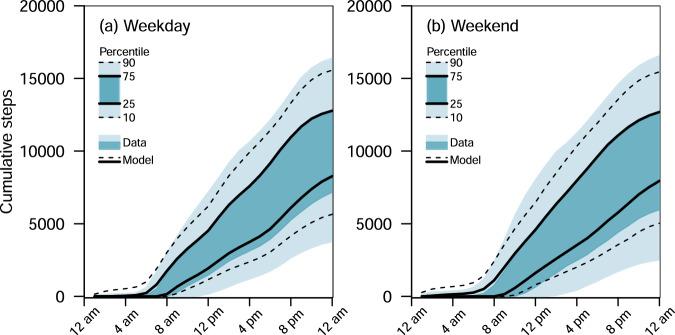
We used 24-h steps data from the National Steps Challenge Season 3, wherein participants were rewarded with vouchers when achieving specified goals of 5000, 7500, and 10,000 steps per day. We extracted data from 3075 participants' including a total of 52,346 participant-days. We modelled the hourly step counts using a two-part model, in which the distribution for step counts was allowed to depend on the sum of step counts up to the previous hour and participant demographics.
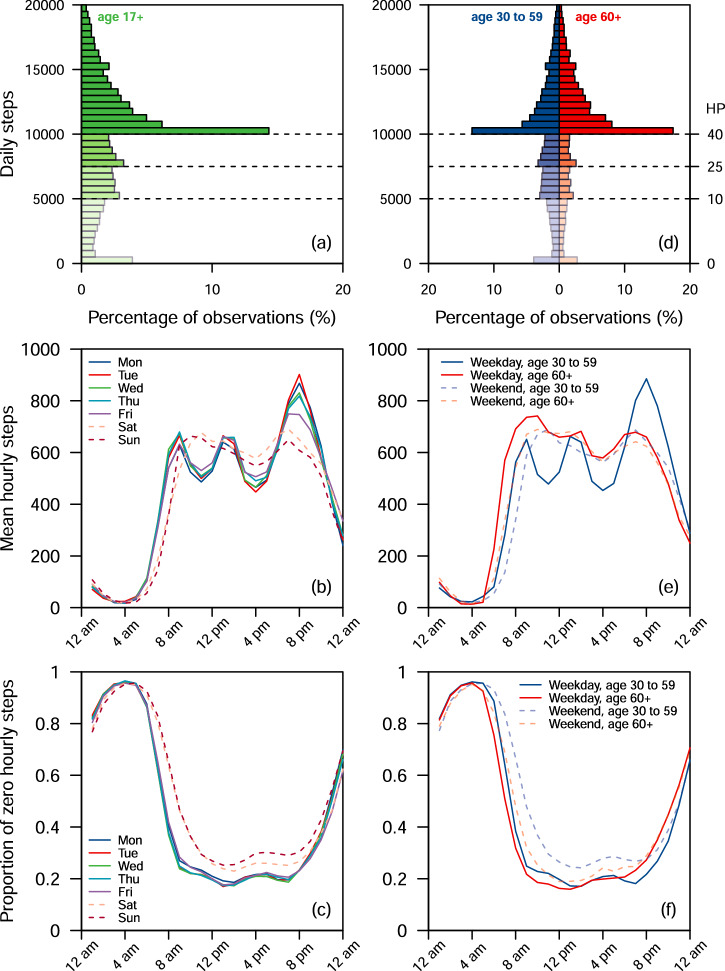
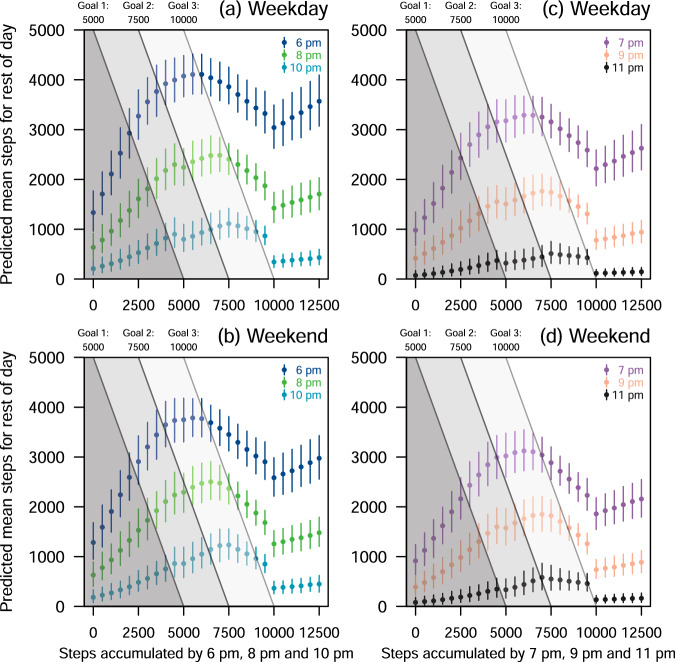
Participants have a mean age of 44.2 years (standard deviation = 13.9), and 40.4% are males. We show that on weekdays, the hourly mean step counts among participants aged 60 and above are higher than participants aged 30 to 59 from the start of the day till 6 p.m. We also find that participants who accumulate at least 7000 steps by 7 p.m. are associated with higher success of achieving 10,000 steps.
We provide recommendations on the hourly targets to achieve daily goals, based on different participants' characteristics. Future studies could experimentally test if prompts and nudges at the recommended times of day could promote reaching step goals.
身体活动追踪器的广泛使用使得能够收集高分辨率的健康数据,如每小时的步数,以评估健康促进项目。我们旨在调查参与者如何实现他们的每日步数目标。
我们使用了国家步数挑战第三季的24小时步数数据,其中参与者在达到每天5000步、7500步和10000步的特定目标时可获得代金券奖励。我们从3075名参与者中提取了数据,共计52346个参与者日。我们使用两部分模型对每小时的步数进行建模,其中步数的分布允许依赖于上一小时的步数总和以及参与者的人口统计学特征。
参与者的平均年龄为44.2岁(标准差 = 13.9),男性占40.4%。我们发现,在工作日,从一天开始到下午6点,60岁及以上参与者的每小时平均步数高于30至59岁的参与者。我们还发现,到晚上7点至少积累7000步的参与者实现10000步的成功率更高。
我们根据不同参与者的特征,提供了关于实现每日目标的每小时目标的建议。未来的研究可以通过实验测试在一天中建议的时间进行提示和推动是否能促进达到步数目标。