
通过MTCC 2423产生的蛋白酶优化酶解以改善小麦面筋水解物的功能特性
Optimization of Enzymatic Hydrolysis by Protease Produced from MTCC 2423 to Improve the Functional Properties of Wheat Gluten Hydrolysates.
作者信息
Rajendhran Hari Prasath, Vaidyanathan Vinoth Kumar, Venkatraman Swethaa, Karthik Pothiyappan
机构信息
Integrated Bioprocess Laboratory Department of Biotechnology School of Bioengineering SRM Institute of Science and Technology, Kattankulathur, Chennai, Tamil Nadu 603203, India.
Department of Food Technology Faculty of Engineering Karpagam Academy of Higher Education, Coimbatore 641021, India.
出版信息
Int J Food Sci. 2024 Jun 30;2024:5053510. doi: 10.1155/2024/5053510. eCollection 2024.
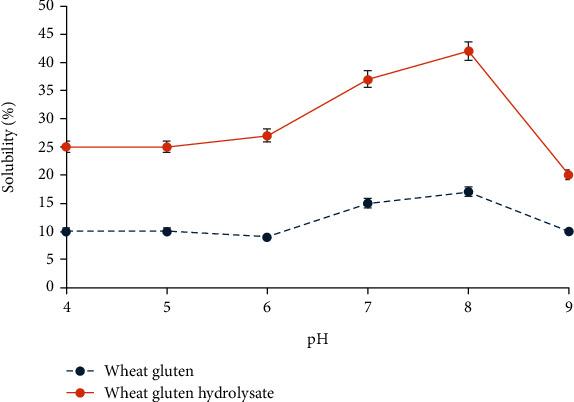
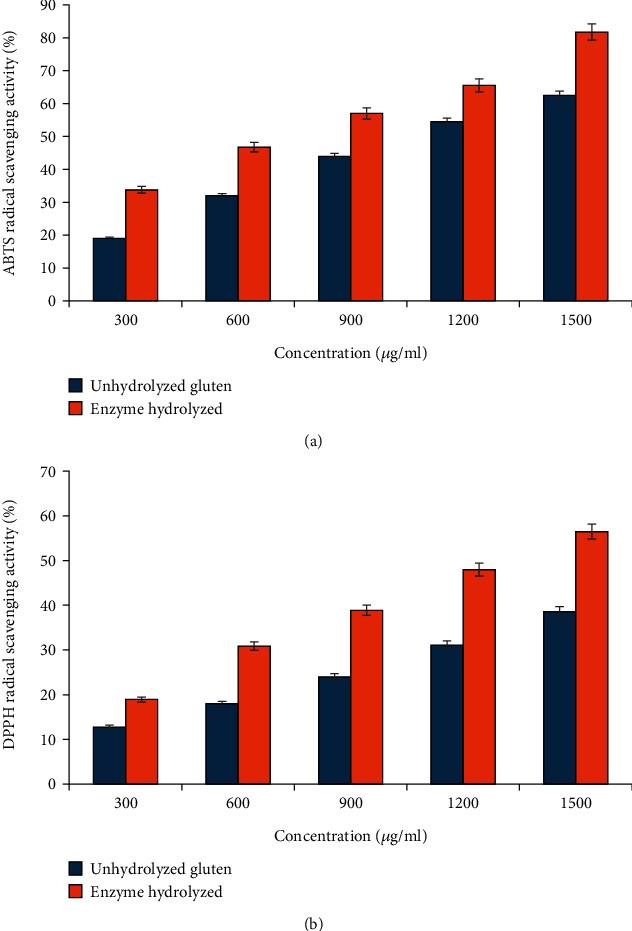
This study is aimed at investigating the reutilizing of gluten protein from the wheat processing industry by MTCC 2423 protease to obtain gluten hydrolysates with high added value. Gluten protein hydrolysis using protease achieved a 34.07% degree of hydrolysis with 5% gluten protein, at a hydrolysis time of 2 h for 1000 U/mL at pH 8.0 and temperature of 40°C. Compared to the wheat gluten, the obtained hydrolysates exhibited enhanced functional attributes, including heightened solubility (43%), increased emulsifying activity (93.08 m/g), and improved radical scavenging properties. Furthermore, these hydrolysates demonstrated enhanced antioxidant potential, as evidenced by elevated ABTS (2,2'-azino-bis-(3-ethylbenzothiazoline-6-sulfonic acid) of 81.25% and DPPH (2,2-diphenyl-1-picrylhydrazyl) of 56.46% radical scavenging activities and also exhibited a higher -amylase inhibitory effect of 33.98%. The enhancement in functional characteristics of wheat gluten hydrolysates was observed by Fourier transform infrared spectroscopy. The percentage of free amino acids obtained by protease-mediated hydrolysates increased significantly compared to the unhydrolyzed wheat, which was observed by high-performance liquid chromatography. These findings suggest that wheat gluten hydrolysates hold promising potential as functional and nutritional food ingredients in the food industry, owing to their enhanced functionalities and potential antioxidant and antidiabetic properties.
本研究旨在通过MTCC 2423蛋白酶研究小麦加工业中麸质蛋白的再利用,以获得具有高附加值的麸质水解产物。在pH 8.0、温度40°C条件下,使用蛋白酶水解麸质蛋白,当麸质蛋白含量为5%、水解时间为2小时、蛋白酶浓度为1000 U/mL时,水解度达到34.07%。与小麦麸质相比,所得水解产物表现出增强的功能特性,包括更高的溶解度(43%)、增加的乳化活性(93.08 m/g)和改善的自由基清除性能。此外,这些水解产物还表现出增强的抗氧化潜力,ABTS(2,2'-偶氮二(3-乙基苯并噻唑啉-6-磺酸)自由基清除活性提高了81.25%,DPPH(2,2-二苯基-1-苦基肼)自由基清除活性提高了56.46%,并且还表现出更高的α-淀粉酶抑制作用,为33.98%。通过傅里叶变换红外光谱观察到小麦麸质水解产物功能特性的增强。通过高效液相色谱法观察到,与未水解的小麦相比,蛋白酶介导的水解产物中游离氨基酸的百分比显著增加。这些发现表明,小麦麸质水解产物因其增强的功能以及潜在的抗氧化和抗糖尿病特性,在食品工业中作为功能性和营养性食品成分具有广阔的应用前景。




 Zotero 插件