Vitalant Research Institute, Denver, Colorado, United States of America.
Trauma and Transfusion Medicine Research Center (TTMRC), Department of Surgery, University of Pittsburgh, Pittsburgh, Pennsylvania, United States of America.
PLoS One. 2024 Jul 10;19(7):e0304231. doi: 10.1371/journal.pone.0304231. eCollection 2024.
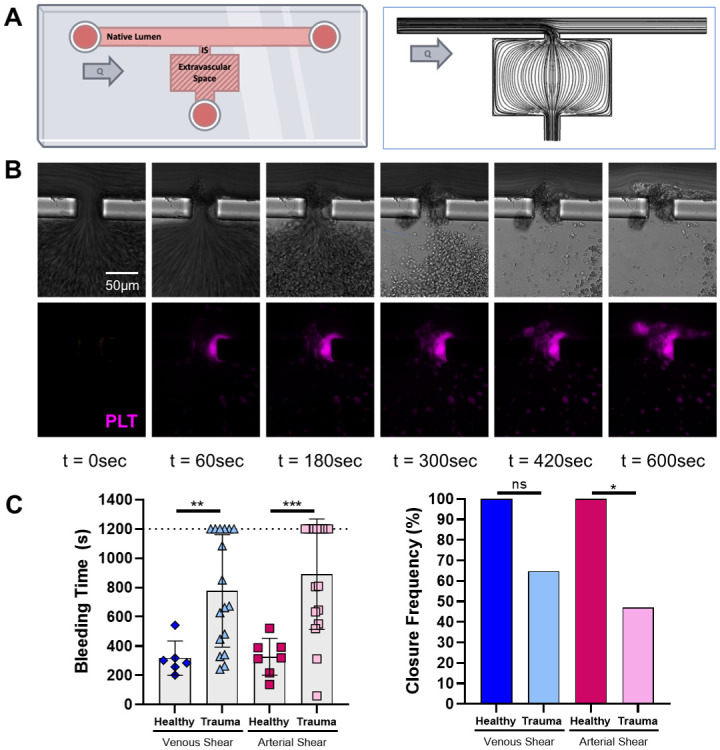
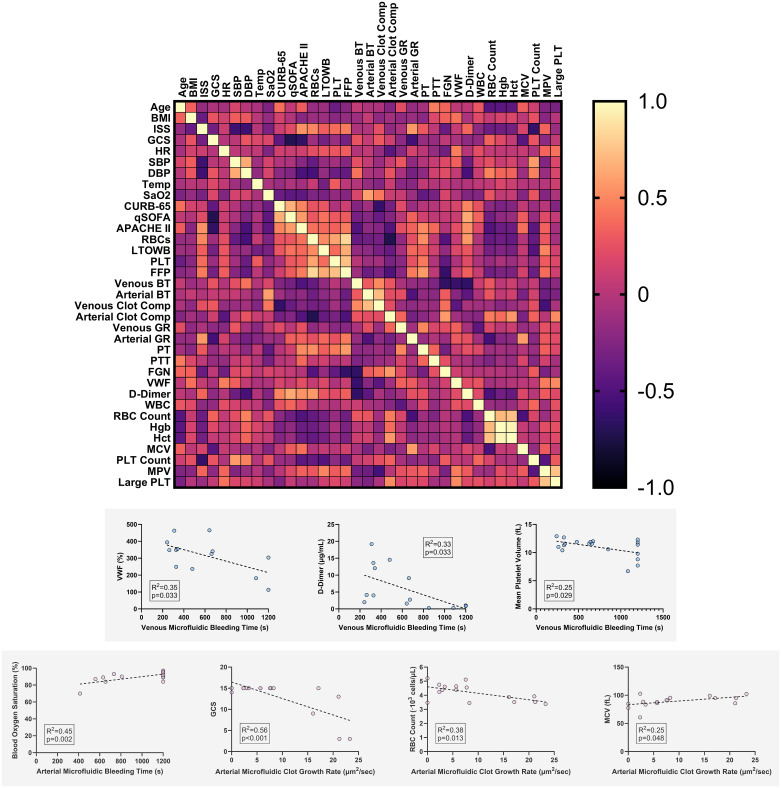
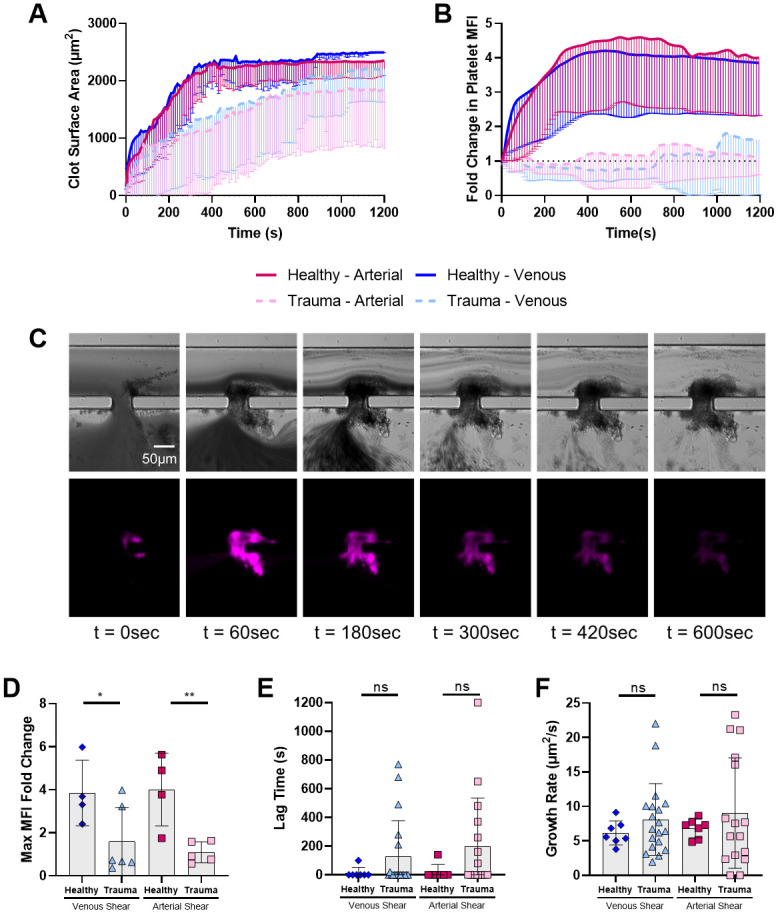
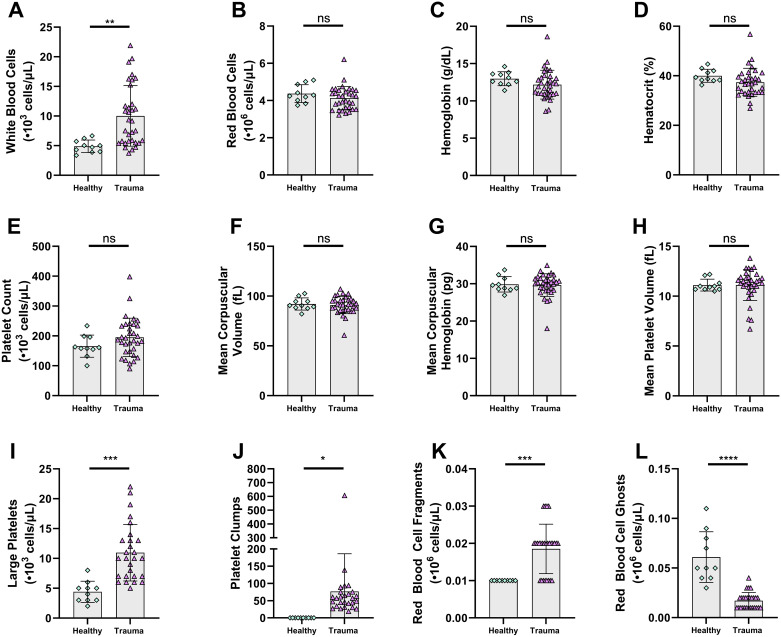
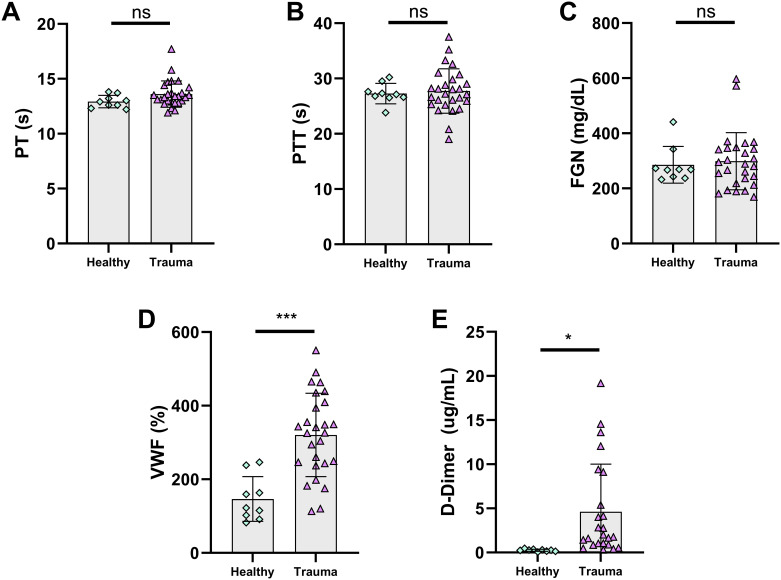
Trauma is the leading cause of death in individuals up to 45 years of age. Alterations in platelet function are a critical component of trauma-induced coagulopathy (TIC), yet these changes and the potential resulting dysfunction is incompletely understood. The lack of clinical assays available to explore platelet function in this patient population has hindered detailed understanding of the role of platelets in TIC. The objective of this study was to assess trauma patient ex vivo flow-dependent platelet hemostatic capacity in a microfluidic model. We hypothesized that trauma patients would have flow-regime dependent alterations in platelet function. Blood was collected from trauma patients with level I activations (N = 34) within 60 min of hospital arrival, as well as healthy volunteer controls (N = 10). Samples were perfused through a microfluidic model of injury at venous and arterial shear rates, and a subset of experiments were performed after incubation with fluorescent anti-CD41 to quantify platelets. Complete blood counts were performed as well as plasma-based assays to quantify coagulation times, fibrinogen, and von Willebrand factor (VWF). Exploratory correlation analyses were employed to identify relationships with microfluidic hemostatic parameters. Trauma patients had increased microfluidic bleeding times compared to healthy controls. While trauma patient samples were able to deposit a substantial amount of clot in the model injury site, the platelet contribution to microfluidic hemostasis was attenuated. Trauma patients had largely normal hematology and plasma-based coagulation times, yet had elevated D-Dimer and VWF. Venous microfluidic bleeding time negatively correlated with VWF, D-Dimer, and mean platelet volume (MPV), while arterial microfluidic bleeding time positively correlated with oxygenation. Arterial clot growth rate negatively correlated with red cell count, and positively with mean corpuscular volume (MCV). We observed changes in clot composition in trauma patient samples reflected by significantly diminished platelet contribution, which resulted in reduced hemostatic function in a microfluidic model of vessel injury. We observed a reduction in platelet clot contribution under both venous and arterial flow ex vivo in trauma patient samples. While our population was heterogenous and had relatively mild injury severity, microfluidic hemostatic parameters correlated with different patient-specific data depending on the flow setting, indicating potentially differential mechanistic pathways contributing to platelet hemostatic capacity in the context of TIC. These data were generated with the goal of identifying key features of platelet dysfunction in bleeding trauma patients under conditions of flow and to determine if these features correlate with clinically available metrics, thus providing preliminary surrogate markers of physiological platelet dysfunction to be further studied across larger cohorts. Future studies will continue to explore those relationships and further define mechanisms of TIC and their relationship with patient outcomes.
创伤是导致 45 岁以下人群死亡的主要原因。血小板功能的改变是创伤性凝血病(TIC)的一个关键组成部分,但这些变化及其潜在的功能障碍尚不完全清楚。缺乏可用于探索该患者群体血小板功能的临床检测方法,阻碍了对血小板在 TIC 中作用的详细了解。本研究的目的是在微流控模型中评估创伤患者体外血流依赖性血小板止血能力。我们假设创伤患者的血小板功能会随着血流状态的改变而改变。在入院后 60 分钟内,从 I 级激活的创伤患者(N=34)和健康志愿者对照(N=10)中采集血液。样本在静脉和动脉剪切率下通过损伤微流控模型灌注,并对一部分实验进行了荧光抗 CD41 孵育以定量血小板。进行全血细胞计数和基于血浆的检测以定量凝血时间、纤维蛋白原和血管性血友病因子(VWF)。采用探索性相关分析来确定与微流控止血参数的关系。与健康对照组相比,创伤患者的微流控出血时间增加。尽管创伤患者样本能够在模型损伤部位沉积大量血栓,但血小板对微流控止血的贡献减弱。创伤患者的血液学和基于血浆的凝血时间基本正常,但 D-二聚体和 VWF 升高。静脉微流控出血时间与 VWF、D-二聚体和平均血小板体积(MPV)呈负相关,而动脉微流控出血时间与氧合呈正相关。动脉血栓生长速率与红细胞计数呈负相关,与平均红细胞体积(MCV)呈正相关。我们观察到创伤患者样本中血栓组成的变化,反映出血小板贡献明显减少,导致血管损伤微流控模型中的止血功能降低。我们观察到在创伤患者样本中,静脉和动脉体外血流下的血小板血栓形成贡献减少。虽然我们的人群存在异质性且损伤严重程度相对较轻,但微流控止血参数与不同的患者特定数据相关,具体取决于血流状态,表明在 TIC 背景下,血小板止血能力的潜在机制途径不同。这些数据的生成目的是确定在流动条件下出血性创伤患者血小板功能障碍的关键特征,并确定这些特征是否与临床可用指标相关,从而提供血小板生理功能障碍的初步替代标志物,以在更大的队列中进一步研究。未来的研究将继续探索这些关系,并进一步确定 TIC 的机制及其与患者结局的关系。