Department of Emergency Medicine, University of Washington, Seattle, WA, USA.
Bloodworks Northwest Research Institute, Seattle, WA, USA.
J Thromb Haemost. 2019 May;17(5):771-781. doi: 10.1111/jth.14414. Epub 2019 Mar 18.
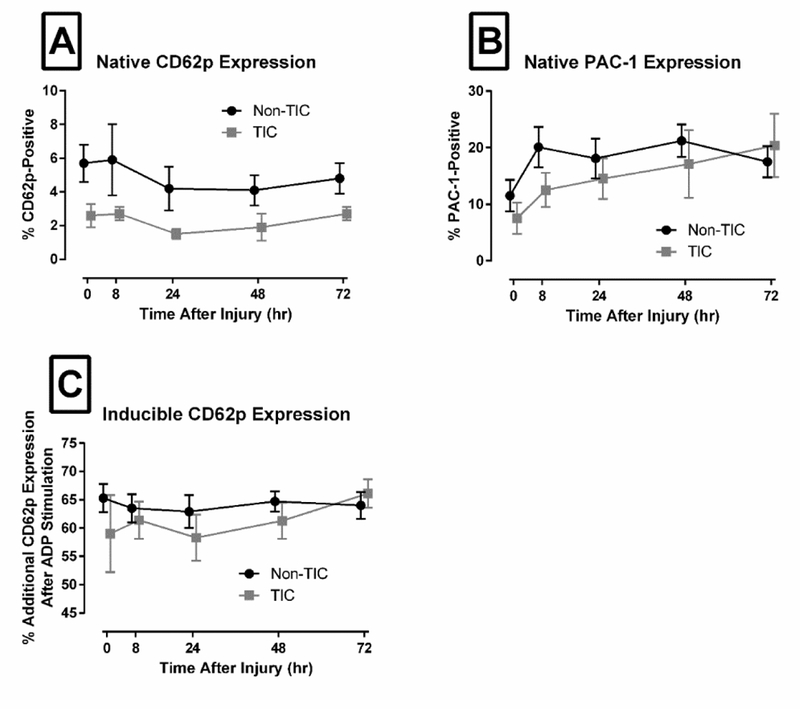
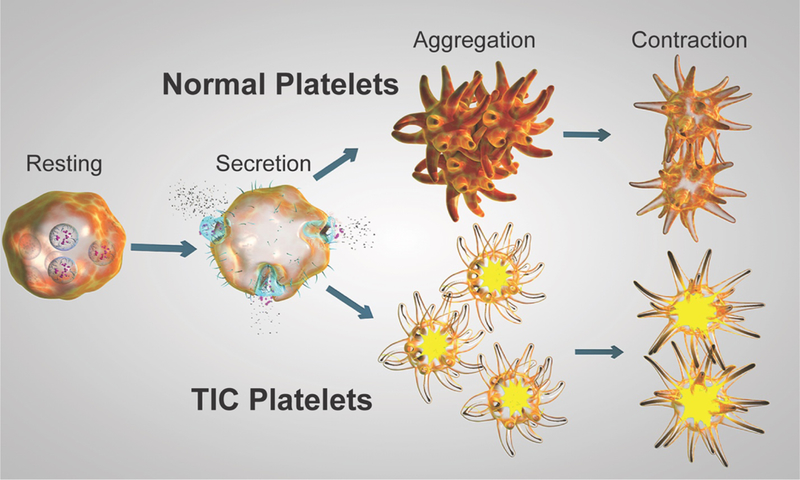
Essentials Platelets in trauma-induced coagulopathy (TIC) are impaired, but the mechanism is not known. We performed comprehensive longitudinal platelet function testing in trauma patient samples. Platelets in TIC are widely impaired early after injury, but platelet activatability is intact. This suggests a mechanism of transient platelet cytoskeletal/integrin dysfunction during TIC. SUMMARY: Background Trauma-induced coagulopathy (TIC) is a common and deadly bleeding disorder. Platelet dysfunction is present during TIC, but its mechanisms remain unclear. Platelets are currently thought to become "exhausted," a state in which they have released their granule contents and can no longer aggregate or contract. Methods This prospective observational cohort study tested the hypothesis that platelet exhaustion is present during TIC and characterized the early time course of platelet dysfunction. Blood was collected from 95 adult trauma patients at a Level I trauma center at time of Emergency Department arrival and several time points over 72 h. Platelet activation state and function were characterized using CD62P (P-selectin) and PAC-1 surface membrane staining, platelet function analyzer (PFA-100), aggregometry, viscoelastic platelet mapping, and, to test for exhaustion, their ability to express CD62P after ex vivo adenosine diphosphate (ADP) agonism. Platelet function was compared between patients with and without TIC, defined by prothrombin time ≥18 s. Results Platelets in TIC showed no initial increase in their level of surface activation markers or impairment of their capacity to express CD62P in response to ADP stimulation. However, TIC platelets were impaired in nearly all functional assays, spanning adhesion, aggregation, and contraction. These effects largely remained after controlling for platelet count and fibrinogen concentration and resolved after 8 h. Conclusion The TIC platelets exhibit early impairment of adhesion, aggregation, and contraction with retained alpha granule secretion ability, suggesting a specific mechanism of cytoskeletal or integrin dysfunction that is not a result of more general platelet exhaustion.
创伤诱导性凝血病(TIC)中的血小板功能受损,但具体机制尚不清楚。我们对创伤患者样本进行了全面的纵向血小板功能检测。TIC 后早期,血小板广泛受损,但血小板激活能力正常。这表明 TIC 期间存在短暂的血小板细胞骨架/整合素功能障碍。
背景 创伤诱导性凝血病(TIC)是一种常见且致命的出血性疾病。TIC 时存在血小板功能障碍,但具体机制尚不清楚。目前认为血小板处于“耗竭”状态,即已经释放了颗粒内容物,无法再聚集或收缩。
方法 这项前瞻性观察队列研究检验了 TIC 时存在血小板耗竭的假设,并描述了血小板功能障碍的早期时程。在到达急诊室时和 72 小时内的多个时间点,从一级创伤中心的 95 名成年创伤患者采集血液。使用 CD62P(P-选择素)和 PAC-1 表面膜染色、血小板功能分析仪(PFA-100)、聚集度测定、粘弹性血小板图以及体外二磷酸腺苷(ADP)激动后表达 CD62P 的能力,来检测血小板激活状态和功能,以测试血小板耗竭。将有或无 TIC 的患者(定义为凝血酶原时间≥18 秒)的血小板功能进行比较。
结果 TIC 血小板表面激活标志物水平无初始增加,ADP 刺激后表达 CD62P 的能力也无受损。然而,TIC 血小板在几乎所有功能检测中均受损,包括黏附、聚集和收缩。在控制血小板计数和纤维蛋白原浓度后,这些影响仍然存在,并且在 8 小时后得到解决。
结论 TIC 血小板表现出早期黏附、聚集和收缩受损,同时保持α颗粒分泌能力,这表明存在特定的细胞骨架或整合素功能障碍机制,而不是更普遍的血小板耗竭。