UCD Perinatal Research Centre, School of Medicine, University College Dublin, National Maternity Hospital, Dublin 2, Ireland.
Department of Clinical Medicine, Trinity College Institute of Neuroscience, School of Medicine, Trinity College Dublin, Dublin 2, Ireland.
Sci Rep. 2024 Jul 11;14(1):16055. doi: 10.1038/s41598-024-66651-4.
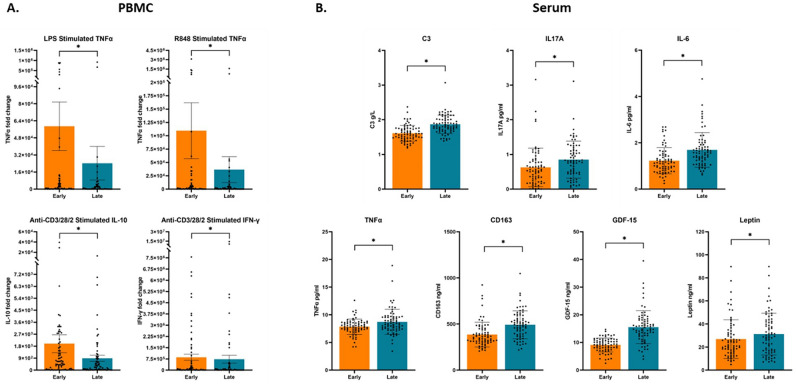
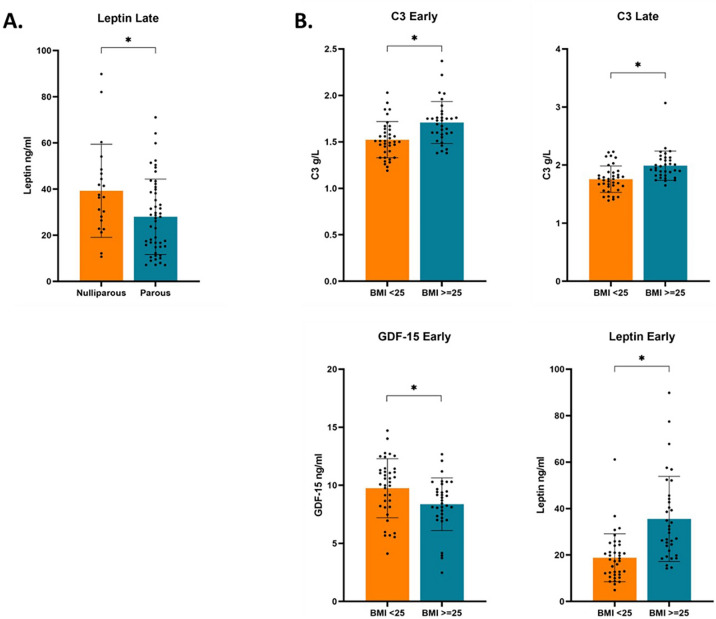
Immunological adaptions during pregnancy play a crucial role in healthy fetal development. Aberrant immune modifications however contribute to adverse pregnancy outcomes, which may be driven by maternal factors such as previous pregnancies and BMI. This secondary analysis of the MicrobeMom2 RCT investigates the changes to maternal inflammatory biomarkers derived from serum and stimulated peripheral blood mononuclear cells (PBMCs) during pregnancy, and the effects of previous pregnancies (parity) and BMI on maternal immune responses. Changes in immune and metabolic biomarkers from early (11-15 weeks' gestation) to late (28-32 weeks' gestation) pregnancy were compared using paired t-tests. Participants were then split by parity (nulliparous, parous) and BMI (BMI < 25, BMI > = 25), and the relationship between parity and BMI with immune biomarker levels was examined using independent t-tests, paired t-tests, ANCOVA, and linear regression. Equivalent non-parametric tests were used for skewed data. Recruited women (n = 72) were on average 31.17 (SD ± 4.53) years of age and 25.11 (SD ± 3.82) BMI (kg/m). Of these, 51 (70.8%) had a previous term pregnancy. Throughout gestation, PBMC cytokines displayed contrasting trends to serum, with a dampening of immune responses noted in PBMCs, and enhanced production of cytokines observed in the serum. Significant decreases in PBMC derived TNF-α, IL-10 and IFN-γ were seen from early to late pregnancy. Serum C3, IL-17A, IL-6, TNF-α, CD163, GDF-15 and leptin increased throughout gestation. First pregnancy was associated with higher levels of leptin in late pregnancy, while parous women showed significant decreases in PBMC derived TNF-α, IL10, and IFN-γ with gestation. Differences in levels of C3, IL-17A, TNF-α, GDF-15 and leptin were observed across BMI groups. Overall, serum-derived cytokines exhibit contrasting levels to those derived from stimulated PBMCs. Maternal immune responses undergo significant changes from early to late pregnancy, which are influenced by parity and BMI. These differences aid our understanding as to why first-time mothers are at greater risk of placental disease such as pre-eclampsia and fetal growth restriction.
怀孕期间的免疫适应性在胎儿健康发育中起着至关重要的作用。然而,异常的免疫修饰会导致不良的妊娠结局,这可能是由母体因素引起的,如既往妊娠和 BMI。这项 MicrobeMom2 RCT 的二次分析研究了怀孕期间母体来源于血清和刺激外周血单核细胞 (PBMC) 的炎症生物标志物的变化,以及既往妊娠(产次)和 BMI 对母体免疫反应的影响。使用配对 t 检验比较了早期(妊娠 11-15 周)到晚期(妊娠 28-32 周)妊娠期间免疫和代谢生物标志物的变化。然后根据产次(初产妇、经产妇)和 BMI(BMI<25、BMI≥25)将参与者分开,并使用独立 t 检验、配对 t 检验、ANCOVA 和线性回归检查产次和 BMI 与免疫生物标志物水平的关系。偏态数据使用等效的非参数检验。招募的女性(n=72)的平均年龄为 31.17(SD±4.53)岁,平均 BMI(kg/m)为 25.11(SD±3.82)。其中,51 名(70.8%)有过足月妊娠。整个孕期,PBMC 细胞因子的趋势与血清相反,在 PBMC 中观察到免疫反应减弱,而在血清中观察到细胞因子的产生增强。从早期到晚期妊娠,PBMC 衍生的 TNF-α、IL-10 和 IFN-γ 显著减少。血清 C3、IL-17A、IL-6、TNF-α、CD163、GDF-15 和瘦素在整个孕期都增加。初产妇在妊娠晚期的瘦素水平较高,而经产妇随着妊娠的进行,PBMC 衍生的 TNF-α、IL10 和 IFN-γ 显著减少。C3、IL-17A、TNF-α、GDF-15 和瘦素的水平在 BMI 组之间存在差异。总体而言,血清衍生的细胞因子的水平与来自刺激 PBMC 的细胞因子的水平相反。从早期到晚期妊娠,母体免疫反应发生显著变化,受产次和 BMI 的影响。这些差异有助于我们理解为什么初产妇更容易患胎盘疾病,如子痫前期和胎儿生长受限。