Jiang Lili, Wang Hairong, Qiao Kang, Wu Chong
Shandong Institute of Pomology, Tai'an 271000, China.
Key Laboratory of Pesticide Toxicology & Application Technique, College of Plant Protection, Shandong Agricultural University, Tai'an 271018, China.
Plants (Basel). 2024 Jun 28;13(13):1792. doi: 10.3390/plants13131792.
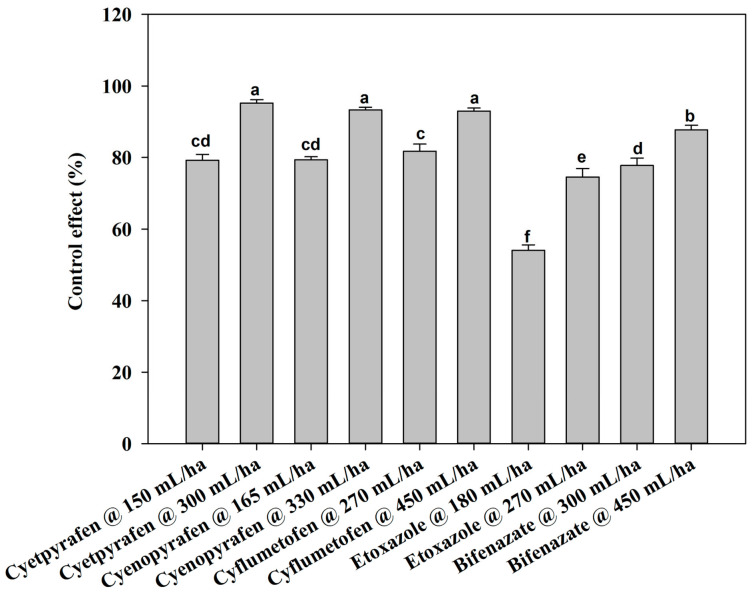
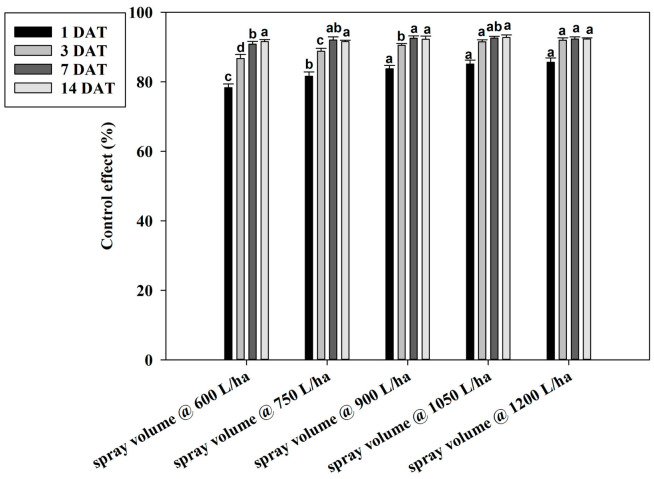
The two-spotted spider mite () is a constant threat to greenhouse strawberry production. The application of synthetic acaricides is the main method of controlling . However, resistance development to traditional acaricides reduces their efficacy and eventually leads to control failure. It is important for strawberry growers to look for new acaricides and application technologies that can limit the harmfulness of in environmentally friendly ways. In the current study, laboratory toxicity tests and field trials were performed to screen high-efficiency acaricides, and then application technologies were improved to enhance the management of . In the laboratory toxicity tests, the results showed that the LC (median lethal concentration) value of cyetpyrafen, cyenopyrafen, cyflumetofen, bifenazate, abamectin, azocyclotin, pyridaben, spirodiclofen, and etoxazole against adult was 0.226, 0.240, 0.415, 3.583, 5.531, 25.58, 39.69, 140.3, and 267.7 mg/L, respectively. In addition, the LC value of the nine acaricides against eggs of was 0.082, 0.097, 0.931, 18.56, 25.52, 45.61, 36.32, 1.954, and 0.040 mg/L, respectively. The field trial results showed that the best control effect was obtained in cyetpyrafen at 300 mL/ha treatment. Cyetpyrafen was chosen for further application technology tests. In the spray volume tests, the results showed that increasing the spray volume from 900 to 1050 L/ha significantly improved the control of . In addition, the results from the spray instrument tests demonstrated that the control effects on in the ozone spray treatments were significantly higher than those of the conventional and electrostatic sprays 1 and 3 days after treatment (DAT). Therefore, this study suggested that cyetpyrafen effectively controlled both in the laboratory tests and in the field trials. Increasing the spray volume and application of ozone spray significantly improved management.
二斑叶螨对温室草莓生产始终构成威胁。施用合成杀螨剂是防治二斑叶螨的主要方法。然而,对传统杀螨剂产生的抗性降低了其防治效果,最终导致防治失败。对草莓种植者而言,寻找能够以环境友好方式限制二斑叶螨危害的新型杀螨剂和施用技术非常重要。在本研究中,进行了实验室毒性试验和田间试验以筛选高效杀螨剂,随后改进施用技术以加强对二斑叶螨的管理。在实验室毒性试验中,结果表明,乙螨唑、环虫酰肼、氟螨嗪、联苯肼酯、阿维菌素、三环锡、哒螨灵、螺螨酯和乙唑螨腈对二斑叶螨成虫的LC(半数致死浓度)值分别为0.226、0.240、0.415、3.583、5.531、25.58、39.69、140.3和267.7毫克/升。此外,这九种杀螨剂对二斑叶螨卵的LC值分别为0.082、0.097、0.931、18.56、25.52、45.61、36.32、1.954和0.040毫克/升。田间试验结果表明,在300毫升/公顷处理的乙螨唑中获得了最佳防治效果。选择乙螨唑进行进一步的施用技术试验。在喷雾量试验中,结果表明,将喷雾量从900升/公顷增加到1050升/公顷可显著提高对二斑叶螨的防治效果。此外,喷雾器械试验结果表明,处理后1天和3天,臭氧喷雾处理对二斑叶螨的防治效果显著高于常规喷雾和静电喷雾1。因此,本研究表明,乙螨唑在实验室试验和田间试验中均能有效防治二斑叶螨。增加喷雾量和施用臭氧喷雾可显著改善对二斑叶螨的管理。